
Blogs

Blog title place here
We understand that every federal employee's situation is unique. Our solutions are designed to fit your specific needs.

Blog title place here
We understand that every federal employee's situation is unique. Our solutions are designed to fit your specific needs.

Blog title place here
We understand that every federal employee's situation is unique. Our solutions are designed to fit your specific needs.
How Does TSP Work A Guide to the Traveling Salesman Problem
At its heart, the Traveling Salesman Problem (TSP) is a deceptively simple question: what’s the shortest possible route that hits a series of stops exactly once before returning to the start? Think of it as the ultimate puzzle for a delivery driver trying to be as efficient as possible. Getting a handle on how TSP works is the first step to unlocking some serious savings in planning and logistics.
The Ultimate Route Planning Puzzle
Let's say you’re a driver with 10 different deliveries to make today. You have to start at your warehouse, visit each of those 10 locations, and then head back to base. The challenge is to do it all while burning the least amount of gas and spending the minimum time on the road.
You're essentially solving the Traveling Salesman Problem.

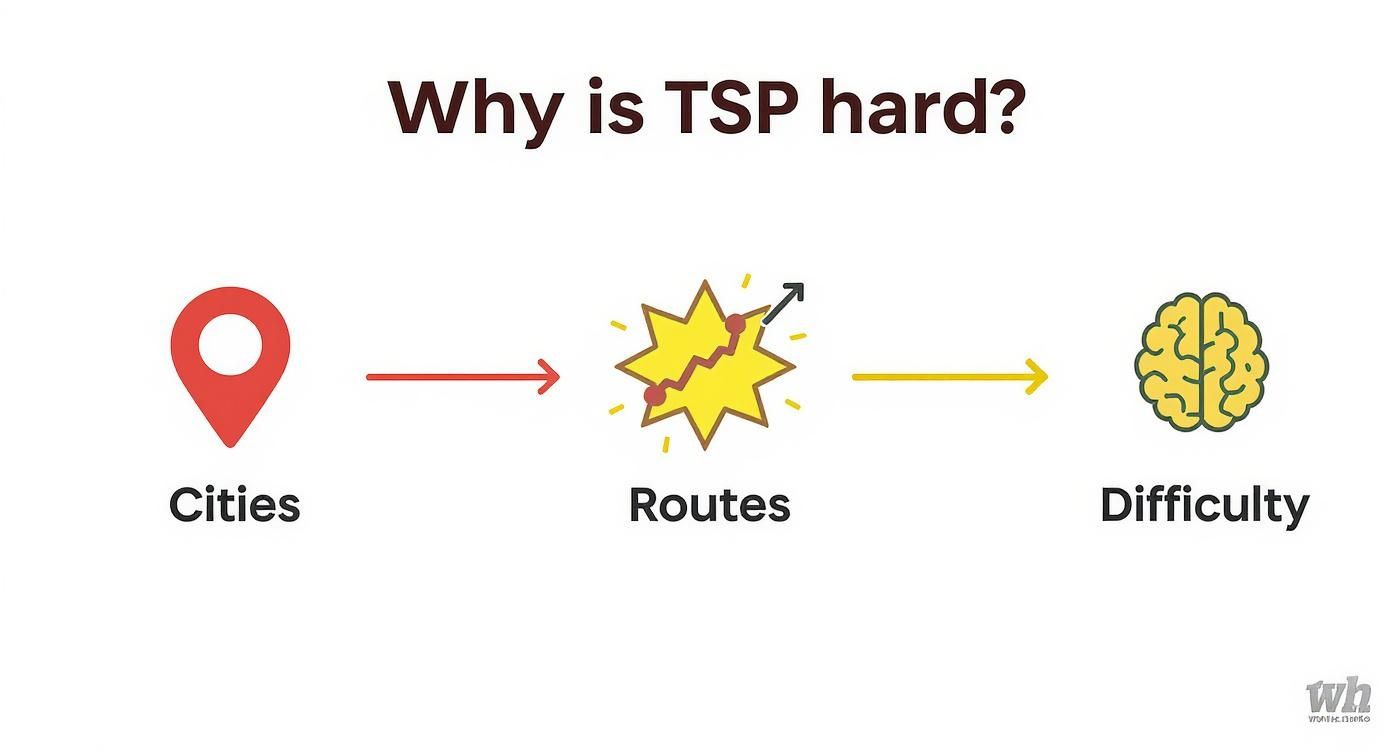
It sounds simple enough for a handful of stops. But what happens when you add more? The complexity doesn't just grow—it explodes. Finding the best route for four cities is a breeze. For 15 or 20, the number of possible paths becomes astronomical, turning it into a notoriously difficult puzzle to solve perfectly.
Breaking Down the Core Components
To really get what makes the TSP tick, it helps to understand its basic building blocks. Every version of this puzzle, no matter how complex, boils down to three key elements.
We can think of these as the fundamental rules of the game. Let's break them down using our delivery driver analogy.
ConceptSimple AnalogyTechnical TermThe StopsEach city on your delivery list.NodesThe RoadsThe actual roads connecting any two cities.EdgesThe "Cost"The distance or time it takes to drive between cities.Weights
This table shows how a real-world problem translates into the language of computer science and mathematics.
The goal is to map out a single, continuous loop—what’s known as a "tour"—that visits every single node just once and has the lowest combined weight. It's a classic algorithmic challenge that has fascinated mathematicians since the 1930s, with deep roots in a field called combinatorial optimization.
This kind of efficiency is a core component of modern performance management systems, where optimizing every detail is key to success.
The point isn't just to find any route that gets the job done. It's to find the single best route out of potentially billions of options. This is what makes solving the TSP so valuable.
Understanding the Building Blocks of the TSP

To really get your head around how the TSP works, you have to break it down into its core parts. It’s a bit like looking at a road trip map. The map itself isn't just a picture; it’s a system of cities, roads, and the distances between them, all working together to help you find your way. The TSP is built on a similar foundation, using a few key pieces to define the puzzle.
These pieces give the problem its structure, whether you're dealing with five cities or five hundred. At its heart, you're just looking at the "what" and the "where."
The "what" are the specific locations you need to visit. In the classic delivery driver scenario, these are the customer addresses. In the formal language of the TSP, we call these nodes.
The "where" are the pathways connecting these locations. Think of them as the roads, flight paths, or even circuit traces that link one node to the next. We call these connections edges.
Introducing the Weighted Graph
When you put the nodes (cities) and the edges (roads) together, you get a network that we call a graph. This graph is the basic map for our problem. But just knowing the connections isn't enough—we need to know what it costs to travel between them.
That brings in the third, and most critical, element: the weight. Every edge is assigned a weight, which represents a cost—like distance, time, or fuel. A graph that includes these costs is called a weighted graph, and this is the complete blueprint for our TSP.
Solving the puzzle means finding a "tour" (a single loop visiting every node) with the lowest possible total weight.
The real challenge of the TSP isn't just connecting the dots. It's about connecting them in the most efficient sequence to minimize the total cost defined by the weights on the edges.
Symmetric vs. Asymmetric: A Tale of Two Roads
Now, let's throw in a bit of real-world messiness. The nature of the "roads" can completely change the problem, leading us to two main flavors of the TSP.
Symmetric TSP: This is the one that usually comes to mind first. Here, the cost of traveling from City A to City B is the exact same as going from City B back to City A. It’s like a standard two-way highway—the mileage is identical no matter which direction you're heading.
Asymmetric TSP: In this version, the path isn't always a two-way street. The cost from A to B might be different from B to A. You see this all the time in real life with one-way streets, different airfares for round-trip legs, or tolls that only apply in one direction.
Picture a downtown area riddled with one-way streets. Driving from your warehouse to a customer might be a quick 10-minute trip. But getting back could force you on a roundabout 20-minute detour. That's a perfect example of an asymmetric problem.
This single difference—whether the path costs are the same both ways—fundamentally changes the puzzle. Getting a handle on these building blocks, from nodes and edges to the specific rules of the road like symmetry, gives us a solid foundation. With this model in mind, we can start to understand why adding just a few more cities turns this seemingly simple problem into one of the most famous head-scratchers in computer science.
Why Is Solving the TSP So Damn Hard?
On the surface, the Traveling Salesman Problem sounds simple: find the shortest possible loop connecting a bunch of dots on a map. So why has this puzzle stumped the greatest minds in mathematics and computer science for decades? The challenge isn't in grasping the goal, but in the astronomical, almost unimaginable number of possible routes that explode into existence as you add more stops.
This rapid scaling is a classic case of combinatorial explosion. Think of it like this: shuffling a few playing cards is easy. You can quickly see every possible order. But try to map out every possible shuffle for a standard 52-card deck? The number of combinations is 80 unvigintillion—that’s an 8 with 67 zeros after it. It’s a number so vast it’s larger than the estimated number of atoms on Earth.
The TSP’s difficulty grows in the exact same way, quickly spiraling beyond the reach of even the most powerful computers.
The Unstoppable Growth of Possible Routes
Let's ground this in reality. Imagine you're a delivery driver with just a handful of stops.
With 4 cities, there are only 3 unique routes to consider. You could sketch that out on a napkin in a minute.
Add just one more stop for a total of 5 cities, and the number of routes jumps to 12. Still totally doable.
But double it to 10 cities? The number of possible tours skyrockets to a staggering 181,440. Suddenly, checking them all by hand isn't just tedious; it's impossible.
This is why you can't just throw more processing power at the problem and hope for the best. The problem's growth will always outpace our ability to solve it with raw, brute-force computation.
The real monster in the TSP is that adding one more city doesn't just add a few more routes—it multiplies the total number of routes by an ever-increasing number.
When Brute Force Hits a Brick Wall
The most obvious way to solve the TSP is what we call the brute-force method: just calculate the length of every single possible route and pick the shortest. For a tiny number of cities, this works just fine. But as we've seen, this approach slams into a computational wall almost immediately.
This is where the idea of computational complexity comes in. The TSP is what's known as an NP-hard problem. That's not just some academic buzzword; it’s a formal classification that means there is no known algorithm that can efficiently find the 100% perfect solution for every case as the number of cities grows.
Take a route with just 20 cities. That "just" is deceptive—it generates over 60 quintillion possible routes to check. If you had a supercomputer that could analyze a billion routes per second, it would still need over 1,900 years to find the best one. This insane scale shows why brute force is a complete non-starter for any real-world application. For a deeper dive into the world of complex computation, you can find some great insights on the Custom Market Insights website.
That's precisely why we've had to get much, much smarter.
The Shift to "Good Enough" Solutions
Since finding the perfect, mathematically optimal route is often out of the question, researchers and logistics experts have developed clever workarounds. The goal changes from finding the one perfect route to finding a really good route in a reasonable amount of time.
These smarter approaches generally fall into two buckets:
Exact Algorithms: These are designed to find the absolute best solution, guaranteed. The catch? They are incredibly slow and resource-intensive, making them practical only for problems with a small number of cities.
Heuristics and Approximation Algorithms: This is where the real action is for solving large-scale TSPs. These algorithms use smart shortcuts, rules of thumb, and iterative improvements to find near-optimal solutions very quickly. They trade the guarantee of absolute perfection for speed and practicality.
Understanding this fundamental difficulty is the key to appreciating how the TSP is tackled in the real world. The game isn't about an impossible quest for perfection; it's a practical hunt for efficiency.
Practical Ways to Tackle the TSP
So, if finding the single best route is mathematically a nightmare, how do delivery companies and logistics planners get anything done? The reality is, they shift the goalposts. Instead of chasing a perfect, mathematically proven answer, the focus is on finding a really good answer in a reasonable amount of time.
This practical mindset has led to two main schools of thought for solving the Traveling Salesman Problem: the purists who hunt for perfection and the pragmatists who use clever shortcuts.
The Hunt for the Perfect Solution
On one side, you have what are called exact algorithms. These are the perfectionists. They are designed to methodically chew through every possibility until they can guarantee, with 100% certainty, that they've found the absolute shortest route. Think of it like a detective determined to interview every single person in a city to solve a case—it’s incredibly thorough, but it's only realistic if the city is tiny.
Methods like the branch-and-bound algorithm work wonders on small-scale problems with just a handful of cities. But as we've seen, that combinatorial explosion quickly brings them to their knees. For any logistics problem involving dozens, let alone hundreds, of stops, relying solely on an exact algorithm just isn't an option. The computer would be running for years.
Embracing "Good Enough" with Clever Shortcuts
This is where the second approach, using heuristics, saves the day. A heuristic is basically a smart shortcut or a rule of thumb. It trades the guarantee of a perfect answer for massive gains in speed. These are the workhorses that power modern logistics software.
Heuristics don't promise the best route, but they almost always find a route that's very close to the best, and they do it in a fraction of the time. Let's look at a couple of popular ones.
The Nearest Neighbor Algorithm: A Simple Start
The Nearest Neighbor algorithm is probably the most intuitive heuristic out there. It works just like it sounds:
Pick any city to start.
From your current location, find the closest unvisited city.
Go there.
Repeat until you've visited every city.
Finally, travel back to where you started.
It’s exactly what you’d do if you were dropped in a new town with a list of sights to see and no map. You’d just walk to the closest one, then the next closest one from there, and so on.
The problem? It’s a "greedy" approach. It makes the best decision for the very next step without any thought for the bigger picture. This can easily lead you into a trap, forcing a very long, awkward trip at the end to get back home.
Key Takeaway: The Nearest Neighbor algorithm is the classic example of a heuristic. It's fast and makes sense, but its short-sightedness means it usually produces a good route, not a great one.
Genetic Algorithms: Learning from Nature
A much more sophisticated approach is to borrow a page from Charles Darwin's playbook. Genetic algorithms use the principles of natural selection to "evolve" an optimal solution over many generations.
Instead of just working on one route at a time, you start with a whole population of random routes.
It's precisely this explosion of possibilities that makes genetic algorithms so powerful. They can navigate this massive search space intelligently.
Here's the basic idea:
Creation: The algorithm creates a big "population" of random tours.
Evaluation: Each tour gets a "fitness score" based on its total distance. Shorter is fitter.
Selection: The best tours (the "fittest") are chosen to "reproduce."
Crossover & Mutation: They mix and match parts of their routes (crossover) and have small, random changes introduced (mutation). This creates a new generation of "offspring" tours.
This cycle repeats over and over. Just like in nature, the best traits get passed down, and the population of solutions gradually gets better and better, converging on a high-quality, near-perfect route. Understanding how TSP works in the real world is all about appreciating this trade-off between the perfect and the practical.
TSP Algorithm Approaches Compared
To make sense of these different methods, it helps to see them side-by-side. Each has its place, depending on whether you need a perfect answer or just a fast, workable one.
Algorithm TypeGuarantees Optimal Solution?SpeedBest ForExact AlgorithmsYesVery Slow (for large problems)Small-scale problems where perfection is required (e.g., < 20 cities)Heuristics (Nearest Neighbor)NoVery FastQuick, simple estimations; situations where speed is paramountHeuristics (Genetic)NoFast to ModerateComplex, large-scale problems where a high-quality solution is needed quickly
Ultimately, the choice of algorithm depends entirely on the problem. For academic exercises or tiny datasets, an exact algorithm is fine. For powering a real-world delivery network, it's heuristics all the way down.
Real-World Applications of TSP
The Traveling Salesman Problem is much more than a quirky brain teaser for computer science students. It's actually the invisible engine behind many of the systems we depend on every single day. The core principles of the TSP are constantly at work, quietly driving efficiency and saving incredible amounts of money across a surprisingly wide range of industries.
Sure, the delivery driver analogy is a great way to start, but the real-world impact of finding good solutions to this problem is staggering. From global shipping giants to microchip manufacturers, finding that "good enough" route translates directly into lower costs, faster service, and smarter use of resources. This is where the academic challenge of how TSP works becomes a practical, money-saving tool.
Revolutionizing Logistics and Delivery
The most obvious place you'll find the TSP in action is in logistics. It's the lifeblood of companies like FedEx, UPS, and Amazon. Their entire business model hinges on their ability to manage mind-bogglingly complex delivery networks. Every day, they are essentially solving thousands of individual TSPs to figure out the best routes for their fleets of trucks and planes.
Optimizing these routes does way more than just shave a few minutes off a delivery. It sets off a chain reaction of benefits:
Slash Fuel Consumption: Shorter routes mean less fuel burned. For a company with thousands of vehicles, this is a massive operational expense.
Reduce Vehicle Wear and Tear: Driving fewer miles extends the life of every truck in the fleet, which means lower maintenance and replacement costs.
Boost Delivery Capacity: When routes are efficient, drivers can make more stops in the same amount of time. This increases productivity without having to hire more people or buy more trucks.
The financial upside here is enormous. One major courier, for instance, reported that using TSP-based algorithms to optimize their routes cut fuel consumption by 15% and trimmed delivery times by 20% across its European operations. You can dig deeper into how this kind of optimization impacts business by exploring the research on the system software market performance.
Every minute saved on the road, when multiplied across thousands of drivers and millions of packages, adds up to millions of dollars in savings and a major reduction in carbon emissions.
Precision in Modern Manufacturing
The TSP isn't just for packages and parcels. It plays a critical role on the factory floor, particularly in high-tech manufacturing.
Picture a robotic arm tasked with drilling hundreds of holes on a printed circuit board (PCB). Or think of a laser cutter etching an intricate pattern into a sheet of metal. The order in which these operations happen is a classic TSP. The "cities" are the holes that need to be drilled, and the "distance" is the time it takes the robotic arm to travel from one point to the next.
Finding the optimal path minimizes that travel time. In turn, this maximizes the number of boards the machine can produce in an hour. The same logic applies to all sorts of automated processes, from welding spots on a car frame to sequencing tasks on an assembly line. In fact, studies have shown that implementing TSP-based scheduling can increase productivity by up to 30% in settings like automotive plants.
Surprising Applications in Science and Technology
The influence of the TSP pops up in fields you might never expect, which really shows just how fundamental this optimization problem is.
Genomics and DNA Sequencing: Scientists use TSP algorithms to piece together fragments of DNA. They treat the DNA fragments as "cities" and how much they overlap as the "distance," which helps them figure out the most probable sequence of an entire genome.
Astronomy and Observation: To get the most out of incredibly powerful tools like the Hubble Space Telescope, astronomers have to create an efficient schedule for observing different stars and galaxies. The telescope's movement from one target to the next is a TSP, where the goal is to minimize the total "slewing" time and capture as much data as possible.
Computer Chip Design: When designing a microchip, thousands of components have to be wired together. Optimizing the path for these tiny electronic connections to keep the wire length at a minimum is a TSP-like problem. Solving it makes the chip faster and more efficient.
From getting a package to your front door to mapping the human genome, the principles of the Traveling Salesman Problem are constantly at work, making our world run a little bit smoother.
Wrapping It All Up: How the TSP Fits Together
So, what's the bottom line? The Thrift Savings Plan is far more than just a line item on your paystub. Think of it as the federal government's version of a 401(k), but with some distinct features built specifically for you.
We started with the two doors for your money: Traditional contributions, which lower your taxable income today, and Roth contributions, which give you tax-free withdrawals in retirement. Then we hit the most important part—the employer match.
If you're under FERS, the government automatically kicks in 1% of your salary, even if you contribute nothing. But the real magic happens when you contribute at least 5%; they'll match you on the first 4%, effectively doubling your initial investment. Getting this full match is the single most important step to building a healthy TSP balance.
From there, we looked at your investment options—the five core funds. You can play it safe with the G Fund, or you can aim for higher growth with the C, S, and I stock funds. And for those who prefer a "set it and forget it" approach, the Lifecycle (L) Funds automatically adjust for you over time.
The big picture is this: The TSP is a system designed to work for you, but it requires your input. It starts with your savings and the government match, but your long-term growth comes down to picking an investment mix that you're comfortable with and that makes sense for your retirement goals.
Finally, we touched on how to get your money out, whether through a loan while you're still working or withdrawals in retirement. Seeing how all these pieces connect is the key. Your consistent contributions are supercharged by the government match and then put to work in the market. By staying engaged with your account, you can make this incredible benefit the cornerstone of a secure retirement.
Your Top TSP Questions, Answered
Even after you get the hang of the TSP, some specific questions always seem to pop up. Think of this as the go-to spot for those nagging "what if" scenarios. Let's clear the air on a few of the most common ones.
Can I Roll My Old 401(k) Into the TSP?
Absolutely. The TSP is happy to accept rollovers from other qualified retirement plans, like an old 401(k), 403(b), or even a traditional IRA. This is a great way to tidy up your financial life—instead of tracking multiple accounts, you can bring everything under one roof.
There's one crucial detail you need to know, though. Any money you roll into the TSP will land in your traditional balance. This is true even if the money came from a Roth 401(k). For now, there’s no way to roll outside Roth money directly into your Roth TSP.
What's the Deal with TSP Loans? Should I Even Consider One?
Active federal employees have the option to borrow from their own TSP account through two types of loans: a general-purpose loan and a residential loan. The general-purpose loan is for pretty much anything and has to be paid back within one to five years. The residential loan, meant for buying or building your main home, gives you a much longer repayment window.
The idea of "paying yourself back" with interest sounds great on paper. But don't take this decision lightly. When you take out a loan, that money comes out of your investments. It's sitting on the sidelines, completely missing out on any market gains that might happen while you're paying it back.
Heads Up: If you leave your federal job with an outstanding loan, the clock starts ticking. You have to pay it back in full. If you can't, the IRS treats the remaining balance as a taxable distribution. On top of that, if you're under age 59 ½, you’ll likely get hit with an extra 10% early withdrawal penalty.
What Happens to My TSP If I Leave My Federal Job?
When you separate from federal service, you’ve got choices. You don't have to move your money right away. In fact, many people keep their money right where it is to continue taking advantage of the TSP's incredibly low fees.
Here are your main options:
Keep It in the TSP: You can simply leave your account as is. It will stay invested according to your fund choices and continue to grow (or fall) with the market.
Roll It Over: You can move your TSP balance to another retirement account, like a personal IRA or your new job's 401(k).
Start Taking Withdrawals: You can begin accessing your money. Your choices range from taking it all out as a lump sum, setting up monthly payments, or purchasing a life annuity for a guaranteed income stream.
There’s no single "best" answer here—it really depends on your financial picture, when you plan to retire, and what your other investment options look like. It’s a big decision that will shape your retirement, so take the time to understand the tax rules and investment pros and cons of each path.
Getting these details right is what separates a good retirement from a great one. The team at Federal Benefits Sherpa lives and breathes this stuff, helping federal employees make sense of their benefits to build a solid financial plan. To make sure you’re on the right track for retirement, schedule your free 15-minute benefits review today.


Dedicated to helping Federal employees nationwide.
“Sherpa” - Someone who guides others through complex challenges, helping them navigate difficult decisions and achieve their goals, much like a trusted advisor in the business world.
Email: [email protected]
Phone: (833) 753-1825
© 2024 Federalbenefitssherpa. All rights reserved