
Blogs

Blog title place here
We understand that every federal employee's situation is unique. Our solutions are designed to fit your specific needs.

Blog title place here
We understand that every federal employee's situation is unique. Our solutions are designed to fit your specific needs.

Blog title place here
We understand that every federal employee's situation is unique. Our solutions are designed to fit your specific needs.
Maximizing Your Government Matching TSP Contributions
Let's be blunt: the government's TSP match is the single most powerful tool you have in your federal benefits package. It's essentially free money—a guaranteed, instant return on your investment that you won't find anywhere else.
Frankly, not contributing enough to get the full match is like telling your boss you don't want a pay raise.
What Exactly Is the Government TSP Match?
For federal employees under the Federal Employees Retirement System (FERS), the government matching program is the government’s way of supercharging your retirement savings. It works a lot like a 401(k) match you'd see in the private sector. You put money in, and your employer (the government) puts money in, too.
This isn't just some minor perk; it's a core component of the FERS retirement plan. The numbers speak for themselves. An incredible 94.6% of FERS participants contribute to their TSP, a clear sign of just how valuable this benefit is. If you want to dig into the data, the Federal Retirement Thrift Investment Board's recent report breaks it all down.
Why You Absolutely Cannot Afford to Miss the Match
Let me say this as clearly as I can: contributing enough to secure the full government match is not optional. It’s a foundational, non-negotiable financial move for every single federal employee. If you don't do it, you are literally leaving a pile of guaranteed money on the table every single year.
Think about it this way: The government match is one of the only "guaranteed" returns you'll ever find. By contributing just 5% of your basic pay, you instantly double that money with the government's 5% match.
The entire program was designed to reward you for saving for your own future. Your consistent contributions unlock a major boost from your employer, letting the magic of compounding start working for you at double the speed. It's the bedrock of a solid retirement plan and the first financial box every FERS employee should check.
Unpacking the 5% Government TSP Match
So, how does the government's 5% TSP match actually work? It's one of the most powerful benefits of federal service, but the formula isn't quite as simple as a flat 5% match. The government’s contribution is actually split into two different parts.
Think of it this way: one part is a gift you get just for being a FERS employee, and the other is a reward for actively saving for your future. To get the most out of your TSP, you need to understand how both pieces work together.
The Automatic 1% Contribution: A "Thank You" for Your Service
The first piece of the puzzle is the Agency Automatic (1%) Contribution. This is the easiest money you'll ever earn for retirement.
Every pay period, your agency automatically deposits an amount equal to 1% of your basic pay into your TSP account. You get this whether you contribute a dime or not. It's a foundational benefit that gives every FERS employee an immediate head start on building their nest egg.
This infographic breaks down how your savings efforts trigger the government's contributions, all working toward your retirement goals.
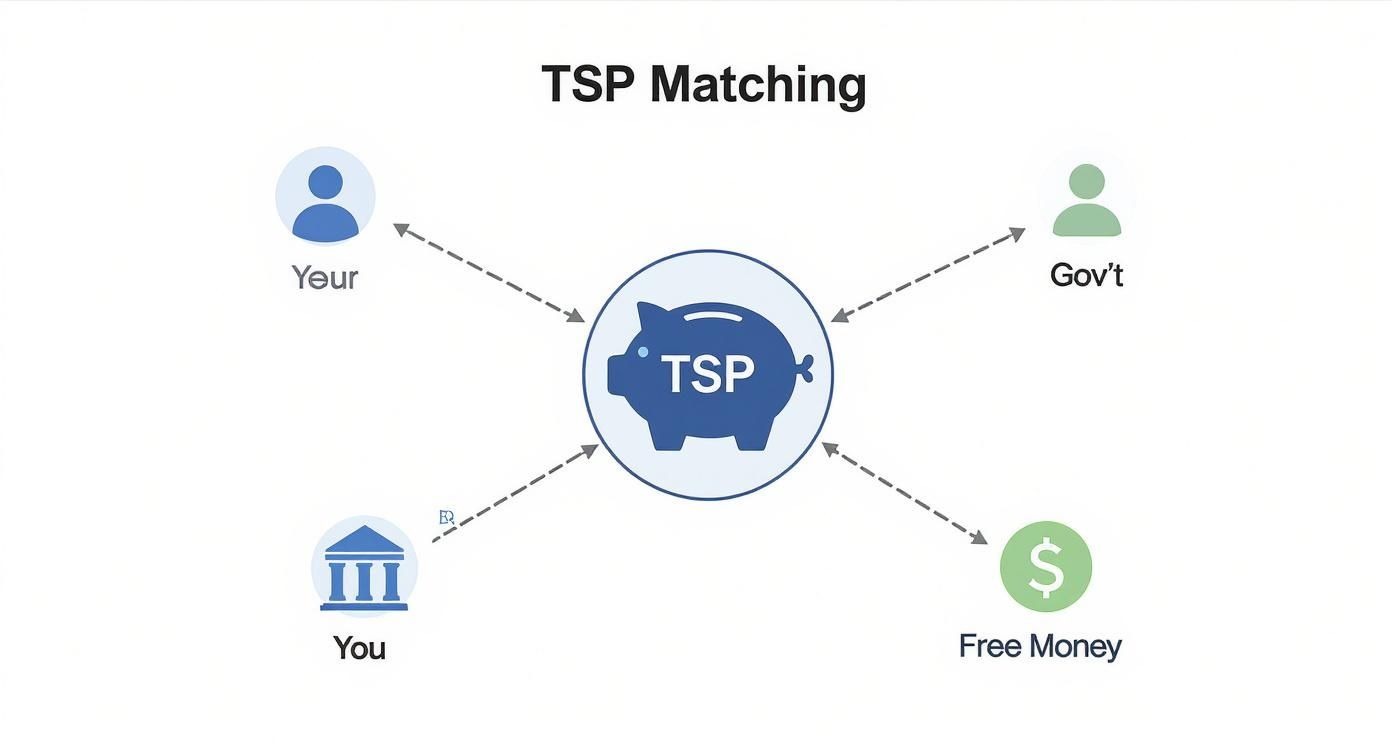
As you can see, your personal contributions are the key that unlocks a flow of "free money" from the government, accelerating your account's growth.
The Matching 4%: Where Your Contributions Pay Off Big
The second part is the Agency Matching Contribution. This is where your personal saving habits really make a difference, but it’s a tiered system. Not every dollar you save is matched the same way.
Here’s exactly how the government matches your contributions:
The First 3% You Save: The government matches this dollar-for-dollar. You put in 3% of your pay, and they put in 3%. Simple as that.
The Next 2% You Save: This portion is matched at a rate of fifty cents on the dollar. So, to get the full 1% match on this tier, you have to contribute the full 2%.
Put it all together, and what do you get? By contributing 5% of your basic pay, you unlock the maximum possible government contribution. You'll receive your automatic 1% plus the full 4% in matching funds, for a grand total of a 5% government contribution.
Key Takeaway: Contributing 5% of your pay means you are instantly doubling that money. You put in 5%, the government adds another 5%, and your TSP account grows by 10% of your salary from contributions alone, before any market gains.
The table below really drives home how much of a difference your contribution rate makes.
Your TSP Contribution vs Total Government Match
This table illustrates how different employee contribution levels affect the total government contribution, combining both automatic and matching funds.
If You Contribute (Percent of Pay)Agency Automatic (1%) ContributionAgency Matching ContributionTotal Government ContributionTotal Deposited Into Your TSP0%1%0%1%1%1%1%1%2%3%2%1%2%3%5%3%1%3%4%7%4%1%3.5%4.5%8.5%5% or more1%4%5%10% or more
The numbers don't lie. If you're a FERS employee, contributing at least 5% of your basic pay should be your number one financial priority. Anything less, and you’re walking away from free money that could be compounding for you all the way to retirement.
Are You Eligible for the TSP Match? Let's Find Out
Not every federal employee gets the government TSP match—it's not automatic. Your eligibility hinges entirely on which federal retirement system you're enrolled in. Figuring this out is the absolute first step, because it’s the difference between getting thousands in free money each year and missing out.
The vast majority of federal workers eligible for the full government match are covered by the Federal Employees Retirement System (FERS). If you started your government career anytime after 1986, it's a near-certainty that you're in FERS.
Think of FERS as a three-legged stool for retirement: Social Security, your FERS pension, and the Thrift Savings Plan. The government match was built into the TSP from the start as a powerful incentive to get you to save for that third leg of the stool. It’s a core part of the entire FERS benefits package.
Who Typically Doesn't Get a Match?
On the flip side, we have employees under the older Civil Service Retirement System (CSRS). As a general rule, CSRS employees do not receive any government matching contributions on their TSP investments.
This isn't an oversight. The CSRS system was created long before 401(k)-style plans existed and was designed to provide a much larger pension on its own. Because the pension is so generous, the government doesn't offer a TSP match. CSRS employees can still contribute to the TSP—and many do—but their account's growth comes from their own money and market performance, not from an agency match.
What About Military Service Members?
For those in the armed forces, eligibility depends on which military retirement plan you're under. Service members who opted into the newer Blended Retirement System (BRS) are eligible for TSP matching funds, but there's a waiting period. You have to complete two years of service before the matching kicks in.
The BRS matching structure is very similar to the FERS system:
Automatic 1% Contribution: After 60 days of service, your service branch automatically contributes 1% of your basic pay to your TSP, whether you put in a dime or not.
Matching Contributions: On top of that, your service will match your own contributions dollar-for-dollar on the first 3% you put in, and fifty cents on the dollar for the next 2%. This brings the total potential government contribution to 5%.
Key Takeaway: Eligibility for the government TSP match isn't a given; it's tied directly to your specific retirement system. If you're under FERS or the military's BRS, you're in a great position to benefit. If you're under CSRS, the match isn't part of your plan.
Understanding Vesting and Contribution Timelines

Putting your own money into your Thrift Savings Plan is just the first step. To really get the full benefit, you need to understand how you come to own the money the government puts in for you. This is where a concept called vesting comes into play.
Think of vesting as an ownership clock. It’s the amount of time you need to work before your agency's contributions are officially yours to keep, no strings attached.
The great thing is, every dollar you contribute is always 100% yours from the get-go, along with any investment earnings on that money. The vesting rules only apply to the government’s contributions.
How Long Until You Are Vested?
For most civilian employees under the FERS system, the magic number is three years. Once you complete three years of creditable civilian service, you are "fully vested." This means you have an undeniable right to the Agency Automatic (1%) Contribution and all the earnings it has generated.
But what about the Agency Matching Contributions—the money the government kicks in when you contribute? You get to own that money immediately. As soon as it hits your account, it's yours.
Key Takeaway: If you leave federal service before hitting your three-year mark, you'll walk away with all your own contributions and the matching funds. The catch is that you'll have to say goodbye to the automatic 1% contributions and any money they earned.
This vesting requirement is really there to encourage federal employees to stick around and reward them for their commitment. It seems to be working, too. The TSP has become an increasingly vital part of the federal benefits package. For instance, federal employee participation patterns show that participation rose from 85.4% in 2008 to 88.5% by 2012, a clear sign of its growing importance.
The Pay Period Mechanics of the Match
Here’s a detail that trips up a lot of people: the TSP match is calculated every single pay period, not annually. This is a critical piece of the puzzle, and misunderstanding it can cost you dearly.
If you fail to contribute at least 5% of your pay during any given two-week pay period, you lose the full government match for that period. Forever. There’s no way to go back and get it later in the year.
This is exactly why "front-loading" your TSP—maxing out your annual contributions early in the year—is such a bad idea. Let's say you contribute heavily and hit the IRS limit by October. For the rest of the year, your contributions will be $0. And if you contribute nothing, the government matches nothing.
You’d be walking away from free money for every remaining pay period, potentially leaving thousands of dollars on the table. The only way to guarantee you get every cent of the government match you're entitled to is to contribute consistently throughout the entire year.
Actionable Strategies to Maximize Your TSP Match

Knowing how the government match works is the first step. The real trick is turning that knowledge into action to make sure you get every single dollar you’re entitled to. This is where we get practical. With a couple of smart, consistent habits, you can ensure you never leave that free money on the table.
The most important rule of thumb is dead simple: contribute at least 5% of your basic pay every single pay period. This isn't just a suggestion; it's the golden rule for making the most of your federal retirement benefits. If you miss that mark in even one pay period, you lose the full match for that time, and there's no way to get it back.
The good news is that most federal employees are getting this right. In 2023, a record-high 86.8% of FERS participants received the full match, a huge leap from 79.4% back in 2019. This tells you your colleagues are dialed in on this benefit, and you should be too. You can dig into more of these TSP savings rate trends on GovExec.com.
Avoid the Front-Loading Trap
I see this all the time, especially with high-earners or really aggressive savers. They try to "front-load" their contributions, meaning they put in huge amounts at the beginning of the year to max out their annual IRS contribution limit as fast as possible. It feels proactive, but for your government match, it's a catastrophic mistake.
Why? Because the TSP match is calculated per pay period.
Let's say you contribute so heavily that you hit the annual limit by October. For every paycheck in November and December, your personal contribution will be $0. And if you contribute zero, the government's matching contribution is also $0. You could easily walk away from hundreds, or even thousands, of dollars in free money without realizing it.
The Fix: The solution is to do a little math. Figure out the dollar amount or percentage that will spread your contributions evenly across all 26 pay periods. This guarantees you're putting in at least 5% every time you get paid, locking in the full match for the entire year.
Adjust Your Contributions After a Pay Raise
Getting a promotion, a step increase, or a cost-of-living adjustment is fantastic news for your wallet. But it also means you need to take a quick look at your TSP. If you contribute a fixed dollar amount instead of a percentage, a pay raise can quietly drop your contribution rate below that critical 5% threshold.
Here’s your simple game plan whenever your salary goes up:
Check Your Contribution: As soon as the raise hits, log into your agency’s payroll system.
Calculate the New 5%: Figure out what 5% of your new, higher basic pay equals in dollars.
Make the Change: Adjust your contribution to meet or beat that new 5% target.
This quick financial check-in ensures your retirement savings grow alongside your career and that you continue to capture every last dime of the government match available to you.
Roth vs. Traditional: Your Match is Always Traditional
One of the most common questions I get is about how the Roth vs. Traditional TSP choice impacts the match. The answer is simple: it doesn't. You can put your money in the Roth TSP, the Traditional TSP, or split it between both—the government match works the same way.
However, there's one key detail you absolutely need to know:
Your Contributions: Can go into your Roth account (after-tax) or your Traditional account (pre-tax).
Government Contributions: The automatic 1% and all matching funds always go into your Traditional TSP balance.
This means that even if you're a die-hard Roth contributor, you'll still build a Traditional balance from the government's money. It’s a small but important detail for long-term tax planning, but it should never be a reason to contribute less than 5% and miss out on the match.
Common Questions About the Government TSP Match
Even when you think you have the TSP rules down, specific situations can leave you scratching your head. Let's walk through some of the most common questions federal employees ask about the government match. Think of this as a quick-reference guide to give you clear answers so you can manage your retirement savings with confidence.
Getting these details right is a huge deal—it can be the difference between maximizing your benefits and accidentally leaving free money on the table.
Will I Get the Match if I Contribute to the Roth TSP?
Yes, absolutely. This is probably one of the most frequent points of confusion out there. Your choice between a Traditional (pre-tax) or Roth (after-tax) TSP account has zero impact on whether you get the government match. If you contribute 5% to your Roth TSP, you’ll still get the full 5% government contribution.
But there's a critical detail you need to know.
All government contributions—both the Agency Automatic (1%) Contribution and the Agency Matching Contributions—are always deposited into your Traditional TSP balance. This is true even if your own contributions are going into the Roth side.
What this means in practice is that even if you're a 100% Roth contributor, you're still going to build a Traditional TSP balance over time from the government's money. It’s a small but important nuance for your long-term tax planning.
What Happens to the Government Match if I Leave My Job?
This is where vesting rules really come into play. The money you put in is always yours, no question. But your claim to the government's contributions depends entirely on how long you've been in service.
Let’s break down what you get to keep:
Your Own Contributions: This is 100% yours from day one, along with any earnings. You take it with you, no matter when you leave.
Agency Matching Contributions: The money the government contributes to match your savings is also yours immediately. There's no vesting period for this portion.
Agency Automatic (1%) Contribution: This is the one to watch. You must complete three years of creditable civilian service to be fully vested in the automatic 1% contributions and their earnings.
So, if you leave federal service before hitting that three-year mark, you'll have to say goodbye to the automatic 1% portion and its earnings.
Does the Government Match Apply to Catch-Up Contributions?
That’s a definite no. The government matching TSP formula is calculated strictly on your contributions from your basic pay. Catch-up contributions for employees age 50 and over are a fantastic way to supercharge your savings, but they won't trigger any extra matching funds from your agency.
The match is hardwired to that first 5% of your basic pay you contribute each pay period. Anything you contribute above that—including all your catch-up contributions—is great for your nest egg, but it won't convince the government to put in another dime.
Can I Lose My TSP if I Am Fired?
This is a common fear, but you can relax. In almost every imaginable scenario, the answer is no. Your retirement benefits, including your entire TSP account, are protected even if you're terminated for performance or disciplinary reasons.
As long as you are vested, you keep your contributions, the match, and the automatic 1% from the government.
The only exceptions are incredibly rare and involve convictions for very specific federal crimes like treason or espionage. For the overwhelming majority of federal employees, being fired does not put your earned retirement funds at risk.
Your agency simply can't hold your retirement benefits over your head. What you've earned is yours.
What if a Government Shutdown Occurs?
During a government shutdown, furloughed employees don’t get paid. That has a direct domino effect on your TSP. Since you aren't receiving a paycheck, your contributions stop, and as a result, the government matching TSP contributions stop right along with them.
While the money already in your TSP account remains safely invested, you miss out on making new contributions and getting the match for that entire furlough period. Once you're back on payroll, you can certainly increase your contribution rate to try and make up for lost time, but unfortunately, the matching funds from those missed pay periods are gone for good.
Maximizing your federal benefits is key to a secure retirement. Federal Benefits Sherpa provides personalized guidance to help you navigate the complexities of your TSP, pension, and healthcare options. Schedule your free 15-minute benefit review today.


Dedicated to helping Federal employees nationwide.
“Sherpa” - Someone who guides others through complex challenges, helping them navigate difficult decisions and achieve their goals, much like a trusted advisor in the business world.
Email: [email protected]
Phone: (833) 753-1825
© 2024 Federalbenefitssherpa. All rights reserved