
Blogs

Blog title place here
We understand that every federal employee's situation is unique. Our solutions are designed to fit your specific needs.

Blog title place here
We understand that every federal employee's situation is unique. Our solutions are designed to fit your specific needs.

Blog title place here
We understand that every federal employee's situation is unique. Our solutions are designed to fit your specific needs.
tsp investing strategy: Maximize Your Retirement Savings
A solid TSP investing strategy is your personal roadmap for growing your federal retirement savings. It's not about a one-size-fits-all formula, but about carefully defining your retirement timeline, getting honest about your risk tolerance, and then picking the right mix of TSP funds to match.
The Foundations of Your TSP Strategy
Before you even think about putting a dollar into the C, S, or I funds, the best strategies start with a look in the mirror. This isn’t about trying to predict the market; it’s about understanding your own financial situation and temperament. A plan built on a shaky foundation won't last, so getting this part right is non-negotiable.
Figure Out Your Retirement Timeline
Your timeline is probably the single most important factor in your entire investment plan. It tells you how long your money has to grow and, just as importantly, how much time you have to recover from the market's inevitable ups and downs. Are you a new fed with 30-plus years to go, or is retirement on the horizon within the next decade?
Think of it this way: a 35-year-old employee has a long runway. They can afford to be more aggressive and chase higher returns because their portfolio has decades to bounce back from any downturns. On the other hand, a 58-year-old employee needs to be much more focused on protecting what they’ve already built. Their shorter timeline means a major market dip could be much harder to recover from.
A longer timeline typically means you can handle a more aggressive allocation (more stocks). A shorter one calls for a more conservative approach (more bonds and the G Fund).
Be Honest About Your Risk Tolerance
Next, you need to get real about how you handle market swings. This is less about numbers on a spreadsheet and more about your gut reaction to seeing your account balance drop. Can you stomach a 20% dip, understanding it’s just part of the long game? Or does that kind of volatility give you sleepless nights?
Be brutally honest here. If you pick an aggressive strategy but then panic and sell everything the moment the market gets rocky, you'll lock in your losses and sabotage your own success. A slightly more conservative plan that you can actually stick with is infinitely better than an aggressive one you ditch at the first sign of trouble.
Getting a handle on these basics is key. For a deeper dive, our guide on how to use the TSP for smart federal savings is a great place to start. By defining your timeline and risk profile first, you’re setting up the guardrails that will guide every investment decision you make from this point forward.
Decoding Your TSP Fund Options
Once you've mapped out your financial goals and timeline, it's time to get your hands dirty with the tools inside the Thrift Savings Plan. The good news is the TSP keeps things refreshingly simple, offering a handful of powerful, low-cost investment funds. Really getting to know what these funds are—and just as importantly, what they aren't—is the foundation for building a TSP investing strategy that actually works for you.
You have five core funds to choose from, often referred to by their single-letter tickers. Each one gives you a stake in a different part of the global economy, and each comes with its own unique level of risk and potential for growth.
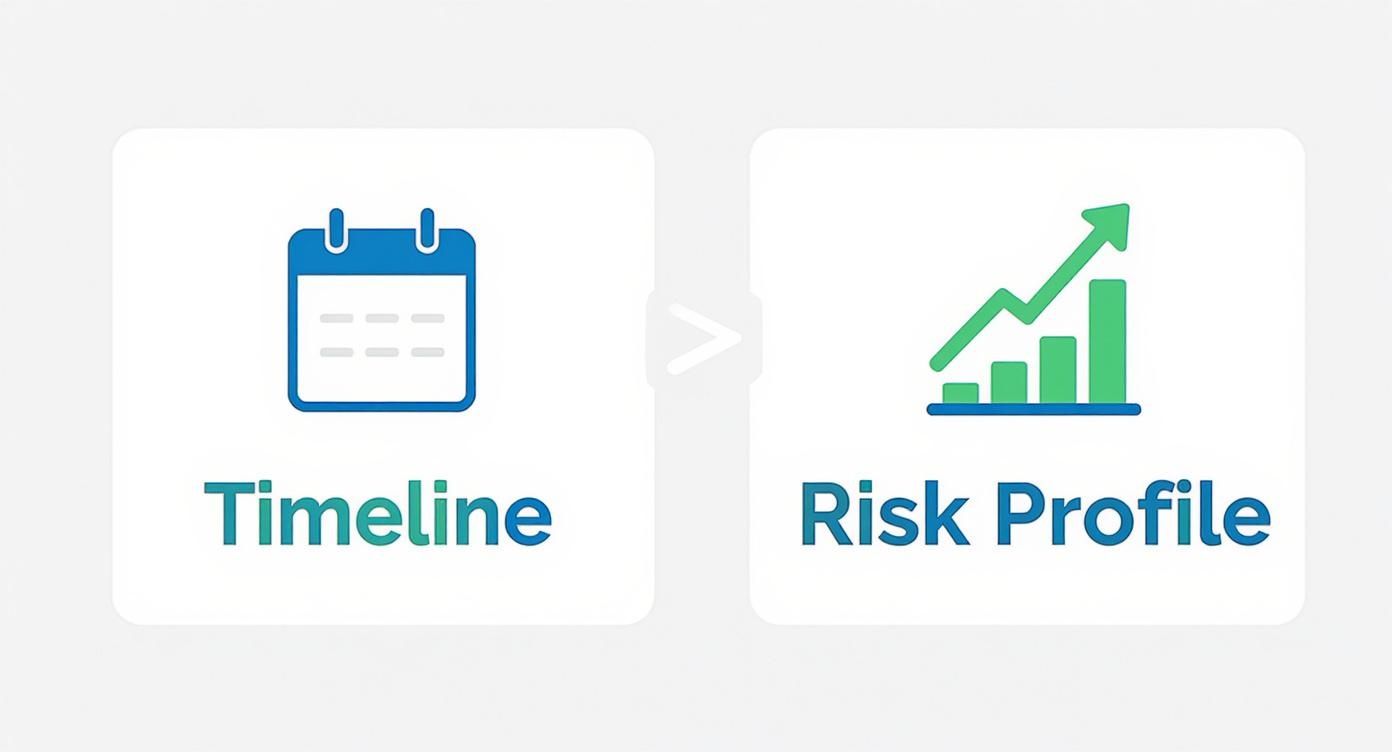
As this shows, your personal timeline and your comfort with risk are the two most important factors guiding which funds you choose. A federal employee in their 20s can afford to take on more risk for higher growth potential than someone five years from retirement.
The Core Individual Funds
Your main choices break down into government securities, bonds, and three different stock funds. I like to think of these as the basic ingredients you can use to cook up your ideal portfolio.
To get a clearer picture, here's a quick look at the five individual TSP funds, what they hold, and their general risk level.
A Snapshot of the Core TSP Funds
FundWhat It HoldsPrimary ObjectiveRisk LevelG FundSpecial U.S. Treasury securities unique to the TSPCapital preservation and modest interest incomeLowestF FundU.S. government, corporate, and mortgage-backed bondsStable income with moderate growthLowC FundStocks of the 500 largest U.S. companies (S&P 500)Long-term growthMedium-HighS FundStocks of small-to-midsize U.S. companiesAggressive long-term growthHighI FundStocks of companies in over 40 developed and emerging marketsInternational diversification and growthHigh
Each fund serves a specific purpose, from the G Fund's ironclad safety to the S Fund's aggressive growth potential. The key is finding the right mix for your personal situation.
The long-term growth potential of stock funds can be compelling. For instance, the NASDAQ Composite Index, which is heavily weighted with growth-focused tech companies similar to those in the S Fund, hit 19,710.47 on December 2, 2025. That represented an impressive five-year return of 84.97%. While past performance is no guarantee, it highlights the power of staying invested in stocks for the long haul.
The Lifecycle Funds Alternative
Feeling a little overwhelmed at the thought of mixing and matching these funds yourself? You’re not alone. That’s exactly why the TSP created the Lifecycle (L) Funds.
These are essentially "set-it-and-forget-it" target-date funds. You just pick the L Fund with the date closest to when you plan to start withdrawing your money.
The L Funds are designed to do the heavy lifting for you. They start out aggressive, with a heavy allocation to the C, S, and I stock funds. Then, as you get closer to that target date, they automatically and gradually shift your money into the safer G and F funds to protect what you’ve earned.
For example, an L 2050 fund is built for someone planning to retire around the year 2050. It’s packed with stocks. On the flip side, the L Income fund is for people already in or near retirement and is weighted heavily toward the G and F funds to prioritize stability.
Beyond just picking your funds, you also have a critical decision to make about how you contribute. Understanding the difference between a Traditional and Roth TSP is huge. You can learn what a TSP Roth is and how it maximizes tax-free growth in our guide. Getting your fund selection right powers your portfolio's growth, but choosing the right account type determines how much of that growth you get to keep.
How to Build a Custom TSP Allocation
https://www.youtube.com/embed/-TIRF0HFFuo
This is where the rubber meets the road. Taking your retirement goals and risk tolerance and turning them into an actual portfolio is what a TSP investing strategy is all about. There's no secret password here—it's about building a mix of funds that truly lines up with your personal finish line. The right allocation gives your money the best shot at growing without giving you sleepless nights.
Crafting your own mix gives you far more control than simply picking an L Fund. You get to fine-tune your exposure to risk. A great starting point many people use is the classic "110 minus your age" rule to determine their stock allocation. If you're 40, this simple formula suggests putting 70% of your money in stocks (the C, S, and I Funds) and the remaining 30% in bonds and fixed income (F and G Funds).
Of course, that’s just a guideline. Someone with a high-risk tolerance, maybe because they have a pension or other stable income on the side, might lean into a more aggressive mix. On the other hand, a more cautious investor might want a much larger slice of their portfolio in the G Fund for its rock-solid stability.
Tailoring Your Mix to Your Career Stage
Your ideal TSP allocation isn't static; it should evolve as you progress through your federal career. What makes sense for someone just starting out is completely different from what a veteran employee needs as they approach retirement.
Early Career (Your 20s and 30s)
At this point, your biggest advantage is time. With decades to go before you'll need the money, you can afford to be aggressive and aim for maximum growth.
A portfolio heavily weighted in stocks is pretty standard here. For example, a 30-year-old might decide on an 80% stock allocation (split between the C, S, and I Funds) with just 20% in the G and F Funds. This lets your money harness the full power of compounding over the long haul.
Mid-Career (Your 40s and 50s)
Growth is still the name of the game, but protecting what you've already built starts to enter the picture. This is the time to begin a slow, gradual shift toward a more balanced portfolio.
You might dial back your stock exposure to something like 60-70%, with 30-40% in bonds and the G Fund. This strategy keeps you in a great position for continued growth while adding a bit of a cushion to smooth out the market's bumps.
Late Career (Nearing Retirement)
In those final 5-10 years before you hang it up, your focus takes a sharp turn toward capital preservation. Your primary job is to protect your nest egg.
Your allocation should become much more conservative. A 50/50 split between stocks and the G/F Funds is common, and some people go even more conservative with a 40/60 mix. This drastically reduces the risk of a major market downturn wiping out a chunk of your savings right when you need it most.
The core idea is simple: You take the most risk when you have the most time to recover from losses. As your timeline shortens, you systematically reduce that risk to lock in your gains.
This entire approach is built on the proven power of staying invested in a diversified slice of the stock market over many years. History has shown time and again that it’s a powerful way to build wealth.
For example, a broad market fund like the Vanguard Total Stock Market Index Fund, which essentially owns the entire U.S. stock market, saw an average annual return of 13.93% over the five years ending November 30, 2025. You can find more insights on the long-term performance of diversified index funds at Missouri MOST.
At the end of the day, your custom allocation is deeply personal. Think of the percentages here as starting points, not unbreakable rules. The best TSP investing strategy is the one that fits your unique journey and gives you peace of mind about your financial future.
Putting Your TSP Contributions on Autopilot

A well-designed TSP investing strategy is great on paper, but it’s absolutely worthless until you actually put it into motion. The single most powerful habit for long-term success? Automating your contributions.
When you have money automatically pulled from your paycheck, investing stops being a choice you have to make every two weeks. It becomes an effortless background process, quietly building your wealth. This consistency is the real engine of growth, letting your money compound without you ever having to think about it. It’s the ultimate "pay yourself first" move.
The Magic of Dollar-Cost Averaging
By setting up automatic TSP contributions, you’re tapping into a wonderfully simple and effective concept: dollar-cost averaging. All it means is that you're investing a fixed amount of money on a regular schedule, no matter what the market is doing that day.
This disciplined approach has a massive built-in advantage. When fund prices dip, your fixed contribution buys more shares. When prices are high, it naturally buys fewer shares. Over the long haul, this smooths out your average cost and dampens the gut-wrenching effects of market volatility.
Automating contributions is the best way to take emotion out of the equation. Forget reacting to scary headlines or getting swept up in market hype. Your strategy stays on a steady, disciplined course, which is exactly what you need for long-term growth.
How to Get Your Automation Started
Setting this up is surprisingly simple and is done directly through your agency’s payroll system. The goal here is to set it once and then forget about it.
Pick Your Percentage: First, decide what percentage of your pay you want to contribute. The absolute rock-bottom minimum should be 5%. Contributing any less means you're literally turning down a 100% instant return on your money from the government match. Don't do it.
Log into Your Payroll System: Head over to your agency's employee self-service portal—whether it's MyPay, Employee Express, or another system—and find the section for TSP contributions.
Confirm Your Fund Allocation: Remember, your contributions will automatically flow into the funds you've already selected in your TSP account. Make sure that allocation is set where you want it.
This small, one-time task builds a sustainable investing habit that doesn't rely on willpower. For a deeper dive, you can explore different ways of maximizing your government matching TSP contributions to ensure you're not leaving any free money on the table. This automated system is the foundation you build a successful retirement on.
Maintaining and Rebalancing Your Portfolio
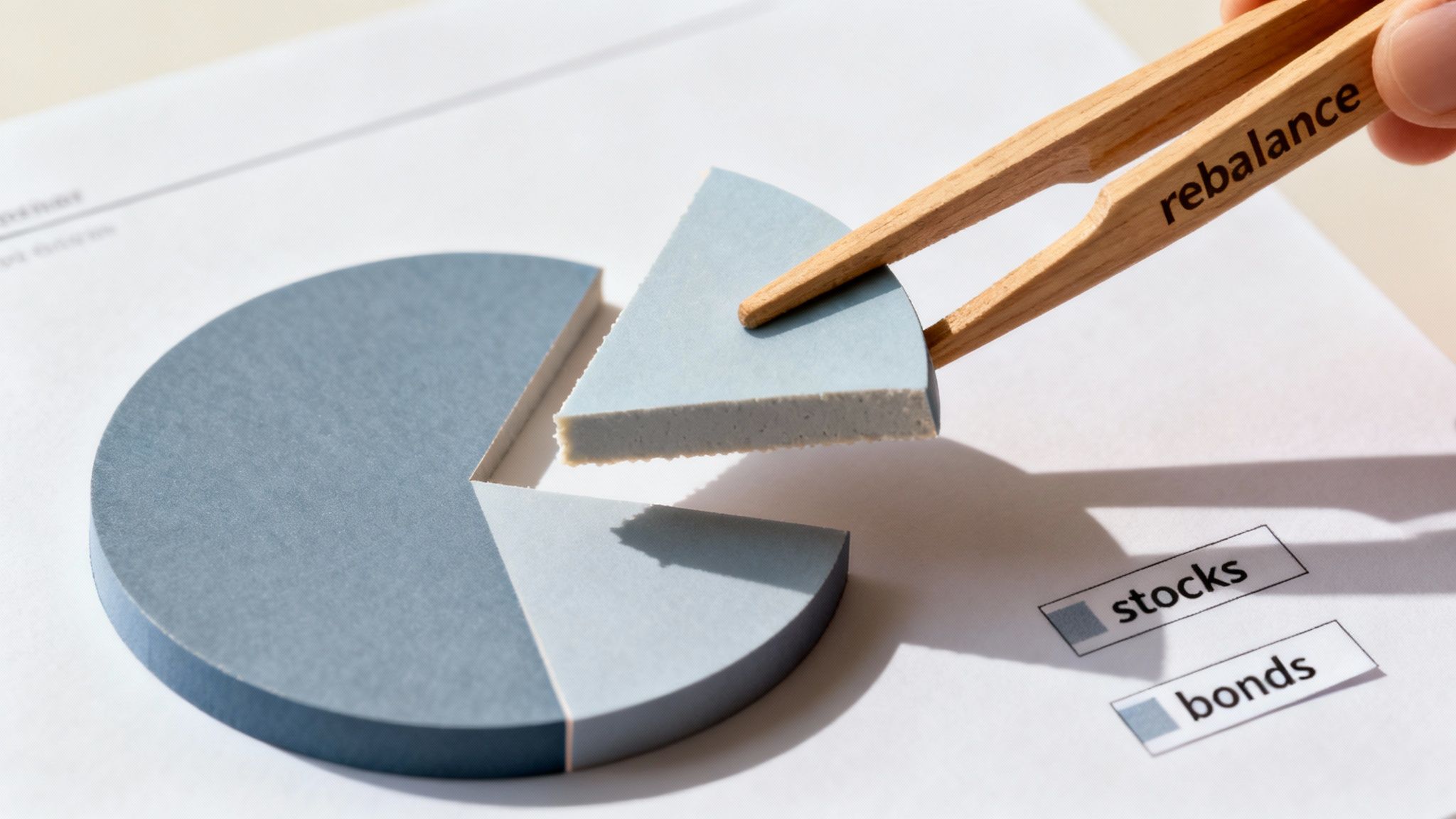
Congratulations—you’ve crafted your ideal TSP allocation. That’s a massive step, but the work isn't quite over. Your account isn’t a slow cooker you can set and forget for the next thirty years. It needs a periodic tune-up to stay on track with your goals, and that essential maintenance is called rebalancing.
Think about it: the market is always moving. That means your carefully planned asset mix is going to drift over time as some investments grow faster than others.
Let’s say you started with a classic 80/20 portfolio (80% stocks, 20% bonds). After a fantastic year for the C and S Funds, you might log in to see your allocation has morphed into an 85/15 split. It’s awesome that your stocks performed so well, but now your portfolio is carrying more risk than you originally signed up for. Rebalancing is simply the discipline of getting it back to where it should be.
Why Systematic Adjustments Work
At its core, rebalancing forces you to follow one of the oldest and wisest investing rules: sell high and buy low. In our 85/15 example, you’d sell some of your now-overweight stock funds (selling high) and shift that money into your underweight G and F Funds (buying low).
It can feel counterintuitive to trim your best performers, but this is what takes emotion out of the equation. It keeps you from getting too aggressive during a bull market or panic-selling when things get choppy.
Rebalancing is the disciplined, unemotional process of trimming your winners and adding to your underperformers to restore your portfolio's original risk profile. It's the key to maintaining a consistent TSP investing strategy over the long haul.
This steady approach is built on the same principles as a buy-and-hold strategy, which has proven itself time and again. Just look at the S&P 500, which the C Fund tracks. It delivered a total return of 31.21% in 2019 and has averaged roughly 10% annually over the last 90 years. You can dig into the historical performance data of the S&P 500 at NYU Stern for a full picture.
When Should You Rebalance Your TSP?
For most of us, a simple schedule is the best way to handle rebalancing. Don't try to time the market; it’s a losing game. Consistency is your best friend here.
A few key moments should trigger a portfolio review:
Your Annual Check-Up: The easiest way to stay on top of this is to pick a date you'll remember—your birthday, New Year's Day, your service anniversary—and make that your annual TSP review day. Just log in, check your percentages, and make the adjustments to get back to your target.
Major Life Events: Some milestones are big enough to warrant a full review of your entire strategy, not just a simple rebalance. These events can fundamentally change your risk tolerance or retirement timeline.
A Significant Promotion: A big jump in pay might mean you can contribute more or perhaps even take on a bit more risk if it aligns with your goals.
Getting Married or Divorced: Combining or separating finances is a major event that requires a complete rethink of your household’s retirement plans.
Getting Close to Retirement: Once you’re within about five years of your planned retirement date, it’s critical to reassess. You’ll likely want to shift toward a more conservative allocation to protect what you’ve worked so hard to build.
This regular maintenance ensures your TSP strategy grows with you, keeping your portfolio aligned with your journey. It’s the simple, sometimes boring, but incredibly effective secret to staying the course.
Common Questions About Your TSP Strategy
Even with a solid plan, questions are bound to pop up. Think of your TSP investing strategy as a living guide, not a stone tablet. It's totally normal to wonder if you’re still on the right track as things change. Here, we'll walk through some of the most common questions federal employees ask about managing their retirement nest egg.
Getting clear answers is the key to building the confidence you need to stick with your plan, especially when the market gets a little choppy. Let's dig in.
How Often Should I Change My TSP Allocation?
This is probably the most common question I hear, and the short answer is: almost never.
Your core asset allocation is built for the long haul, based on your retirement timeline and how you feel about risk. Fiddling with your funds every time you see a scary headline is a classic mistake. That kind of market timing usually leads to buying high and selling low—exactly what we want to avoid.
Instead, a quick review once a year is plenty. This annual check-in is the perfect opportunity to rebalance your portfolio back to your original targets, not to blow up your entire strategy.
So, when should you think about a major change? Only after a significant life event, like:
A big promotion that changes your financial picture.
Getting married or divorced.
Getting within five years of your planned retirement date.
Your core strategy is meant to be stable. The real secret to building long-term wealth in the TSP isn't fancy timing; it's discipline and consistency.
Are Lifecycle Funds Better Than a Custom Mix?
There’s no one-size-fits-all answer here—it really depends on your personality.
The L Funds are a brilliant, hands-off solution. You just pick the fund with the date closest to when you think you'll retire, and it handles everything else. The fund automatically rebalances and gets more conservative as you get closer to that target date. For a lot of people, this "set-it-and-forget-it" approach is perfect.
On the other hand, building your own mix from the core G, F, C, S, and I funds gives you maximum control. This path is for investors who are more hands-on or have a specific goal that doesn't quite fit the L Fund's pre-set path. You can dial in your exact risk exposure, which many find empowering.
Ultimately, the best choice is the one you’ll be comfortable sticking with for the next 10, 20, or 30 years.
What Is the Biggest Mistake People Make?
This one is easy. By far, the most destructive mistake is panic-selling during a market downturn.
When the market is dropping, our instincts scream at us to run for the safety of the G Fund. But moving all your money after a drop just turns a temporary paper loss into a permanent one. It also guarantees you'll be on the sidelines for the eventual recovery.
A successful TSP strategy is all about having the guts to trust your plan. That means continuing to contribute through the good times and the bad. History shows us time and again that markets recover, and the biggest winners are always the ones who stayed in the game.
Figuring out your federal benefits can feel like a maze, but you don’t have to go it alone. At Federal Benefits Sherpa, we specialize in helping federal employees build clear, personalized roadmaps to retirement. Schedule your free 15-minute benefits review today and get the clarity you need for a secure future.


Dedicated to helping Federal employees nationwide.
“Sherpa” - Someone who guides others through complex challenges, helping them navigate difficult decisions and achieve their goals, much like a trusted advisor in the business world.
Email: [email protected]
Phone: (833) 753-1825
© 2024 Federalbenefitssherpa. All rights reserved