
Blogs

Blog title place here
We understand that every federal employee's situation is unique. Our solutions are designed to fit your specific needs.

Blog title place here
We understand that every federal employee's situation is unique. Our solutions are designed to fit your specific needs.

Blog title place here
We understand that every federal employee's situation is unique. Our solutions are designed to fit your specific needs.
Your Guide to the GEHA Health Savings Account
Think of a GEHA Health Savings Account (HSA) as a personal savings account, but with some serious financial superpowers. It's not just a rainy-day fund for medical bills; it’s a powerful tool designed to work alongside a High-Deductible Health Plan (HDHP). For federal employees, this combination can be a game-changer for managing both immediate health costs and long-term retirement savings.
This isn't just about spending—it's about strategic saving.
Your Healthcare 401(k) Explained
Let's break this down. Your GEHA Health Savings Account is like a 401(k) built specifically for your health. It’s a long-term investment vehicle designed to grow your wealth while covering everything from routine check-ups to unexpected medical needs. But there’s a catch: to open an HSA, you must first be enrolled in a High-Deductible Health Plan (HDHP).
The HDHP and the HSA are a package deal—you can't have one without the other. The HDHP is your actual health insurance, which typically comes with lower monthly premiums but requires you to pay more out-of-pocket (the deductible) before your insurance kicks in. The HSA is the financial tool that makes this setup so brilliant, giving you a tax-advantaged place to put the money you're saving on those lower premiums.
The Essential Partnership of an HDHP and HSA
So, why are these two always linked? The government designed HSAs to give people with HDHPs a smart way to save for their medical care. Since you're taking on a bit more of the initial cost with a higher deductible, the HSA provides a tax-advantaged cushion to prepare for those expenses.
This partnership is all about empowering you to take control of your healthcare spending. For federal employees who are relatively healthy and want to keep their monthly insurance costs down, this can be an ideal setup. It shifts your focus from just paying for care to strategically investing for a lifetime of health and wellness.
To give you a clearer picture, here's a quick rundown of the key features of a GEHA HSA.
GEHA HSA Key Features at a Glance
FeatureDescriptionEligibilityMust be enrolled in a qualified High-Deductible Health Plan (HDHP).Contribution SourceYou, your employer, or even a family member can contribute.Account OwnershipThe account is yours and completely portable—it goes with you if you change jobs or retire.Tax BenefitsOffers a unique triple-tax advantage on contributions, growth, and withdrawals.Investment OptionsFunds can be invested in mutual funds, stocks, and other assets once a certain balance is reached.Withdrawal RulesTax-free withdrawals for qualified medical expenses at any age.
This table shows how the HSA is much more than just a savings account; it's a flexible, long-term financial asset.
Introducing the Triple-Tax Advantage
The real magic of the GEHA Health Savings Account lies in its triple-tax advantage. No other retirement or savings account can match this benefit, which combines three powerful perks to supercharge your savings.
Here’s how it works:
Tax-Deductible Contributions: The money you put in is tax-deductible, which lowers your taxable income for the year. It's an immediate, satisfying tax break.
Tax-Free Growth: Your money can be invested, and any earnings it generates grow completely tax-free. No capital gains, no income tax—nothing.
Tax-Free Withdrawals: You can pull money out at any time to pay for qualified medical expenses, and you won’t pay a single cent in taxes on it.
This triple-threat of tax savings is what elevates the HSA from a simple healthcare fund to one of the most efficient retirement savings tools available to federal employees. It's a way to build a dedicated, tax-free nest egg for your long-term well-being.
Maximizing Your Annual HSA Contributions
One of the best perks of the GEHA Health Savings Account is the pass-through contribution you get right off the bat. Think of it as free money—GEHA deposits a generous amount directly into your account at the start of the year, giving you an immediate cushion for medical costs.
This initial boost is a great head start, but the real power comes from your own contributions. When you aim to max out your HSA each year, you're not just saving for healthcare; you're building a powerful, tax-advantaged investment vehicle. The best part? You can do it all through simple, automatic payroll deductions.
Understanding Annual Contribution Limits
Every year, the IRS sets the maximum amount you can put into an HSA. These limits change periodically to keep up with inflation, and they depend on whether you have a self-only or a family health plan. For federal employees, knowing these numbers is the first step to building a serious healthcare fund.
For 2025, GEHA puts up to $2,000 into the HSAs of members with family coverage. That's a huge help. The total 2025 contribution limits are $4,300 for self-only coverage and $8,550 for family coverage. You can always check the latest numbers on GEHA's official site.
This infographic breaks down the "triple-tax advantage" that makes every dollar you contribute so incredibly valuable.
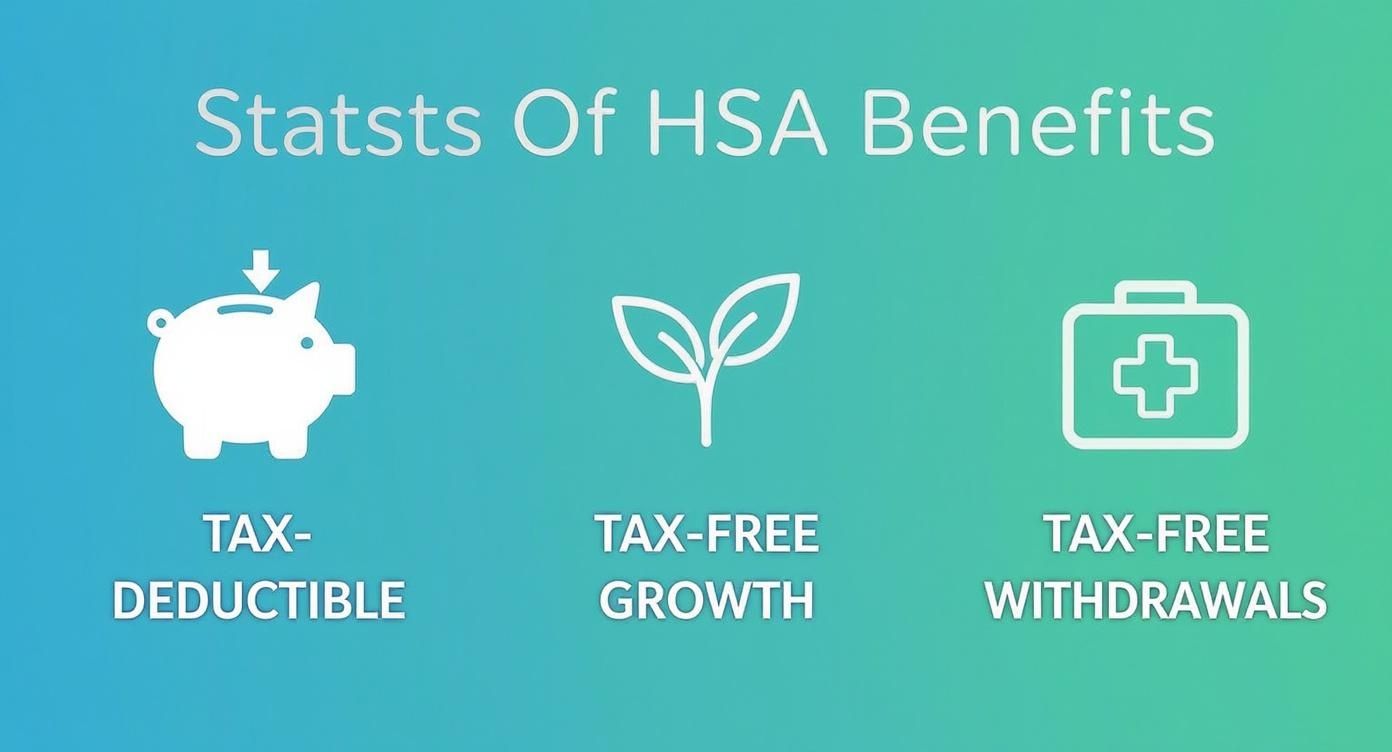
Simply put, your contributions are tax-deductible, the money grows tax-free, and you can pull it out tax-free for qualified medical expenses. It doesn't get much better than that.
Leveraging Catch-Up Contributions After 55
For those of us getting closer to retirement, the HSA has another fantastic feature. Once you turn 55, you can make catch-up contributions. This lets you put in an extra $1,000 per year on top of the regular limit, which is perfect for beefing up your savings in those final working years.
This isn’t just a small bonus—it’s a strategic way to supercharge your account. Over five or ten years, that extra thousand dollars a year really adds up, giving you a much larger nest egg for healthcare costs in retirement.
The catch-up contribution is an individual benefit. This means if both you and your spouse are 55 or older and covered under a family HDHP, you can each contribute an additional $1,000 to your respective HSAs.
This is where it gets really powerful for couples. If both spouses are eligible, you can collectively add an extra $2,000 to your HSAs each year.
Putting It All Together: A Practical Example
Let's walk through how this works for a federal employee couple, both age 56, with a GEHA family HDHP.
Here’s how they could max out their HSA contributions in 2025:
GEHA Pass-Through: First, GEHA deposits $2,000 into their account.
Standard Family Contribution: The total family limit is $8,550. After GEHA's part, their contribution is $8,550 - $2,000 = $6,550.
Spouse 1 Catch-Up: The first spouse adds their $1,000 catch-up.
Spouse 2 Catch-Up: The second spouse does the same, adding another $1,000.
By taking full advantage of the rules, this couple could contribute a grand total of $10,550 to their HSAs in a single year. By setting up automatic payroll deductions, they can methodically build a powerful, tax-free fund to cover healthcare costs now and throughout a long, healthy retirement.
The HSA’s Secret Weapon: The Triple-Tax Advantage
When you hear about the GEHA Health Savings Account, you’ll almost always hear the term “triple-tax advantage.” It’s not just a catchy phrase; it’s the core feature that makes an HSA one of the most powerful savings and investment tools available to anyone, especially federal employees.
Think of it like a financial triathlon where you win at every single stage: when you put money in, while it grows, and when you take it out for medical costs. No other retirement or savings account—not your TSP, not a 401(k), not even a Roth IRA—offers this complete tax shelter.
Let's break down exactly how this works.
Benefit 1: Tax-Deductible Contributions
The first win is immediate. Every single dollar you contribute to your GEHA HSA is 100% tax-deductible for the year you make the deposit. This isn't a credit or a complicated formula; it's a direct reduction of your taxable income.
Let’s put that into real numbers. Say you’re in the 22% federal tax bracket and you decide to contribute $4,000 to your HSA for the year. That contribution instantly lowers your taxable income by $4,000, which saves you $880 in taxes ($4,000 x 0.22). It's like getting an instant discount on saving for your own future.
This upfront deduction is a game-changer. You're effectively getting a bonus from the government just for setting aside money for healthcare, making it one of the smartest ways to lower your tax bill each year.
Benefit 2: Tax-Free Growth
Once your money is inside the HSA, the second advantage starts working its magic. Your funds don’t have to just sit there in cash. You can invest them in a range of mutual funds, much like you would with your TSP account. Here’s the key: all the growth from those investments—dividends, interest, capital gains—is completely tax-free.
This is where the HSA really pulls ahead of other accounts. Imagine you invest $10,000 in an HSA and another $10,000 in a typical taxable brokerage account. Assuming both earn a 7% return annually for 20 years, the difference is stark.
In a taxable brokerage account, you’d owe taxes on dividends and capital gains along the way. This "tax drag" constantly slows down your growth. After 20 years, your $10,000 might grow to about $32,000.
In your GEHA HSA, that same $10,000 grows completely untouched by taxes. It compounds without interruption, potentially reaching over $38,000.
That extra $6,000 is purely the result of your money growing in a tax-free environment. Over a career, that gap can become enormous.
Benefit 3: Tax-Free Withdrawals
The final piece of the puzzle brings it all home. You can pull money out of your HSA at any time, for any qualified medical expense, completely tax-free. It doesn't matter if you're 25 or 75. This is what truly cements the HSA's status as the ultimate account for healthcare costs.
And what counts as a "qualified medical expense"? The list is incredibly broad and covers things you're already paying for:
Doctor visits and co-pays
Prescriptions
Dental work (including major things like braces)
Vision care (glasses, contacts, even Lasik)
Acupuncture and chiropractic care
Best of all, this privilege never expires. You can use the funds to pay for a dental crown next month or let the account grow for 30 years and use it to cover healthcare expenses in retirement. When all three benefits work together, you get to lower your taxes today, grow your money tax-free, and then use it tax-free for a lifetime of health needs.
Using Your HSA Funds for Medical Expenses
When you open your GEHA Health Savings Account, you'll get a debit card. It's super convenient for paying medical bills on the spot. But here's a little secret from the pros: just because you can spend the money right away doesn’t mean you should.
The real magic of an HSA isn't just in spending it—it's in understanding how to use it strategically. With the right approach, you can transform it from a simple healthcare spending account into a powerful tool for your retirement.
Most people use their HSA in the most straightforward way: they swipe the card at the doctor's office, pharmacy, or dentist to cover the bill. The money comes right out of your account, tax-free. This is a perfectly fine way to manage your high deductible and keep your out-of-pocket costs predictable.
What Are Qualified Medical Expenses?
One of the best things about an HSA is the sheer breadth of expenses it can cover tax-free. The IRS defines "qualified medical expenses" pretty broadly as costs to diagnose, cure, treat, or prevent a disease. This covers a lot more ground than you might think.
Here's a quick look at what you can pay for with your HSA funds:
Medical Services: Think doctor’s visit co-pays, hospital bills, and lab fees.
Prescriptions: Any medication prescribed by your doctor is covered.
Dental Care: This is a big one. It includes routine cleanings, fillings, major work like crowns and root canals, and even braces. To learn more about how this works with your plan, check out our comprehensive guide to the GEHA Dental High Option Plan.
Vision Care: Expenses like eye exams, prescription glasses, contact lenses, and even LASIK surgery are eligible.
Alternative Treatments: Services that often aren't covered by traditional insurance, like acupuncture and chiropractic care, can be paid for with your HSA.
This incredible flexibility makes your GEHA Health Savings Account a true all-purpose fund for nearly any healthcare need your family might have.
A powerful, yet often overlooked, strategy is to treat your HSA as an investment account first and a spending account second. This simple shift in mindset can create hundreds of thousands of dollars in tax-free wealth for retirement.
The Ultimate Strategy: Pay and Delay
Ready for the most powerful way to use your HSA? Let your money grow, untouched, for as long as possible. It works like this: instead of swiping your HSA debit card for a current medical expense, pay for it with cash or a credit card. And—this is the crucial part—diligently save every single receipt.
By paying out-of-pocket, you leave your HSA funds invested where they can grow completely tax-free. Years down the road, that small $80 dental co-pay you covered today could be backed by an invested HSA balance that has ballooned in value.
Then, when you actually need cash in retirement—for any reason at all—you can reimburse yourself for all those medical expenses you saved receipts for, even if they happened decades ago.
Turning Receipts into a Tax-Free Pipeline
This "pay and delay" method essentially transforms your old medical receipts into a stockpile of future tax-free cash withdrawals. The IRS has no time limit on when you can reimburse yourself for a qualified medical expense, so long as the expense happened after you established the HSA.
Let’s play this out over a career:
Years 1-30: You pay for all medical costs out-of-pocket and keep every receipt. Over three decades, this adds up to $40,000 in saved receipts.
During this time: Your HSA contributions are invested and grow tax-free. Your balance swells to $350,000.
In Retirement: You decide you want $40,000 for a home renovation or a new car. You simply submit your $40,000 worth of old receipts to your HSA provider and withdraw that amount from your account, completely tax-free.
You’ve successfully allowed your investments to compound for decades and then tapped into that growth without paying a dime in taxes. This is how you turn everyday healthcare costs into a strategic tool for building long-term, flexible, tax-free wealth.
How Your HSA Boosts Your Federal Retirement
https://www.youtube.com/embed/uQhDgDuewKc
Most federal employees picture retirement as a three-legged stool: your FERS pension, Social Security, and your Thrift Savings Plan (TSP). But there's a fourth leg, one that many people overlook, that can make your financial future far more stable: the GEHA Health Savings Account.
Thinking of your HSA as just a way to pay for doctor's visits today is like using a rocket ship for a trip to the corner store. You’re completely missing its real power. The moment you shift your mindset, you'll see the HSA for what it truly is—an incredibly powerful retirement account, purpose-built to tackle one of the biggest expenses you'll face: healthcare.
The Game-Changing Rule at Age 65
Something magical happens when you turn 65. Your HSA gets a major upgrade, suddenly acting a lot like your TSP or a traditional IRA, but with one massive advantage. This little-known rule unlocks a whole new level of financial flexibility.
From age 65 onward, you can pull money out of your HSA for any reason at all without facing a penalty. Want to fund a dream vacation or renovate the kitchen? Go for it. You'll just pay regular income tax on the withdrawal, exactly like you would with a distribution from your TSP.
But here’s the real kicker: any money you withdraw for qualified medical expenses is still 100% tax-free, forever. This dual-purpose nature is what makes the GEHA Health Savings Account so unique. It’s a flexible spending account for your golden years that keeps its special tax-free power for anything health-related.
You can think of it as a "super-IRA." For everyday expenses, it works just like a traditional retirement account. But for healthcare, it wipes out the tax bill entirely, making it the single most efficient way to pay for medical care in retirement.
Funding Your Healthcare in Retirement Tax-Free
Healthcare costs are one of the scariest unknowns when planning for retirement. Some studies estimate that a couple retiring at 65 might need over $300,000 saved up just to handle their medical bills. Your HSA is the perfect weapon to fight back against that uncertainty.
Because your withdrawals are tax-free, every dollar you’ve saved goes further. A $5,000 medical bill costs you exactly $5,000 from your HSA. If you had to pull that money from your TSP, you might need to withdraw $6,250 just to have $5,000 left after taxes eat their share.
You can use your HSA funds for all sorts of healthcare costs in retirement, including:
Medicare Premiums: Pay for your Medicare Part B, Part D (prescriptions), and Medicare Advantage plan premiums with tax-free dollars.
Long-Term Care Insurance: You can pay the premiums for a qualified long-term care policy right from your HSA, which helps protect the rest of your nest egg.
Out-of-Pocket Costs: Think dental, vision, hearing aids, and all those prescription co-pays that Medicare doesn't quite cover.
By dedicating your GEHA Health Savings Account to these kinds of costs, you let your TSP and other retirement accounts do what they do best: fund your lifestyle. This strategic approach is a cornerstone of a solid financial plan. Our guide to federal employee retirement benefits dives deeper into how to make all these pieces work together.
The HSA as a Strategic Super-IRA
When you get right down to it, weaving an HSA into your long-term strategy gives you a level of financial security and flexibility that's hard to beat. It becomes your dedicated, tax-free war chest for medical expenses, while also serving as a fantastic emergency fund for anything else life throws at you after 65.
By contributing the max each year and investing those funds for growth, you aren't just saving for healthcare—you're building one of the most efficient retirement accounts ever created. It's time to stop looking at your HSA as a simple checking account for co-pays and start treating it like the strategic super-IRA it was meant to be.
Pairing Your HSA with the GEHA HDHP
A GEHA Health Savings Account doesn't exist in a vacuum; it’s one half of a powerful duo. Its partner is the High-Deductible Health Plan (HDHP), and you really need both for the strategy to click. Think of them as two sides of the same coin: the HDHP gives you those lower monthly premiums, and the HSA gives you a tax-free bucket to save for your medical expenses.
To get the most out of your GEHA Health Savings Account, you first have to get comfortable with how the health plan itself works. It’s all built around two numbers that determine when your insurance kicks in and starts covering the bills.
Demystifying Your Plan Structure
The GEHA HDHP is designed for federal employees who want more control over their healthcare spending. Once you understand two key terms, the whole structure makes a lot more sense.
Deductible: This is simply the amount you have to pay out-of-pocket for covered medical services before your insurance starts sharing the cost. It’s your initial share for the year.
Out-of-Pocket Maximum: This is the absolute ceiling on what you'll spend on covered services in a plan year. Once you hit this limit, GEHA picks up 100% of the tab for the rest of the year. No more bills.
This setup puts a hard stop on your potential medical spending, which is a huge relief if you’re worried about catastrophic costs. It keeps your monthly premiums low while giving you a clear financial safety net. A deeper look into a guide to the Federal Employees Health Benefits (FEHB) program can help you see how this plan compares to others in the federal system.
High-Value Benefits Beyond the Deductible
Don't let the term "high deductible" fool you. The GEHA HDHP is loaded with valuable perks that are covered before you even touch your deductible. These benefits are there to help you stay on top of your health without worrying about the cost.
For example, you get routine vision and preventive dental checkups at little to no cost. Even better, the plan includes unlimited telehealth visits, including mental health services through MDLIVE, all covered completely. For busy feds, that kind of convenient access is a game-changer.
Earn Rewards for Healthy Living
GEHA really doubles down on this with incentive programs that can put serious money back into your HSA. These rewards aren’t hard to get—they’re for doing things that keep you healthy.
The Wellness Pays program lets you earn up to $500 a year ($1,000 if your spouse is covered, too). On top of that, the Health Rewards program offers another $250 per person (up to $500 total) for healthy actions. You can dig into the specifics right in GEHA's member benefits and rewards guide.
By combining lower premiums, valuable no-cost benefits, and substantial wellness rewards, the GEHA HDHP and HSA create a powerful synergy. You're not just saving money; you're being paid to stay healthy.
Answering Your Top GEHA HSA Questions
When federal employees start digging into the GEHA Health Savings Account, a few key questions always pop up. Getting these sorted out is the first step to really making this account work for you. Let's walk through the most common ones.
What Happens to My HSA If I Leave Federal Service?
This is one of the best parts about an HSA: it's your money, for life.
Your Health Savings Account is 100% portable. Think of it like a 401(k) or an IRA, not a "use it or lose it" FSA. The account and all the money inside it belong to you, no matter where you work or if you switch to a different type of health plan down the road.
You can always spend the existing funds on qualified medical expenses, completely tax-free. The only catch is you can't add new money to the account unless you're actively enrolled in an HSA-qualified health plan.
Can I Invest the Money in My GEHA HSA?
Yes, and you absolutely should! This is where an HSA transforms from a simple savings account into a powerful retirement vehicle.
Once your cash balance hits a certain minimum—typically around $1,000—you can invest any amount above that threshold. You'll get access to a menu of mutual funds, similar to what you see in the Thrift Savings Plan (TSP). This feature lets your money grow tax-free, creating a compounding effect that can seriously boost your retirement nest egg.
Who Is the Ideal Candidate for This Plan?
The GEHA HDHP with its accompanying HSA is a fantastic match for feds who are generally healthy and don't anticipate a lot of medical bills. It’s perfect for anyone focused on building long-term, tax-advantaged savings for the future.
It's also a great fit for people who are comfortable with a higher deductible in exchange for significantly lower monthly premiums. You're essentially taking the money you save on premiums and putting it straight into a tax-free retirement account.
Can My Spouse Contribute to My HSA?
Yes, but it's important to understand the rules. If you're on a family plan, the total amount contributed by you, your employer, and your spouse can't go over the annual family contribution limit for that year.
While your spouse can technically make contributions, it's often much simpler to handle everything through your own payroll deductions to avoid any confusion.
One more thing to note: if your spouse is 55 or older and has their own HSA, they can make their own $1,000 catch-up contribution to that separate account.
Ready to take control of your retirement? Federal Benefits Sherpa provides personalized retirement planning to help you make the most of your federal benefits. Schedule your free 15-minute benefit review today.


Dedicated to helping Federal employees nationwide.
“Sherpa” - Someone who guides others through complex challenges, helping them navigate difficult decisions and achieve their goals, much like a trusted advisor in the business world.
Email: [email protected]
Phone: (833) 753-1825
© 2024 Federalbenefitssherpa. All rights reserved