Is It Aging or Your Gut? The Silent Signs of Imbalance Most Women Miss
These Are the Signs Your Gut May Be Out of Balance—And Most Women Don’t Realize Them
Many women think they would know if something was wrong with their gut.
They assume gut issues would show up as severe pain, extreme digestive problems, or a clear diagnosis.
But in reality, gut imbalance often develops quietly.
And because our bodies are incredibly adaptable, many of the early warning signs become things we simply learn to live with.
Over time, what starts as occasional discomfort can slowly become something we consider “normal.”
But normal doesn’t always mean healthy.
Why Gut Health Matters More Than Most People Realize
Hi, I’m Xi, a Functional Diagnostic Nutrition Practitioner. I help women take control of how they age through personalized, data-driven health strategies that address the underlying imbalances affecting energy, metabolism, hormones, and long-term health.
One of the most common root issues I see in midlife women is poor gut health.
And the tricky part is that many women don’t recognize the signs—because they’ve slowly adapted to them.
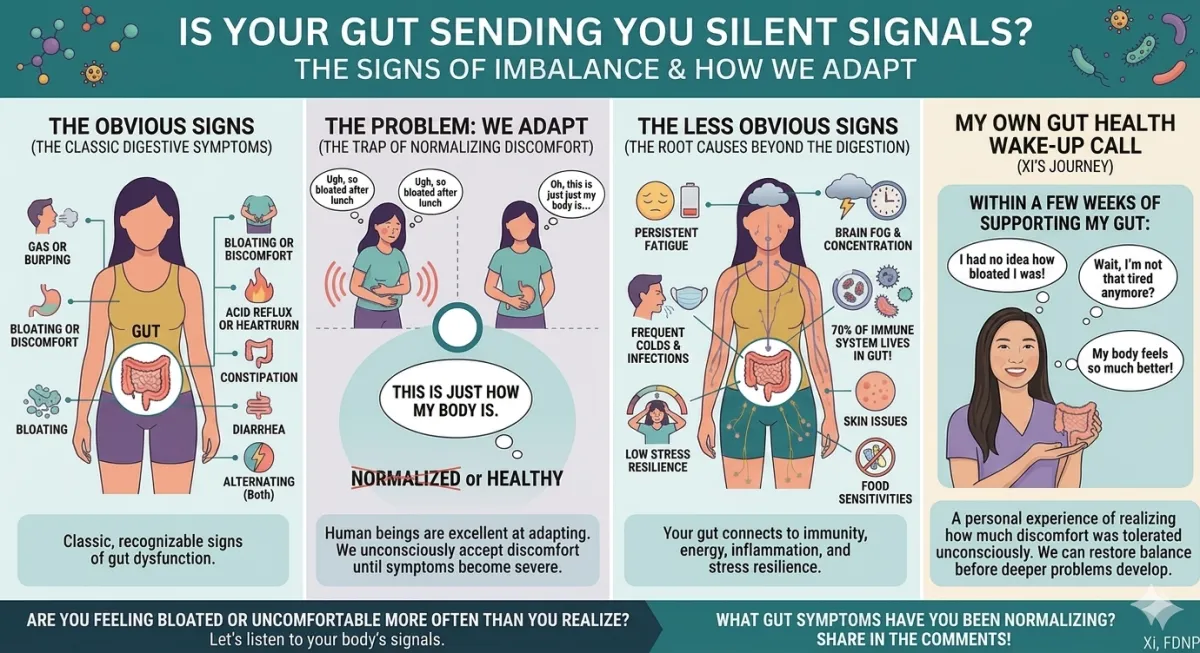
The Obvious Signs Your Gut May Be Out of Balance
Some symptoms are easier to recognize as digestive issues.
These include things like:
Gas or excessive burping
Bloating or abdominal discomfort
Acid reflux or heartburn
Constipation
Diarrhea
Alternating between constipation and diarrhea
These are the classic signs that digestion and gut function may not be working the way they should.
But what’s often more important—and more overlooked—is what happens next.
The Problem: We Adapt
Here’s the insight I want more women to understand:
We adapt.
Human beings are incredibly good at adapting to discomfort.
So good, in fact, that we often begin to normalize things like:
Feeling bloated after most meals
Constant gas or stomach discomfort
Irregular bowel movements
Frequent reflux or heartburn
Over time, these symptoms start to feel like they’re simply part of how our body works.
We tell ourselves:
“This is just how my body is.”
And we continue on—until the symptoms eventually become severe enough that they can no longer be ignored.
When “Normal” Isn’t Actually Normal
This pattern is incredibly common.
What starts as mild digestive irritation can slowly evolve into chronic gut dysfunction.
Because the change happens gradually, it’s easy to miss.
You don’t suddenly wake up one day with poor gut health—it develops over months or years.
And by the time many women seek help, they’ve already been normalizing symptoms for a very long time.
My Own Gut Health Wake-Up Call
I actually experienced this firsthand during my own gut healing journey.
When I began cleaning up my diet and actively supporting my gut health, something surprising happened.
Within a few weeks, I had a moment where I stopped and thought:
“Oh my gosh… I had no idea how bloated I was.”
I also didn’t realize how much underlying fatigue I had been carrying—or how uneasy my body felt on a daily basis.
It wasn’t until my gut started improving that I realized how much discomfort I had been unconsciously tolerating.
That moment was a powerful reminder of how easy it is to normalize feeling unwell.
But it doesn’t have to be that way.
The Less Obvious Signs of Gut Imbalance
Gut issues don’t always show up as digestive symptoms.
In fact, many of the most common signs appear elsewhere in the body.
Some less obvious indicators of poor gut health include:
Persistent fatigue
Brain fog or difficulty concentrating
Frequent colds or infections
Low resilience to stress
Skin issues
Food sensitivities
Your gut is deeply connected to your immune system, energy production, and inflammation levels.
In fact, roughly 70% of the immune system lives in the gut.
So if you’re the person who seems to catch every cold or flu that goes around, that could be a sign your gut—and immune system—need support.
Your Body Is Always Communicating
The body rarely sends signals without a reason.
Symptoms like bloating, fatigue, brain fog, or frequent illness are often the body’s way of saying:
Something needs attention.
When we learn to listen to those signals early, we can often restore balance before deeper problems develop.
And that’s one of the most powerful things about improving gut health—it can impact energy, immunity, digestion, hormones, and overall well-being.
A Simple Question to Ask Yourself
I invite you to pause for a moment and reflect honestly:
Are you feeling bloated or uncomfortable more often than you realize?
Sometimes we’ve been living with symptoms for so long that we stop noticing them.
But recognizing those signals is the first step toward improving how your body feels every day.
Let’s Continue the Conversation
What gut symptoms have you been normalizing?
Gas, bloating, reflux, fatigue, or something else?
Share in the comments—I’d love to hear your experience.