The Real Reason Your Health Concerns Get Dismissed
If you’ve ever walked out of a doctor’s office feeling frustrated, dismissed, or unheard—you’re not alone.
Many women in midlife dealing with symptoms like fatigue, weight changes, poor sleep, or brain fog hear the same phrase:
“Everything looks normal.”
And after hearing that, it’s easy to feel like your concerns aren’t being taken seriously.
But here’s something most people don’t realize:
Your doctor often isn’t ignoring you—they’re working inside a system that limits what they’re allowed to do.
The System Doctors Are Required to Follow
Most physicians are bound to something called the standard of care.
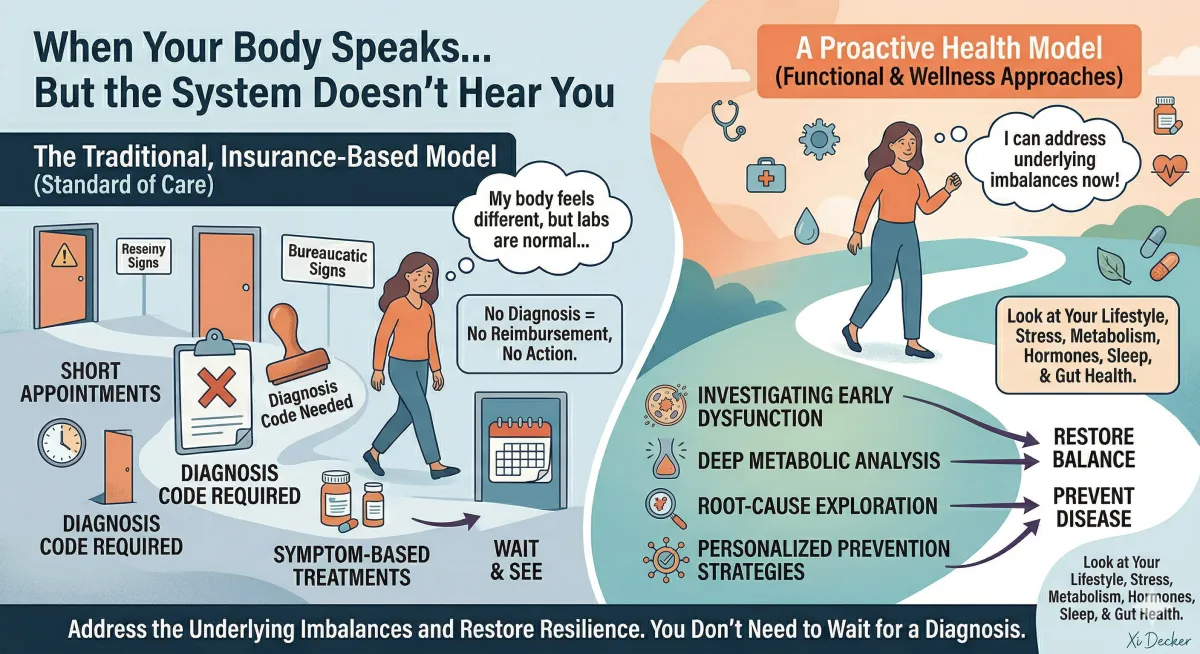
This is a rigid set of diagnostic rules and treatment protocols that doctors must follow in order to practice within the medical system and receive insurance reimbursement.
Before a physician can take action—order tests, prescribe treatment, or refer you to a specialist—they typically need one thing first:
So if what you’re experiencing doesn’t meet the strict criteria for a diagnosable disease, your doctor often has very little room to act.
Not because they don’t care.
Because the system requires it.
A diagnosis code.
No diagnosis means:
No insurance coverage
No reimbursement
No justification for treatment
Why Prevention Rarely Happens in Traditional Care
The insurance-based healthcare model isn’t built to support prevention.
It’s designed to treat diagnosed disease.
Which means it rewards:
Short appointments
Symptom-based treatments
Prescriptions
“Wait and see” approaches
Those are the things that can be coded and billed.
What the system does not typically cover are things like:
• Investigating early dysfunction before disease appears
• Deep lifestyle and metabolic analysis
• Root-cause exploration
• Personalized prevention strategies
So women are often left managing symptoms that are very real—but not yet “severe enough” to trigger action.
It’s Not About Blame
This doesn’t make your doctor bad or uncaring.
In fact, many physicians are deeply frustrated by the limitations of the system they work within.
They want to help their patients feel better.
But unless they step outside the traditional insurance model—into concierge care, functional medicine, or cash-based practices—they are required to operate within those rules.
Why a Proactive Health Model Matters
This is why more people are beginning to explore proactive models of care.
Approaches that don’t wait for disease to appear before taking action.
Approaches that look at:
Your lifestyle
Your stress load
Your metabolism and hormones
Your sleep and recovery
Your nutrition and gut health
The goal is simple:
Restore balance before your body crosses the threshold into disease.
Because once dysfunction has been building for years, waiting until it becomes diagnosable is often the hardest way to solve the problem.
Your Health Is Worth Paying Attention To
If your energy, sleep, metabolism, or mental clarity feel different than they used to, it’s worth paying attention to those signals.
You don’t need to wait for a diagnosis to begin supporting your health.
Often, the earlier you address the underlying imbalances, the easier it is for your body to recover and regain resilience.