When a Battery Burns, Permits Burn With It: What the Warwick Fire Means for CRE Storage Plans
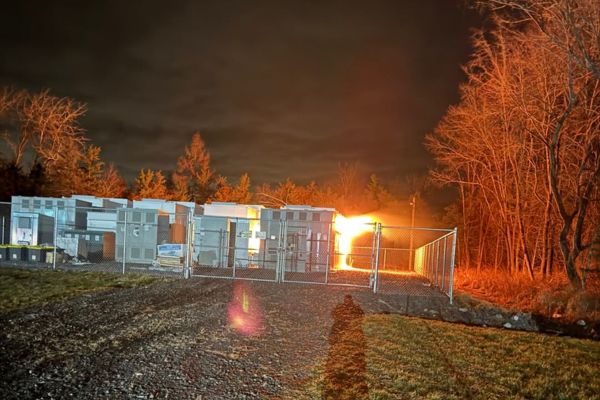
A lithium-ion battery container at a grid-scale energy storage site in Warwick, N.Y., caught fire late Friday, December 19th — and by Monday the 22nd it had become more than a local emergency response. It was a reminder that for commercial real estate owners, the hard part of adding batteries is no longer just engineering and economics. It’s permitting, public trust and how quickly a single incident can reshape the politics of “yes.”
No injuries were reported, and local officials said Orange County’s hazardous materials team monitored air quality without “alarm levels,” according to a statement posted by the Village of Warwick that included Convergent Energy’s update. But the incident persisted long enough — and echoed a similar fire at the site in 2023, according to local officials — that it reignited a familiar question for planners and property owners watching storage: How do you build confidence in a technology that’s supposed to make communities more resilient, when the failure mode is so visible?
What happened in Warwick
The fire was first reported around 10:15 p.m. Friday at Convergent’s battery storage site at 28 Church St., Spectrum News reported, citing town and company statements. Town Supervisor Jesse Dwyer called it an “enormous public safety concern” and described it as the second fire at the facility since 2023.
Convergent Energy said a fire alarm triggered the site’s emergency response plan and that the fire was localized to one container and did not spread to adjacent containers. The company said its systems are monitored 24/7 and that an operator activated a manual emergency stop.
Local reporting described continued monitoring and frustration about how long it can take to fully “finish” a lithium-ion incident. News 12 Westchester said officials believed water infiltration may have contributed — the same issue blamed for the 2023 fire — and that one unit continued to burn internally, complicating suppression.
Why this particular site matters
This is not a random pilot in a lab. The Warwick project was designed as a “non-wires alternative” — meaning a battery system used in place of traditional grid upgrades like new lines and transformers.
Orange and Rockland Utilities says the Warwick Battery Project totals 12 megawatts / 57 megawatt-hours, split into three 4-megawatt systems (two on Warwick Valley Central School District property and one in the Village of Warwick). O&R says the project supports about 7,500 customers in surrounding Orange County communities.
That’s the promise of storage in one sentence: deliver capacity and reliability without building more wires. When it works, it can reduce costs and speed up electrification. When it burns, it can freeze future approvals — not just for utilities, but for the CRE owners who need batteries to make EV charging, heat pumps and backup power pencil out.
The CRE lesson: battery projects are now “social infrastructure”
For years, storage has been sold primarily as math: demand-charge reduction, peak shaving, resilience, grid services. That math is still real. But Warwick shows the next gating factor is permission — and permission is earned with safety credibility and public communication, not just an IRR model.
Battery fires are also uniquely confidence-shaking because they don’t behave like conventional building fires. Convergent’s statement described what emergency responders increasingly treat as best practice: containment and cooling while protecting nearby equipment, rather than rushing to extinguish a reaction that can re-ignite.
The industry argues these events are rare relative to rapid growth in deployments. The American Clean Power Association says safety events have fallen as a percentage of installations as codes and standards evolved, even as U.S. deployments scaled dramatically. The Commonwealth of Massachusetts’ fire safety FAQ page notes that across 35 documented large-scale U.S. BESS fire incidents (2012–2024), officials have not found evidence of off-site public health harm based on the available sampling history — a useful reality check amid fear-driven narratives.
But “rare” doesn’t mean “ignorable.” For owners and investors, the headline risk is that a single incident can harden local opposition and delay or derail projects across an entire county or portfolio.
What owners should do differently now
If you’re a building owner looking at batteries to support EV charging or resilience, Warwick doesn’t mean “don’t build.” It means “build like you’re going to be cross-examined.”
Here’s what that looks like in real estate terms:
Start with the fire marshal, not the vendor
In New York, guidance for local authorities emphasizes UL 9540A fire-testing reports for projects above 600 kWh, and makes clear the fire code official (or a peer reviewer) should interpret those results for siting decisions. Translation: don’t treat safety documentation as paperwork at the end. Make it part of early design and entitlement.
Site selection is a business decision
The Warwick coverage repeatedly returned to one theme: proximity to neighborhoods changes the political stakes. Even if your project is code-compliant, you need a siting story that’s easy for a community to accept.
For CRE portfolios, that means prioritizing locations with:
Clear setbacks and access for emergency vehicles,
Minimal exposure to sensitive receptors (schools, dense residential),
Plans for stormwater/flood risk (water intrusion is a recurring concern in Warwick reporting).
Make the emergency plan real, not performative
New York State’s Battery Energy Storage System Guidebook doesn’t just talk about prevention — it anticipates what happens after an event, including fire remediation and, when required, onsite fire mitigation personnel after the fire department leaves. Owners should ask vendors and operators: Who stays onsite, for how long, and who pays?
Treat communications as part of operations
Warwick also shows how quickly narratives diverge: company statements, town statements, and local reporting can paint different pictures of duration and severity. For owners, that’s not PR trivia — it affects permitting momentum, tenant confidence and insurer posture. Require a communications protocol that includes:
Real-time coordination with local officials,
Clear public updates on air monitoring, perimeter status and next steps,
A remediation and restart plan with third-party validation.
The bottom line
Batteries are becoming a core tool for CRE electrification. They can make EV charging cheaper to operate, protect tenants during outages and reduce demand charges that eat into net operating income. But Warwick is a warning shot: the success of your next storage project may depend as much on your safety and community strategy as on your pro forma.
The good news is that this is manageable. Codes, testing standards and state guidebooks exist for a reason. The owners who win in 2026 and beyond will be the ones who treat storage like critical infrastructure — designed for worst days, explained in plain language, and operated with the kind of transparency that earns a permit the first time.
