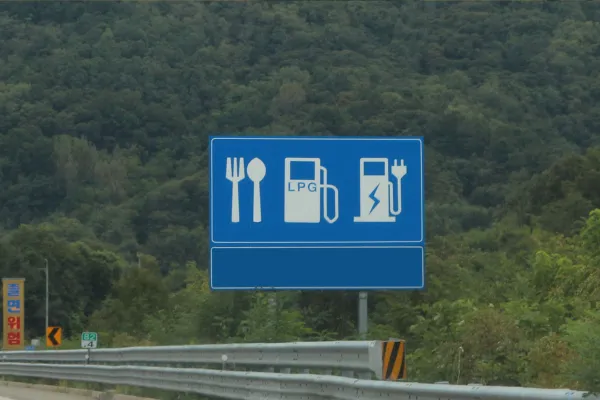
Gas Stations Position Themselves for EV Growth through Clean Energy Hub Partnerships
By Keith Reynolds | Publisher & Editor, ChargedUp!
For decades, the fuel retail playbook has been simple: maximize throughput, keep dwell time short, and win on location. EV fast charging flips that logic. Charging sessions are long enough to turn a quick stop into a mini visit, and the sites that win will feel less like yesterday’s gas station and more like a small-format mobility center, offering power, food, bathrooms, lighting, and connectivity engineered as one product.
The new template: charge where you already stop
A growing share of DC fast charging is landing at travel centers, convenience stores, and fuel-adjacent retail—not because gas stations are nostalgic, but because they already have the fundamentals EV drivers value, including roadside visibility, 24/7 access, restrooms, and a proven operating model for high turnover. Canary Media’s reporting captures the shift: major travel retailers are teaming up with charging networks to add fast chargers alongside pumps, effectively treating charging as the next era of forecourt infrastructure.
Wired makes a similar point with a policy and market lens. As public money and private capital flow back into charging, fuel retailers are well-positioned to capture it, especially where programs reward sites that are easy to access, reliably open, and close to amenities.
Partnerships do the heavy lifting
These trends extend beyond gas stations adding chargers. It’s gas stations and EV charging suppliers partnering, because EV charging is as much software, uptime, and operations as it is cabinets and conduit.
Pilot, GM and EVgo have scaled a nationwide buildout at Pilot and Flying J locations, pushing EV charging into the mainstream travel-center footprint with hundreds of fast-charging sites.
Love’s Travel Stops and Electrify America demonstrate another example based on the same logic: a large travel-stop footprint paired with a dedicated charging operator to accelerate deployment.
Sheetz has gone a step further by investing in an owned charging experience (Think “Rechargery”-style hubs) and modern EV charging management, signaling that some retailers want charging to be a first-party product, not just a hosted amenity.
These deals demonstrate that partnerships are becoming increasingly portfolio-driven rather than one-off leases. Property owners who control multiple sites (or a regional footprint) have leverage extending to branding, data rights, revenue share, and expansion clauses become negotiable.
Why it matters for nearby retail and mixed-use site
This concept of charging where you already stop reshapes demand patterns in subtle ways:
It pulls discretionary spend toward the charger host. Industry voices in convenience retail increasingly frame EV charging as monetizing dwell time rather than “selling electrons.” That framing puts pressure on nearby QSRs and small retail that used to capture that impulse spend.
It changes who shows up, and for how long. Large-scale academic studies found EV charging station installations can shift customer patterns, including where they come from and how long they stay. These finding reinforce that EV charging stations can drive economic activity beyond just taking up physical space.
It forces amenities to modernize. NACS findings suggest that session counts and amenities (bathrooms are a recurring theme) can be more important to retail outcomes than charger nameplates alone.
Consumer Reports makes the land-use argument even more directly. They claim that retail parking lot charging works best when the charging session aligns with the site’s natural dwell time, meaning grocery, big box, and travel retail sites will keep outcompeting locations that don’t offer these features.
Clean energy hubs: An idea is broader than electricity
The phrase, “clean energy hub” is rising in familiarity because some forecourts are exploring more than electrons, including renewable fuels for heavy transport, onsite storage, and eventually, microgrid-like resilience. That’s where the ecosystem gets interesting and can facilitate sponsorships without the hype.
Digital layers like roaming and Plug & Charge aim to make multi-network access feel seamless, which is critical if a forecourt wants to host multiple charger brands or support fleets and public drivers with less friction.
On the liquid side, companies like Byogy are pitching low-carbon, “drop-in” fuel pathways for segments that won’t electrify quickly, such as aviation, shipping, and heavy duty trucking). These trends reinforce why many fuel retailers see a multi-energy future rather than a pure-electrons future.
Takeaways for owners and CPOs to watch next
Site geometry matters: Pull-through stalls, canopy coverage, lighting, and safe circulation are now competitive advantages, especially at travel centers.
Winners will bundle operations: Uptime, remote monitoring, pricing clarity, and customer support matter as much as location. Partnerships are often a way to buy those capabilities quickly.
Older assets will feel the squeeze: If your center’s amenity stack is weak in terms of restrooms, food, safety, or convenience, a modern charging hub two to three exits away can siphon both EV traffic and incremental retail dollars.
If you’re underwriting EV charging at a fuel-adjacent property, the core question is no longer, “Can we install chargers?” Rather, it’s, “Can we provide a modern charging experience better than the site down the road?”
