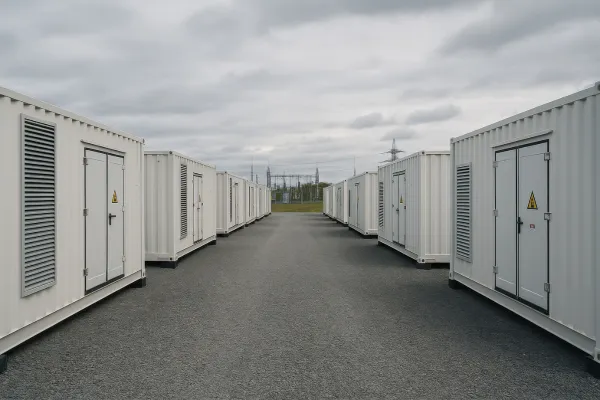
Santa Cruz Tightens the Rules on Battery Storage. Every CRE Battery Project Should Pay Attention.
Santa Cruz County is moving toward a new playbook for regulating large battery energy storage projects, and the message for commercial real estate is bigger than one coastal market: permitting is no longer just about land use and interconnection — it’s about trust, liability and proof of safety.
County staff released an updated draft ordinance this month that adds tougher requirements for environmental monitoring, emergency planning, runoff containment, and financial assurance, including liability insurance that explicitly covers thermal runaway events and decommissioning bonds.
The ordinance is aimed at public utility-scale battery facilities (defined in the county’s draft as systems capable of storing 200 megawatt-hours or more) and focuses on siting near existing substations in unincorporated areas. But the direction of travel still matters for owners and developers planning behind-the-meter batteries, microgrids, and EV charging hubs: even if your project is smaller, local reviewers and insurers are increasingly asking the same kinds of questions.
What Santa Cruz is proposing
Santa Cruz’s proposed “Energy Storage System Combining District” is designed to keep local control over where big battery projects go, and what they must do to earn approval. County leaders began drafting rules after a developer submitted plans for a large battery project, and county officials have explicitly framed the ordinance as a way to avoid ceding approvals entirely to a state process.
The updated draft includes several requirements that are easy to translate into CRE terms:
1) Bigger setbacks, especially from sensitive uses.
The draft sets minimum distances such as 300 feet from “sensitive receptors” and 1,000 feet from facilities like hospitals, schools and certain care facilities, plus other setback rules from roadways and property lines.
2) Show the safety case, not just the spec sheet.
Applicants may have to submit risk analysis and modeling related to thermal runaway, including plume modeling and other technical documentation, plus coordination with local fire districts before filing.
3) Make monitoring a condition of doing business.
The draft calls for annual testing of air, surface water, groundwater and soil compared with baseline measurements, plus a perimeter PM 2.5 sensor network and nearby meteorological monitoring.
4) Emphasize containment planning.
One of the most consequential provisions is a requirement for an engineered catchment system capable of collecting and retaining runoff from firefighting or failures so materials do not leave the site.
5) Make financial assurance explicit, and tie it to worst-case scenarios.
The draft requires a “financial assurances plan,” including liability insurance covering thermal runaway and environmental damages, plus decommissioning bonds and indemnification commitments, and it details requirements for decommissioning financial assurance (bond/guarantee/letter of credit) sized to estimated costs.
6) Expect chemistry choices to become a permitting issue.
In a notable provision, the draft says energy storage systems shall not utilize nickel manganese cobalt (NMC) chemistry. That’s a big deal: it’s a local government attempting to use zoning to steer technology choices, not just locations.
Why CRE should care, even if this ordinance targets utility-scale sites
Most commercial and multifamily battery systems are nowhere near 200 MWh. But the questions Santa Cruz is embedding into law are the same ones that increasingly show up in real projects — often late, when teams are trying to close financing or pull permits.
For CRE owners, the risk is not that your 500 kWh or 2 MWh project suddenly needs a PM 2.5 perimeter network. Rather, the risks are more practical:
Local officials become more cautious after seeing stricter ordinances elsewhere.
Fire marshals expect clearer documentation (sometimes referencing national standards).
Insurers and lenders ask “what happens if something goes wrong?” and want answers in writing.
Santa Cruz’s draft pulls heavily from the broader safety ecosystem: it references widely used standards like NFPA 855 and expects projects to meet or exceed state and fire code requirements. Further, it reflects how safety documentation is becoming normalized through tools like UL 9540A, a test method used to evaluate thermal runaway behavior in battery systems.
This is the same pattern researchers and regulators have been tracking nationally: local zoning and permitting for storage is becoming more detailed, more standardized — and more influenced by fire-safety and emergency-response planning.
The real estate takeaway: storage is moving from “equipment” to “infrastructure”
Commercial batteries used to be treated like an add-on: a capex item, a line in a sustainability plan, maybe a resilience perk. The Santa Cruz approach treats big storage facilities like infrastructure that needs ongoing monitoring, clear emergency protocols, proof of safe siting, and a plan (and money) to clean up and decommission.
That’s not an anti-storage stance. Santa Cruz’s own county materials argue a local ordinance is intended to support clean energy goals and grid reliability, just with local oversight and accountability.
For CRE portfolios, the implication is straightforward: battery projects that are easiest to underwrite will be easiest to permit, so focus on safety documentation, clear operational controls, and credible lifecycle plans.
What owners and developers should do differently now
If you’re planning behind-the-meter storage for EV charging, demand-charge management, or microgrid resilience, Santa Cruz is a useful preview of the questions you’ll want to get ahead of:
Bring the fire district in early and document the meeting. (Santa Cruz’s draft makes this an application requirement for its targeted projects.)
Treat decommissioning as real. Outline removal, recycling, and site restoration — and price it.
Build the insurance story early. If your insurer can’t get comfortable, your permits and financing are at risk even if the project works on paper.
Assume monitoring and reporting will expand over time. Design your operating plan accordingly.
Conclusion
Santa Cruz County isn’t just writing rules for utility-scale batteries. It’s helping define a broader reality: Public trust is becoming part of project scope. For real estate, that’s not a reason to back away from storage, but to build storage projects that are financeable, insurable, and easy for communities to approve.
Sources and Further Reading
Lookout Santa Cruz (Jan. 7, 2026): https://lookout.co/latest-version-of-countys-proposed-battery-storage-rules-include-water-soil-monitoring-insurance-bonds-for-developers/story
Santa Cruz County BESS Ordinance Hub: https://cdi.santacruzcountyca.gov/UPC/GetInvolved/MajorProjectApplications/BatteryEnergyStorageSystemsOrdinance.aspx
Santa Cruz County BESS FAQs: https://cdi.santacruzcountyca.gov/UPC/GetInvolved/MajorProjectApplications/BatteryEnergyStorageSystemsOrdinance/BESSFAQs.aspx
Board of Supervisors Approved Draft: https://cdi.santacruzcountyca.gov/Portals/35/CDI/UnifiedPermitCenter/BESS%20Ordinance%20Page/Files/BOS%20Approved%20Draft%20ESCD%20GP-Code%20Amendments%201-16-26.pdf
Santa Cruz Local (Jan. 14, 2026): https://santacruzlocal.org/2026/01/14/county-supervisors-greenlight-draft-rules-for-battery-energy-storage-facilities/
Local News Matters / Bay City News (Jan. 7, 2026): https://localnewsmatters.org/2026/01/07/santa-cruz-county-releases-updated-draft-battery-storage-ordinance-for-public-review/
NFPA 855 Overview: https://www.nfpa.org/codes-and-standards/nfpa-855-standard-development/855
UL 9540A Explainer: https://www.ul.com/services/ul-9540a-test-method
Sandia (Local Zoning/Permitting Context, PDF): https://www.sandia.gov/app/uploads/sites/82/2023/10/PR2023_1003_Powell_Devyn_Regulatory-Environment.pdf
