
Bizport is a software service and support business that assists clients of all sizes and industries with leading and modular technology.
Revolutionising Risk Mitigation with Innovative Modular Solutions

At the time of issuing this newsletter, our thoughts and heart felt wishes go to those who are in the path of Cyclone Alfred.
The BizPort team are assisting in any way they can. we hope that no one is injured or worse. To all affected by the Cyclone please take care of your family and yourselves as your lives are the most important thing anyone can care for.
Peter Kinnaird
CPBA, CEO, Bizport Services
February 2025 Newsletter
01
New Sexual Harassment Laws
Sexual Harassment and Sex or Gender - based Harassment in the
Workplace Prevention Requirements Plan
02
E-bike and E-scooter Battery - Workplace Risks
Is a Real Worker Safety Issue
03
Employer Ordered to Reinstate Employee
Dismissed for Breach of Drugs and Alcohol Policy
04
Employers Cop $13.3 Million Dollars
In Fines for Safety Breaches in 2024
05
$425,000 Fine For a Safety Offence
Training Failure
06
The NSW State Government is Going to Establish SafeWork NSW as a Standalone Regulator
07
Mental Health Minefield:
Are You Protecting Your Most Valuable Asset?
08
How to Add Bizport Portal as an App on Mobile
A Safer Way Than A Downloaded App
01
What Your Business Needs to Know Now
From 1 March 2025 all businesses are required to prepare (and follow)
a sexual harassment and sex or gender-based harassment prevention plan.
A brief summary is, the plan must:
be in writing (i.e. just saying you have a plan will not suffice);
set out each identified risk;
identify the control measures implemented to manage each identified risk;
identify the matters considered by the employer (i.e. you or your business) in determining the control measures;
describe the consultation process undertaken (under the WHS Act you must consult with workers and other parties as part of the development of this plan);
set out a procedure for dealing with reports of sexual harassment or sex or gender-based harassment at work; and
be set out and expressed in a way that is readily accessible and understandable to workers.

Furthermore, employers must ensure that they implement the plan, ensure workers are aware of the plan and how it can be accessed,
and review the plan at least every three years, or as otherwise required by law.
If you fail to prepare, properly document or implement the plan, your business may be fined.
BizPort Services have prepared both a Policy and a Template plan version, that will be placed in your Policies Folder – please read, complete & implement with your workers as soon as possible.
Naturally some businesses may require variations or if you find you need assistance understanding, completing or implementing, please call us on 1300 859 363 ask for Estelle or call your dedicated Advisor.

The Cost of Non-Compliance
Businesses that fail to implement or review their prevention plans face:
Each state's safe work will be inspecting all businesses to ensure this is all correctly in place- if not:
Potential on-the-spot fines
Improvement notices
Prohibition notices
02
Is a Real Worker Safety Issue Both at Work and at Home
Lithium-ion batteries are amongst the fastest growing fire risks.
Sadly, there is a high injury, including severe burns rate,
with several deaths having occurred.
A significant number of these injuries and possibly deaths have related to the use of e-bikes for workplace purposes.
It is important for all business owners / managers and workers to understand
the risks and be prepared if things go wrong.
Things you need to know
If a workers uses an e-bike outside of workplace premises for work related tasks, both the business owners and managers ARE responsible for the worker to have a correct, safe location and power supply to use in the worker's home or remote location.

Prepare at Home
Make sure a smoke alarm or heat alarm is working in rooms
where it is charged or stored.Make sure that there's nothing around it that could catch on fire.
Don't charge in or near living-spaces like bedrooms or living rooms.
Charge in an open area like a garage or shed, away from exits.
Only charge on hard surfaces that can't catch on fire like concrete floors or tiles.
When to Charge
Do not charge batteries when sleeping or not at home.
Remember, you can't smell smoke when you're asleep.
Once the battery is full, disconnect it from the charger.
Don't use and charge batteries that are swelling or bulging,
leaking, or overheating.
Charging
If the charger didn't come with the device or battery, don't use it.
Only use approved chargers to charge your battery.Only use chargers that show the Australian Regulatory Compliance Mark Tick.
Just because the plug fits, it doesn't mean it's compatible.
Charging a device or battery with the wrong power output (voltage and current), can cause damage to the battery and overheat it which can cause a fire.

Warning Signs
Batteries that show any signs of damage MUST be disposed of immediately and carefully as they carry the risk of becoming involved in a fire.
Damaged batteries and battery-powered devices include:
Batteries that show signs of swelling or bulging, leaking, cracks, dents, punctures, or crushing
Overheated batteries that may have vapours or smoke
Batteries that have gotten wet or have been in water
Batteries that have been in or exposed to fire.
Next Step
Damaged batteries should be kept outside in a well-ventilated area.
Store at least 3 metres from any structures and/or combustible materials.Never use or charge a damaged battery.
Never throw them in your regular home waste or recycling bins.
Never take damaged batteries to battery recycling collection points or sites.
Small batteries or devices can be placed in a plastic container of water to cool and prevent further ignitions.
Place leaking or damaged (but not overheated or off-gassing) batteries in a clear plastic bag or container
and take them to a Community Recycling Centre or a Household Chemical CleanOut event for disposal.
Battery repairs, servicing and installations should always be carried out by qualified professionals.
If a Worker uses or has an e-bike at workplace premises
Regardless of if the e-bike is used for work related purposes or it is a mode of transport for the worker to come to or go from work.
The Management MUST make sure of:
There is a clear and designated space for e-bikes to be parked – away from buildings, flammable materials, vehicles, workspaces.
Make sure there is nothing around the designated space that could catch on fire.
Only allow battery charging in an open area or if weather doesn’t allow open area charging then in an empty non-used space that has ventilation and preferably more than one exit, such as a shed.
Charging only to occur on non-flammable hard surfaces like concrete floors (note bitumen surfaces are not considered non-flammable).
Chargers should be tested and verified as safe to use on a monthly basis.
DO NOT allow e-bikes to be stored or parked when not in use inside any part of the workplace premises where employees are working.
03
04
05
In Training Failure
18 November 2024, a responsible agency for The State of Queensland, was sentenced in the Caboolture Magistrates Court for breaching section 32 of the Work Health and Safety Act 2011 (‘the Act’),
having failed to comply with its primary health and safety duty.

The case followed an incident that occurred to a worker employed by the responsible agency. One of the activities workers may be required to engage in as part of their employment is the placement of a tyre deflation device (“TDD”) across a roadway in order to safely conclude vehicle pursuits or to immobilise a vehicle. In doing so, workers are required to position themselves close to the expected path of the target vehicle, which is often travelling at high speed. It is a plainly hazardous activity which poses a high risk of injury, including fatal injury.
By section 19(1) of the WHS Act, the agency owed a primary duty of care to its workers to ensure their health and safety, so far as is reasonably practicable. It was therefore obliged to ensure workers received adequate training in the deployment of TDDs.
The agency failed to comply with this duty. That failure exposed the worker involved in the incident to a risk of death or serious injury. On 26 June 2021, the worker died in the course of deploying a TDD.
In their 10 years of employment, the worker completed only around five hours of training in the use of TDDs. That training was primarily theoretical and lacked the cognitive demands of a ‘real-world’ context, thereby not adequately preparing workers for a dynamic operational situation. By the time of their death, the inadequacies in relation to their TDD training had existed for almost 10 years. The inadequacies persisted despite the defendant being notified of multiple incidents of TDD-related injuries during that time.
His Honour held that it was incumbent on the defendant to provide adequate training to minimise the risk so far as reasonably practicable, and that the offence had occurred over a protracted period, there was inadequate training as well as processes & systems in place to ensure the training was to be conducted on a regular basis.
06
The establishment of SafeWork NSW as a standalone regulator reflects the NSW Government’s commitment to preventing workplace deaths, injuries and illnesses.
The SafeWork Commissioner will lead the agency with clear authority to enforce compliance meaningfully with workers, unions and businesses across all industries in NSW.

Minister for Work Health and Safety Sophie Cotsis said: “Every worker has the right to go home safely at the end of the day. By creating SafeWork NSW as a standalone agency, the NSW Government is strengthening our ability to enforce WHS laws, & businesses to meet their obligations and drive cultural change to prevent workplace harm."
The standalone regulator is to commence 1st July 2025 with a much larger & more onsite stringent inspection force looking for both physical risks and non- administrative compliance.
07
08
A Safer Way Than A Downloaded App
Video Tutorial
You can watch this video on how to add the Bizport Portal as an app on your mobile or follow the step-by-step instructions below.
Step 1: Open Bizport Portal in Your Mobile
You can scan the QR code shown or use the link:
https://www.app.bizportservices.com.au


Step 2: Click Share Button
On your mobile screen,
click on the Share button.
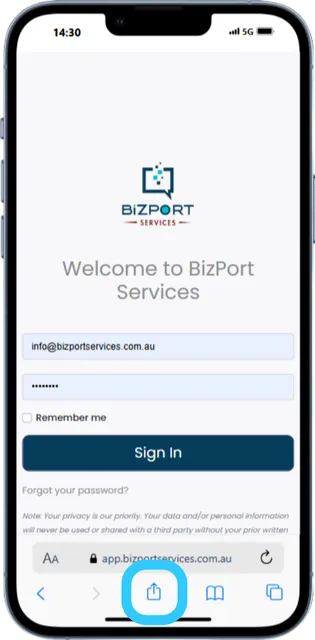
Step 2: Using Chrome
If you are using Google Chrome,
the share button will be on the
right side of your screen.

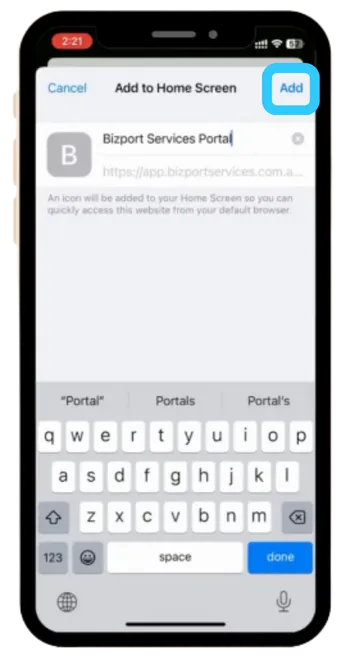
Step 3: Add to Home Screen
After clicking the Share Screen button, scroll to the bottom of the screen and select Add to Home Screen option.

Step 3: Add to Home Screen
Add a suitable name for the shortcut,
and hit the Add button.
Step 4: Bizport App Icon
You will see a Bizport App icon on your mobile home screen.
You can click this to open your portal.


Useful Links
Risk Mitigation
Solutions
Interesting Stuff
About Us
Follow Us
YouTube
Copyright 2025. All Rights Reserved. Bizport Services