Core Exercises for Kids — Fun, Safe Routines in San Francisco
If you’re searching for practical, fun, and safe core exercises for kids, you’re in the right place. This guide is designed for parents, coaches, and caregivers in San Francisco who want short, doable routines that build strength, balance, and confidence — without making children feel like they’re in bootcamp. Think of these exercises as the secret sauce that helps kids climb the jungle gym, sit straighter in class, and move with more ease during sports.
You’ll get age-specific guidance (infants through teens), 12 top exercises with progressions, sample plug-and-play routines, games to keep kids engaged, coaching cues for parents, safety red flags, and local ideas for training in San Francisco.
Why core strength matters for kids
What “core” actually means for children
When we say “core,” we’re not only talking about abs. For children, the core includes the muscles around the trunk — the abdominals (front), obliques (sides), spinal erectors (back), hips and pelvic floor. Together these muscles form a stable central column that supports movement like running, twisting, balancing and even sitting at a desk.
Analogy time: imagine the body is a tent and the core muscles are the tent poles and guy lines. If the poles are weak or crooked, the tent flops in the wind. Strong, stable poles keep the tent upright — same idea for your child’s body.
Benefits: posture, play, and performance
Core strength helps kids in ways you notice every day:
Posture: a stronger core helps children sit and stand taller — less slouching in class, fewer complaints of tired backs.
Play: climbing, jumping, and tumbling become safer and more controlled.
Performance: better balance and coordination transfer to sports — kicking, throwing, changing direction.
Injury prevention: a well-braced midline reduces the risk of overuse injuries, especially in young athletes.
In short: core strength for children is foundational. It’s not just a fitness trend — it’s the engine behind better movement and confidence.
Quick safety rules and age guidelines
Before you start, a few rules to keep things safe and fun:
1.Make it playful. If it feels like punishment, stop. Kids respond to games.
2.Focus on form, not duration. Short, high-quality reps beat long sloppy holds.
3. Avoid heavy load for young kids. No weighted sit-ups or heavy resistance for toddlers. Bodyweight first.
4.Watch breathing. If a child holds their breath consistently, simplify the movement.
5. Pain = stop. If a child complains of sharp pain, stop and reassess.
Below are age-specific guidelines to help you choose appropriate moves.
Infants & toddlers: tummy time basics
For infants, core work equals tummy time — supervised moments on the belly that build neck, shoulder, and trunk control. Start with short sessions (1–3 minutes) several times a day, gradually increasing as the baby tolerates it. For toddlers, crawling, rolling, and supported sitting games are the perfect progression. No structured planks yet — just movement.
Preschool (3–6): playful, bodyweight-first
At preschool age, children benefit most from play-based movement: animal walks (bear, crab), climbing, hopping, and short balance games. Keep things under 10 minutes and make it part of daily play. Use imaginative cues (“be a tall giraffe”, “crawl like a treasure-hunting bear”) to maintain engagement.
School-age (7–11): structured progressions
Around 7–11 years old, kids can handle more structured bodyweight work: planks, dead bugs, bridges, and simple progressions. Short sets (30–60 seconds or 6–12 reps) with rest, 2–3 times per week are appropriate—plus daily active play. Monitor technique and keep sessions playful.
Teens (12+): introduce control before load
Teens can start adding more challenging core work and, when ready, light resistance. The rule of thumb: master control (form, range, breathing) before adding weight. Supervision and coaching cues help prevent form breakdown — especially important for athletes ramping up training.

12 Best Core Exercises for Kids
Below are 12 kid-friendly core exercises — simple descriptions, coaching cues, and quick progressions/regressions so you can adapt them at home or in the park in San Francisco. Use these as building blocks for routines.
Tummy Time / Baby Superman
What: For infants — laid-on-belly lifts of head/chest; for slightly older kids, a gentle “Superman” lifting chest and legs.
Why: Builds neck, shoulder, and posterior chain strength.
Cue: “Look at the toy — lift your chest like a little airplane.”
Progression: Increase tummy time duration; older kids hold a 2–3 second Superman.
Regression: Use rolled towel under chest for support.
Bear Crawl
What: Hands and feet on floor, hips high, crawl forward/backwards.
Why: Full-body core engagement, shoulder stability, hip control.
Cue: “Be a slow bear on a treasure hunt — quick small steps.”
Progression: Increase distance or add time; make it a race.
Regression: Reduce duration, slow pace.
Forearm Plank & Knee Plank
What: Body in a straight line supported on forearms (or knees).
Why: Teaches anti-extension control; trains the whole trunk.
Cue: “Make a straight board from shoulders to toes. Don’t sag!”
Progression: From knees → full toes → alternate leg lifts.
Regression: Incline plank on table or wall.
Side Plank (knee → full)
What: Side support on forearm and knee (or feet) with hips stacked.
Why: Targets obliques and lateral stability.
Cue: “Stack your hips up like pancakes.”
Progression: Knee side plank → full side plank → reach top arm up.
Regression: Shorter holds or hip on ground.
Bird Dog
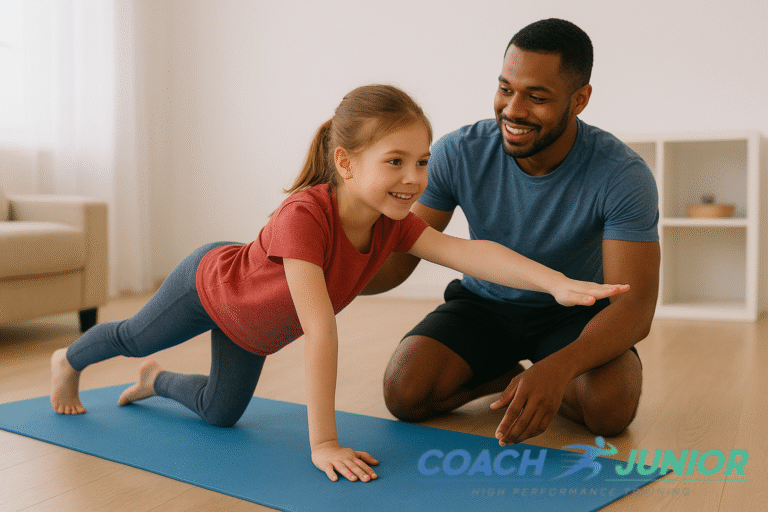
What: From hands and knees, reach opposite arm and leg straight, hold briefly.
Why: Cross-body stability and spinal control.
Cue: “Reach long — like a plane wing and a tail.”
Progression: Hold longer, add light ankle tap.
Regression: Only extend arm or leg, not both.
Dead Bug
What: Lie on back, knees bent 90°, lower one arm+opposite leg slowly while keeping the low back on the floor.
Why: Anti-extension control; pelvic stability.
Cue: “Glue your back to the floor and move slowly.”
Progression: Increase range of motion.
Regression: Reduce leg lowering depth.
Glute Bridge
What: Lie on back, knees bent; lift hips to make a straight line from knees to shoulders.
Why: Strengthens glutes and posterior chain — core synergy.
Cue: “Push your hips to the sky — squeeze your buns.”
Progression: Single-leg bridge.
Regression: Smaller lift range, hold hands for balance.
Inchworm to Plank
What: Stand, fold forward, walk hands out to plank, hold, then walk hands back up.
Why: Integrates mobility and core control.
Cue: “Walk hands out like a slow inchworm — keep your belly tight.”
Progression: Add a push-up at plank.
Regression: Walk to knees rather than full plank.
Slow Mountain Climbers / Bicycle
What: From plank, bring knee to chest slowly; or lie and bicycle legs slowly.
Why: Dynamic core with hip flexor control and coordination.
Cue: “Drive your knee to your chest — steady and controlled.”
Progression: Increase tempo for cardio; keep slow for control.
Regression: Perform while seated or lying with small range.
Hollow/Tuck Hold (beginner progressions)
What: Lying on back, tuck knees to chest and hold (beginner) or extend legs with low back glued (hollow).
Why: Abdominal endurance and anti-extension.
Cue: “Make a little boat with your belly.”
Progression: Move from tuck to hollow with legs lower.
Regression: Keep hands under hips for support.
Farmer Carry / Suitcase Walk
What: Carry a light weight or filled water bottle in one hand and walk short distance.
Why: Trains anti-lateral flexion and grip — functional core stability.
Cue: “Stand tall, don’t lean — walk like a tightrope artist.”
Progression: Increase distance or light weight.
Regression: Use lighter object or both hands.
Functional Play: Crab Walks & Playground Climbs
What: Crab walking, climbing monkey bars, hanging & swinging.
Why: Multi-directional core work in a playful package.
Cue: “Crab race to the finish!”
Progression: Timed circuits, obstacle courses.
Regression: Shorter distances, spotter assistance.

Sample Plug-and-Play Routines (Ages 4–15)
Here are three ready-to-use routines. Use these as a baseline and tweak for your child’s fitness and attention span.
Quick 6-minute routine (ages 4–6)
60s animal walks (30s bear + 30s crab)
30s sit-to-stand game (10 reps)
30s bridge holds (3 × 10s with 5s rest)
60s balance/tightrope (walk heel-to-toe, add arm reach)
60s free play/core game (finish strong with fun)
Designed to be short, energetic, and playful — perfect for small attention spans.
12-minute routine (ages 7–11)
Warm-up (2 min): jog in place, arm circles
Circuit (3 rounds):
40s plank (knees or toes)
8 bird-dogs each side
12 glute bridges
30s side plank (15s each side)
Rest 45–60s between rounds
Cool-down (1–2 min): light stretching, breathing.
20-minute progression (ages 12–15)
Warm-up (4 min): dynamic mobility, light hops
Main (3 rounds):
45s forearm plank → 10s rest
12 single-leg glute bridges (each leg)
12 bicycle crunches
10 lateral bounds (soft landings)
30s farmer carry (light)
Rest 60s between rounds
Finish: 2-minute stretch and quick breathing exercise.
Making core training fun — games and progressions
Core training sticks when it’s fun. Here are ideas to gamify the work.
Obstacle course ideas (perfect for Golden Gate Park or your backyard)
Set up stations: bear crawl under a low rope, plank with a toy on the back, single-leg balance while tossing a beanbag, crab walk between cones. Time kids or have them collect stickers per station. Golden Gate Park, Dolores Park or Alamo Square have sprawling lawns perfect for these mini-courses in San Francisco.
Reward systems and challenges
Try sticker charts, “level up” badges, or family leaderboard boards. Small prizes and praise go a long way. Create micro-challenges: “Hold a plank for 10 seconds? Get a gold sticker!” Keep it motivational, not punitive.
How to teach technique — cues coaches and parents can use
Simple language & visual cues
Kids understand stories and images. Swap technical jargon for vivid cues:
Instead of “brace the core,” say “zip up your superhero belt.”
Instead of “keep a neutral spine,” say “imagine a straight line from your head to your toes.”
Use mirrors or video for older kids to self-correct.
Common faults and easy fixes
Sagging hips in plank: cue “push the floor away” and shorten hold.
Holding breath: coach “breathe like blowing candles, nice and steady.”
Rounded shoulders during bear crawl: cue “reach long with hands and keep chest up.”
Small tactile cues (light tap on hip to remind to tuck) help but always ask permission — kids don’t like unexpected touches.
Safety, red flags, and when to consult a pro
Watch for these red flags: sharp pain, dizziness, persistent soreness that limits play, or any unusual limping. If a child has underlying medical conditions (e.g., recent fractures, growth plate concerns, chronic pain), consult a pediatrician or pediatric physical therapist before starting structured core training.
If progress stalls or pain appears with standard exercises, a pro can provide a tailored assessment and corrective strategies. Don’t hesitate to get help — better safe than sorry.
Localize your workout — doing this in san francisco
Training outdoors or at home in San Francisco is easy and fun. The city’s mild climate and plentiful parks make it ideal for kid workouts year-round.
Best SF parks & spots for kid core sessions
Golden Gate Park: huge grassy areas and playgrounds — perfect for obstacle courses
Dolores Park: lively, central, great for short circuits and people-watching (distraction included!)
Alamo Square: flat lawns and great photo ops — useful for parent-shareable content.
Marina Green: open space with views — ideal for walking carries and long runs.
Local neighborhood parks (Noe Valley, Richmond, Sunset) — smaller, quieter spots for in-home pick-ups or classes.
Pro tip: pack a small kit (band, small ball, cones, sticky mat). Use park benches for step-ups, and monkey bars for safe, supervised hanging drills.
How CoachJunior brings these routines to homes and parks
CoachJunior specializes in turning routines into play-based sessions. A coach can adapt core exercises to the family’s space — whether that’s a tiny apartment near Market Street or a sunny morning at Golden Gate Park. Coaches bring structure, progression, and a stash of playful cues that keep kids engaged, safe, and improving. If you want a personalized plan, ask about trial sessions tailored to your neighborhood in San Francisco.
Tech + tools: videos, printable routines, and tracking
Make the page share-ready: short 30–60s video demos, a printable one-page routine (PDF), and a simple progress tracker work wonders. Record a quick monthly video to show progress — parents love seeing improvement. Use free apps or a simple spreadsheet for tracking plank time, balance holds, and number of reps.
Conclusion
Core exercises for kids are simple, high-impact tools for better posture, safer play, and stronger sport skills. Keep it playful, emphasize control, and scale by age — babies start with tummy time, preschoolers with animal walks, school-age kids with planks and bird dogs, and teens with controlled progressions. Use San Francisco’s parks for variety, and consult local pediatric sports resources (like UCSF) when in doubt. Make it fun, keep it short, and celebrate small wins — that’s how movement becomes habit.
FAQs
How long should a child hold a plank?
Start small — 10–20 seconds for young kids, and build gradually. Quality over time: it’s better to hold a perfect 10s plank than a sloppy 45s one. For older kids, 30–60s is a reasonable target with good form.
Can babies do “core exercises”?
Babies can’t do planks, but tummy time and rolling are their core work. Short, supervised tummy time sessions several times a day are perfect.
How often should kids do core-specific routines?
Aim for 2–3 short focused sessions per week (10–20 minutes) for school-age kids, plus daily active play. Toddlers benefit from frequent short play-based movement throughout the day.
Are sit-ups ok for children?
Traditional sit-ups aren’t ideal as a primary exercise. Focus on functional core moves — planks, dead bugs, bridges — that build stability without spinal flexion strain.
What if my kid hates exercise?
Make it a game. Turn routines into obstacle courses, races, or story-based play. Use rewards, stickers, and short challenges. Try coach-led sessions (CoachJunior or local instructors) to add novelty and social motivation.