Fitness Activities for Kids — San Francisco Coach-Approved
Kids are built to move — like little springs that somehow store energy and demand release. But “moving” doesn’t have to mean drills, timers, or a sweaty hour at the gym. Fitness activities for kids are best when they’re playful, purposeful, and easy to fit into family life — especially in San Francisco, where microclimates, parks, and hilly streets change how families get active.
This guide is coach-forward and parent-friendly: practical routines, age-by-age plans, 12 ready-to-run activities, park picks around San Francisco, safety tips, and sample weekly schedules. If you want to make fitness part of your kid’s day — in short bursts, lots of fun, and without drama — you’re in the right place.
Why movement matters: the big picture
Movement for kids is more than burning calories. It’s the foundation for strong bones, a healthy heart, coordinated muscles, and a brain that’s ready to learn. Regular activity helps kids sleep better, manage stress, and build confidence — all things that make school and home life easier.
Importantly, national guidelines recommend structured and unstructured movement for children. For school-aged kids (roughly 6–17 years), aim for about 60 minutes of moderate-to-vigorous activity each day — a mix of aerobic play, muscle-strengthening, and bone-strengthening activities. This is the big-picture benchmark to keep in mind as you plan daily fun.
Physical benefits (bones, heart, muscles)
Think of activity as a construction crew for a growing body. Short, intense bursts like jumping and sprinting are signals that help bones get stronger. Continuous movement — running, cycling, swimming — improves heart and lung fitness (cardio), while bodyweight play (push-ups, squats, crawls) builds muscle and coordination.
Those benefits stack: stronger bones lower future injury risk, better cardio increases endurance (less whining on long walks), and coordinated muscles reduce trips and tumbles. It’s not about bulging muscles — it’s about functional strength that supports everyday life.
Brain + mood boosts
Want better homework focus and fewer meltdowns? Movement is a secret weapon. Physical activity increases blood flow to the brain, sharpens attention, improves memory, and releases feel-good neurochemicals. Short active breaks (even five minutes) can reset a frustrated child and turn a grumpy evening into a cooperative family game session. So yes — exercise is both a body tune-up and a mood hack.
How much activity do kids really need?
Short answer: aim for about 60 minutes daily for school-aged kids (6–17), with preschoolers active throughout the day and infants getting plenty of supervised movement like tummy time. The 60 minutes can be broken into multiple short bursts (3×20 minutes or 4×15 minutes) — it’s the total movement that counts, not whether it’s one long gym session.
Within that hour, try to include:
Aerobic activity most days (running, games, biking)
Muscle-strengthening (animal crawls, bodyweight circuits) at least 3×/week
Bone-strengthening (jumping, hopping, short sprints) at least 3×/week
This balanced approach builds a resilient child and keeps variety high — which is the secret sauce for consistency.
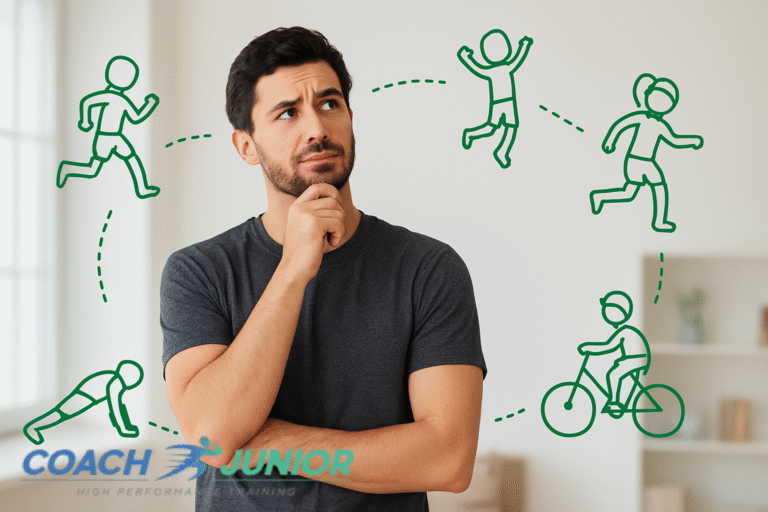
CoachJunior’s Aproach: safe, playful, and personal
If you prefer coaching (so you don’t have to design every session), look for trainers who focus on play-first, age-appropriate progressions and safety. CoachJunior offers tailored youth training programs delivered in-home, outdoors (park sessions), and virtually — designed to meet a family where they are in San Francisco and make movement natural, safe, and fun.
In-home training
In-home sessions bring the coach to your space and your schedule. The coach uses simple equipment (or none at all), reads your child’s cues, and builds short, progressive workouts that blend games and skill practice. In-home is perfect for rainy days, newborn siblings, or busy families who prefer private instruction.
Outdoor / park sessions
San Francisco parks are ideal for mixing play and skill training — long fields for tag or sprints, playgrounds for circuits, and trails for family hikes. Park sessions let kids run, jump, and explore safely under coach supervision while enjoying fresh air and sunlight. The Presidio’s Outpost and Golden Gate Park’s family areas are great examples of parks with kid-friendly space and playgrounds.
Virtual options
Virtual coaching is a great backup: short guided sessions over video, training plans you can follow at home, and weekly check-ins to keep momentum. It’s flexible and keeps the learning loop active even when schedules get tight.
Best fitness activities for kids by age group
We break things down by attention span, motor development, and typical energy patterns. Each block includes a sample 10-minute mini routine you can use today.
Ages 1–3: play-first motor skills
At this stage, focus on exploration and basic motor patterns. Keep things short, sensory-rich, and playful.
Tummy time and rolling races — strengthens core and neck.
Soft obstacle paths — crawl under a blanket, step over pillows.
Push-and-pull toys — introduce controlled force and coordination.
Chase-and-stop games — practice starting/stopping, body control.
Imitation play (animal walks) — bear crawls, crab walks, frog hops are fun and functional.
These activities are about building neural patterns for balance, coordination, and bilateral movement — the foundation for later agility and sport skill.
Ages 4–7: balance, coordination & games
Kids in this group can handle slightly longer sessions and follow simple rules. Introduce targets, games, and tandem play.
Hopscotch & balance lines — balance + sequencing.
Target toss (beanbags into bins) — hand-eye coordination and focus.
Short relays & tag variations — build speed and strategy.
Beginner yoga through storytelling — balance and breath control.
Balloon volleyball — reaction time without heavy impact.
These activities teach spatial awareness, turn-taking, and basic motor skills that transfer to sports later.
Ages 8–12: agility, strength, sport-ready drills
Older kids can do structured circuits, timed drills, and skill stations.
Agility ladder drills — quick feet and coordination.
Timed shuttle runs — speed and pacing.
Bodyweight circuits (push-ups, air squats, planks) — foundational strength.
Sport-skill stations (dribbling, passing, catching) — skill transfer.
Parkour-lite challenges — safe vaults and controlled climbs for spatial confidence.
At this stage, you can introduce light programming principles: progression, measurable goals, and variety to prevent boredom.
Sample 10-minute mini routine for each group
Ages 1–3: 2 min warm-up (marching with music), 4 min obstacle crawl, 2 min animal walk race, 2 min cool-down (song + stretch).
Ages 4–7: 2 min warm-up (jumping jacks), 3 min balance course, 3 min target toss relay, 2 min stretching + praise.
Ages 8–12: 2 min dynamic warm-up, 5 min circuit (40s on / 20s rest: squats, plank hold, hop series), 3 min sprint + cooldown.
12 Fun, high-impact activities parents can run today
Here are 12 go-to activities that are easy to set up and deliver big physical and developmental returns.
Obstacle course
Use cushions, chairs and blankets to build a course: crawl under, hop over, balance across. Time runs for an added game element.
Freeze dance & movement games
Play music; when it stops, kids freeze. Add variations: freeze in a yoga pose, freeze and hold a balance.
Animal walks & playground circuits
Bear crawls, crab walks, frog hops, and playground climbs — combine into short circuits for strength and coordination.
Bike/scooter sessions & relay races
Neighborhood loops or park circuits build endurance and confidence. Relay races add teamwork and intensity.
Simple strength moves (bodyweight)
Air squats, push-up progressions (knees → toes), planks, single-leg stands and box-step-ups are effective and safe.
(Plus five more: balloon volleyball, hopscotch time trials, tug-of-war with rules, partner mirror games, and family scavenger movement hunts — all low-cost and high-fun.)

Park-friendly workouts around San Francisco
Take advantage of local parks to vary scenery, terrain, and equipment.
Top parks & playgrounds for active kids (local picks)
Presidio — Outpost & Tunnel Tops: enormous family playgrounds and meadows perfect for obstacle courses and long sprints. The Presidio has family-specific features that are great for skill-building and exploration.
Golden Gate Park (Koret/Children’s Quarter, Stow Lake): big fields, boating at Stow Lake, and playgrounds for circuits and group games.
Mission Dolores Park — Helen Diller Playground: sunny microclimate, slides, climbing features, and flat lawns for sprint drills and soccer practice.
McLaren Park: trails and a unique Redwood Grove playground; perfect for trail-based games and nature hikes.
Caveat: busy weekend times can make some areas crowded — choose weekday evenings or early mornings for calmer sessions.
How to use park features safely
Scout the playground for age-appropriate features and safe surfaces (no broken equipment).
Use clear start/stop signals for sprint or relay drills (whistle or loud “go!”).
Avoid steep, slick slopes and watch for dog play areas during peak hours.
What to pack and how to adapt
Pack a small kit: jump rope, cones or cups, small ball, chalk, water, a lightweight towel, and layers for San Francisco wind. Adapt drills to the space: cones → cups, ladder drills → tape on the ground, 20m sprints → shuttle runs between benches.
Safety, progress and injury-aware coaching
Safety trumps intensity. Build a child’s fitness by progressing thoughtfully.
Warmups, progressions, and load guidance
Warm-up: 3–5 minutes of light movement — marching, arm circles, leg swings.
Progressions: start with form and range of motion before adding reps or intensity. For example, teach a squat with correct knee alignment before increasing volume.
Loads for young kids: focus on bodyweight, play-based resistance (tug-of-war, climbing). Introduce light resistance only with supervision and proper technique for older kids.
If a child complains of persistent pain (not normal muscle soreness), stop and consult a pediatrician or sports medicine provider.
Screen time swap: making exercise stick
Swap, don’t ban. Replace 30 minutes of screen time with 20 minutes of active play + 10 minutes of calm (reading or snack). Make it a family rule: “After screen-time ends, we move.” Use reward charts and let kids choose activities to increase buy-in.
How to structure a weekly plan (sample schedules)
Structure beats randomness. Here are two realistic patterns.
Busy-week quick plan
Goal: 60 minutes/day, broken into short bursts.
Mon–Fri: Morning 10-min active warm-up (family), school/recess movement 20 min, after-school 30 min (tag, jump rope, or quick sport skills).
Wed / Fri: Strength play mini-circuit (2× per week).
Daily: 5-minute bedtime stretch for calm.
Weekend family-fitness plan
Saturday: Park session (Presidio / Golden Gate Park) — 45–60 minutes of mixed play + picnic.
Sunday: Active recovery — easy family hike or bike for 30–60 minutes and a fun dance session at home.
These plans are flexible — swap days based on weather and naps.

Equipment that actually helps (low-cost)
You don’t need fancy gear. Helpful, cheap items:
Jump rope ($5–$15)
Small cones or plastic cups for markers
Chalk for hopscotch / balance lines
Lightweight playground ball or soccer ball
Resistance bands (light, for older kids)
Printable activity cards or a laminated 7-day chart (lead magnet idea)
A small “movement bag” lives in the trunk — ready for spontaneous park sessions.
Measuring progress (fun, not obsessive)
Avoid scale anxiety. Track wins that matter:
Can your kid do more reps or longer planks than last month?
Have they learned a new skill (ride a bike, do 10 jump-rope skips)?
Mood and sleep improvements — noteable changes in focus at school?
A progress sticker chart or a short weekly video can show growth and feel motivating.
Celebrate effort, not perfection.
How CoachJunior helps San Francisco families
CoachJunior delivers coach-led youth training across San Francisco — in-home, in nearby parks, and virtually — with safe progressions, age-specific plans, and a play-first approach that builds habit and joy. If you want a trainer who knows local parks (Presidio, Golden Gate Park, Mission Dolores, McLaren) and how to adjust sessions for SF weather and family schedules, CoachJunior does exactly that..
Whether you want a 4-week skill-building plan, weekly in-home maintenance, or a family fitness day mapped out for a weekend at the park, a coach can remove guesswork and make results consistent.
Conclusion
Fitness activities for kids are most successful when they’re fun, flexible, and integrated into family life. You don’t need perfect equipment or an hour-long commitment — just variety, short bursts, and a coach-approved progression. In San Francisco, the city’s parks and neighborhood playgrounds make it easy to get outdoors and keep activity interesting.
Start small: pick one 10-minute mini routine from this guide and commit to it three times this week. If you want a ready-made 7-day plan or a printable activity card deck, CoachJunior can create a tailored, local plan and bring the sessions to your home, park, or screens.
FAQs
How many minutes of activity does my 7-year-old need each day?
Aim for about 60 minutes of moderate-to-vigorous activity daily, split into short bursts if needed. Include muscle- and bone-strengthening activities at least 3× weekly.
What’s the easiest way to get kids moving when it’s foggy or rainy in San Francisco?
In-home mini-circuits, freeze-dance, obstacle courses using cushions, and short online guided sessions work well. Virtual coaching or in-home sessions are perfect backups.
Is strength training safe for kids?
Yes, when it’s age-appropriate, technique-first, and supervised. Focus on bodyweight exercises and play-based resistance for younger kids; add light resistance only under coach supervision for older kids.
Where are the best local parks for kids in San Francisco?
The Presidio (Outpost / Tunnel Tops), Golden Gate Park (Children’s Quarter / Stow Lake), Mission Dolores Park (Helen Diller Playground), and McLaren Park are excellent local picks for active kids.
How can CoachJunior help my family get started?
CoachJunior offers tailored youth training in-home, in nearby parks, and virtually — with programs built around your child’s age, goals, and San Francisco schedule to make movement consistent, safe, and fun.