The Risk with Property Management Transitions
Changing property managers is supposed to feel like progress.
In reality, it’s one of the most overwhelming operational moments a board will ever go through.
Not because the new management firm isn’t capable.
They do transitions all the time.
They know their process.
The real risk is something else.
It’s that you, as a board, are expected to trust a single process you can’t see — during the one moment where your building is most exposed to losing critical information.
The Hidden Chaos of a “Normal” Transition
A property management transition in NYC involves hundreds of moving parts.
Documents. Systems. Vendors. Access. People. History.
And here’s what most boards don’t realize:
For the first 30 days, the old manager is still running the building.
The new manager is primarily setting up banking, accounting systems, portals, and internal workflows so they can take over.
So during this period, two firms are involved, but no one truly owns the full picture.
That’s exactly where things start slipping.
A Reality Most Boards Forget About
It’s also worth remembering that full digitization is relatively new in property management.
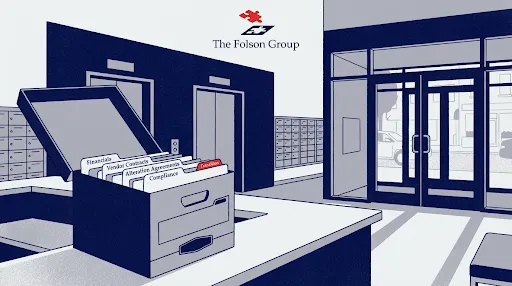
For decades, management firms stored records in:
Manila folders.
Filing cabinets.
Offices.
Basements.
Storage units.
If those records are anything like the corporate offices that we worked at in the 1990s, how well they are organized is questionable.
Which means a lot of your building’s most important history may still live in physical boxes that need to be identified, located, labeled, and physically handed over.
If no one explicitly manages that process, those boxes don’t magically move.
There’s a risk that all or some of them just quietly stay behind.
1. Documents That Slowly Disappear
Not in a dramatic way.
In a quiet, dangerous way.
Some are sent.
Some are incomplete.
Some are in the wrong format.
Some are buried in email threads no one revisits.
Governing documents.
Alteration agreements.
Engineering reports.
Compliance filings.
And some may still be sitting in a storage unit no one has checked in years.
Everyone assumes they’ll surface eventually.
But to “assume” is not a system.
2. Financial Records That Don’t Line Up
This is where boards feel the pain first.
Opening balances don’t reconcile.
Reserves look different depending on the report.
Payables exist with no backup.
Receivables are carried over with no explanation.
The new manager is building fresh systems.
The old manager is closing out old ones.
And the board is expected to bridge two financial realities without a clean audit trail.
3. Vendor Contracts in Limbo
Some contracts are transferred.
Some are missing.
Some are expired but still being billed.
Some auto-renew without anyone realizing.
Elevator.
Boiler.
Security.
Fire alarm.
Cleaning.
You’re paying real money for services you may not even be legally bound to (or even receiving) anymore.
4. Keys, Access, and Physical Control
Master keys.
Fobs.
Door codes.
Mechanical rooms.
Roof access.
Access is operational power.
If it’s not tracked, documented, and verified, your building is exposed — even if nothing bad happens.
And most of the time, no one can say with certainty who has what.
5. The Most Dangerous Loss: Historical Knowledge
Why that contractor was fired.
Why that project stalled.
Why that system was chosen.
Why that resident is a risk.
That knowledge doesn’t live in files.
It lives in people.
When management changes, context leaves with them.
And once it’s gone, it’s almost impossible to recreate.
Here’s a real example we see more often than boards realize:
One of our clients replaced the windows throughout their building about fifteen years ago.
The board later changed management firms.
The current manager has no records of the window replacement.
The only proof the board had was an old email chain.
We tracked down the architect and the installer.
The architect no longer keeps records that old.
The installer had no records of this window project.
So a major capital project — worth hundreds of thousands of dollars — now effectively exists only in memory and emails. The windows themselves may still be under warranty, and we’ll never know.
From a legal, insurance, and planning standpoint, that’s a nightmare.
6. The 90-Day Learning Curve Everyone Accepts
Every new management firm needs time to learn your building.
That’s normal.
And expected.
But during those 60 to 90 days:
Decisions still happen.
Money still moves.
Vendors still operate.
Compliance deadlines still exist.
So your building is functioning at full speed — while the people running it are still assembling the puzzle.
7. The Blame Loop Boards Get Stuck In
Old manager: “We sent everything.”
New manager: “We never received that.”
Board: has no independent way to verify either.
So issues don’t get solved.
They just get labeled as “transition problems.”
And transition problems have a way of becoming permanent ones.
The Real Risk Isn’t Your New Manager
Your new property manager is doing what they’re supposed to do.
They have their internal checklists.
Their systems.
Their process.
The real risk is that the board only has one point of view on the entire transition.
You’re relying on the same firm that is receiving the information to also be the one confirming that everything was received, correctly, completely, and in the right order of importance.
That’s not negligence.
It’s just not independent oversight with a third-party transition checklist.
Why the First 30 Days Matter More Than You Think
This is the most misunderstood phase.
Old management is still handling day-to-day operations.
New management is focused on:
Banking setup.
Accounting systems.
Portals.
Vendor onboarding.
Internal workflows.
Which means the actual transfer of institutional knowledge, records, and history is happening in the background — quietly, informally, and without a single owner.
That’s where most losses occur.
Not because anyone failed.
But because no one was solely responsible for protecting the board’s institutional memory.
At The Folson Group, we stay involved through the entire transition to ensure nothing falls through the cracks.
We act as a second set of eyes and ears on the ground — independent from both management firms — making sure records are received, verified, prioritized, and transferred within the right timeframes to support a smooth and successful handoff.
Not to replace your new manager.
But to protect you during the most vulnerable moment in your building’s operations.
Because once information is lost in a transition, it’s rarely recovered.
And boards usually only realize what’s missing when they need it most.


