
ADHD, Autism, Eczema, and Unexplained Behaviour: Why Food Is Always Worth Investigating
When a child is diagnosed with ADHD, autism, or eczema — or when a parent is struggling with unexplained behaviour changes they just can’t make sense of — food is rarely the first thing that gets investigated.
Medication, therapy, behavioural strategies, specialist referrals — these are the standard pathways. Diet sits somewhere further down the list, often dismissed or mentioned only briefly.
But a growing body of research suggests that for a significant proportion of affected children, what they eat every day is quietly influencing the severity of their symptoms. Not causing the condition. But contributing to it in ways that are measurable, that respond to dietary change, and that parents deserve to know about.
ADHD and Artificial Food Colours
The link between artificial food colours and ADHD symptoms is one of the most studied dietary connections in paediatric health.
Multiple rigorous meta-analyses — including the body of work by L. Eugene Arnold and colleagues at Ohio State University — have found that artificial food colours produce a small but statistically significant increase in hyperactivity in children. The effect is present across the general child population but is notably stronger in children already diagnosed with ADHD and in those with particular sensitivities.
The 2007 Southampton Study, published in The Lancet, tested six specific synthetic dyes — tartrazine (E102), quinoline yellow (E104), sunset yellow (E110), carmoisine (E122), ponceau 4R (E124), and allura red (E129) — in combination with sodium benzoate preservative, and found consistent increases in hyperactivity across both three-year-olds and eight-to-nine-year-olds from the general population.
The UK responded with mandatory warning labels and a voluntary reformulation push. Australia reviewed the same research and required no action.
All six dyes remain approved in Australia, with no warning labels required.
Beyond synthetic dyes, research also points to:
Sodium benzoate (E211) — the preservative used in the Southampton Study, found in soft drinks, fruit juices, and condiments
Artificial sweeteners — including aspartame and sucralose, which have been studied in relation to behaviour and gut microbiome disruption
Ultra-processed foods broadly — high in refined sugars, additives, and seed oils, and low in nutrients that support neurological function
Omega-3 deficiency — low omega-3 intake is consistently associated with more severe ADHD symptoms; supplementation studies show modest but meaningful benefit
The practical takeaway is not that removing one additive will resolve ADHD. But for children already managing a neurological condition, reducing the dietary factors that measurably worsen symptoms is a logical and low-risk intervention.
Autism and the Gut-Brain Connection
The relationship between autism spectrum disorder (ASD) and gut health is one of the most active areas of current neuroscience research.
The gut-brain axis — the bidirectional communication pathway between the digestive system and the central nervous system — is now understood to play a significant role in neurological function, mood, behaviour, and cognitive performance. The gut microbiome, which regulates this communication, is profoundly influenced by diet.
Research findings relevant to autism and gut health include:
Gut microbiome differences in children with ASD
Multiple studies have found that children with ASD have measurably different gut microbiome compositions compared to neurotypical children — with lower diversity and different balances of bacterial strains. Whether this is cause, effect, or a contributing factor in a bidirectional relationship remains an area of active research.
Gastrointestinal symptoms are highly prevalent in ASD
Studies estimate that between 30% and 70% of children with ASD experience gastrointestinal symptoms including constipation, diarrhoea, bloating, and abdominal pain. These GI symptoms correlate with more severe behavioural symptoms, suggesting a meaningful gut-brain link.
Dietary intervention studies
A gluten-free, casein-free (GFCF) diet is one of the most commonly tried dietary interventions in ASD. Research results are mixed — some studies show meaningful improvements in behaviour, communication, and focus; others show minimal effect. The variability in results likely reflects the variability in individual children’s specific sensitivities and gut microbiome profiles.
Commonly investigated dietary factors in ASD include:
Gluten (wheat, barley, rye) — may contribute to gut permeability and neurological response in sensitive individuals
Casein (dairy protein) — similar mechanism to gluten in some children
Artificial food additives — dyes, preservatives, and flavour enhancers that may affect gut microbiome and neurological function
High sugar intake — feeds less beneficial gut bacteria and contributes to dysbiosis
Food sensitivities and intolerances — which are more prevalent in children with ASD and can drive behavioural changes when not identified
Eczema and Food Triggers
Eczema (atopic dermatitis) is fundamentally an inflammatory condition, and diet influences inflammation throughout the body.
The link between food and eczema is well-established in the research, particularly in children. The most commonly identified dietary triggers include:
Classic food allergens:
Cow’s milk and dairy products
Eggs
Wheat and gluten
Soy
Peanuts and tree nuts
Shellfish and fish
In children under five, food allergies are identified as a contributing trigger in approximately 30-40% of moderate to severe eczema cases.
Beyond classic allergens, research also implicates:
Artificial food additives:Certain food additives — particularly artificial colours, sodium benzoate, and some preservatives — have been associated with worsening eczema in sensitive children. These are not IgE-mediated allergic responses but non-immunological reactions that nonetheless drive inflammatory responses in the skin.
Histamine-rich foods:Fermented foods, aged cheeses, processed meats, alcohol, and some fruits are high in histamine, which can worsen eczema in children with histamine intolerance.
Highly processed, high-sugar diets:There is growing evidence that diets high in ultra-processed foods and refined sugars contribute to systemic inflammation and worsen eczema severity, independent of specific food allergens.
Omega-3 and omega-6 imbalance:The inflammatory response central to eczema is influenced by fatty acid balance. Diets high in omega-6 (from seed oils) relative to omega-3 promote a pro-inflammatory state that can worsen skin conditions.
Unexplained Behaviour Changes: Where to Start
If your child doesn’t have a formal diagnosis but you’re noticing changes in behaviour — increased irritability, mood instability, hyperactivity, poor sleep, difficulty concentrating — food is absolutely worth investigating.
Children who are sensitive to food additives may not meet the threshold for an ADHD diagnosis but can still experience significant behavioural responses to dietary triggers. These sensitivities are real, they are under-recognised, and they respond to dietary change.
A practical starting framework:
Food and behaviour diary — keep a simple daily record of what your child eats and any notable behaviour patterns for two to four weeks. Patterns often emerge that weren’t visible day-to-day.
Start with artificial colours and preservatives — these are the most researched dietary triggers for behaviour. Remove them consistently for four to six weeks and observe. Key E-numbers to eliminate: E102, E104, E110, E122, E124, E129, E211.
Reduce ultra-processed foods — replace packaged snacks with whole food alternatives where possible. This removes multiple potential triggers simultaneously.
Consider an elimination diet — if the above doesn’t produce clear results, a more structured elimination diet under the guidance of a paediatric dietitian can help identify specific sensitivities.
Work with your child’s healthcare team — dietary changes for children with ADHD, ASD, or eczema should be done in consultation with a paediatrician or registered dietitian, particularly where medication is involved.
Reading Labels Without a Chemistry Degree
Knowing which additives to look for is half the battle. The E-numbers most consistently flagged in research relating to children’s behaviour and health are:
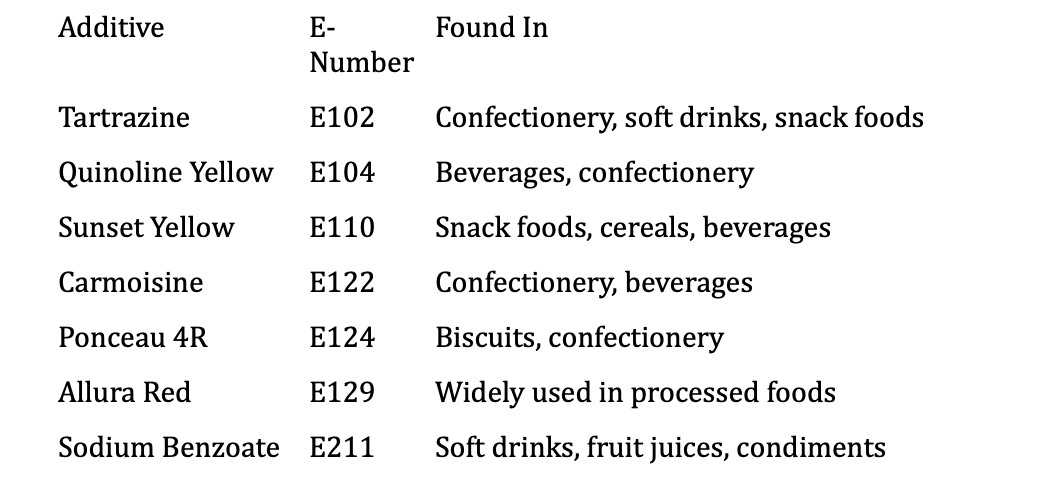
The Goodnessly app flags all of these automatically when you scan a product barcode — so you can make an informed decision at the shelf without needing to memorise every number.
The Bottom Line
These are complex conditions — the causes are layered, and food is one piece of a much bigger picture. But for a meaningful proportion of affected children, dietary factors — particularly synthetic food additives, gut microbiome disruption, and nutritional deficiencies — are measurably influencing symptom severity.
Investigating the food connection is low-risk, practical, and increasingly supported by research. It won’t be the answer for every family. But for some, it makes a profound difference.
You know your child better than anyone. If your instinct says food might be playing a role, that instinct is worth following.

Facebook
Instagram
X
TikTok