
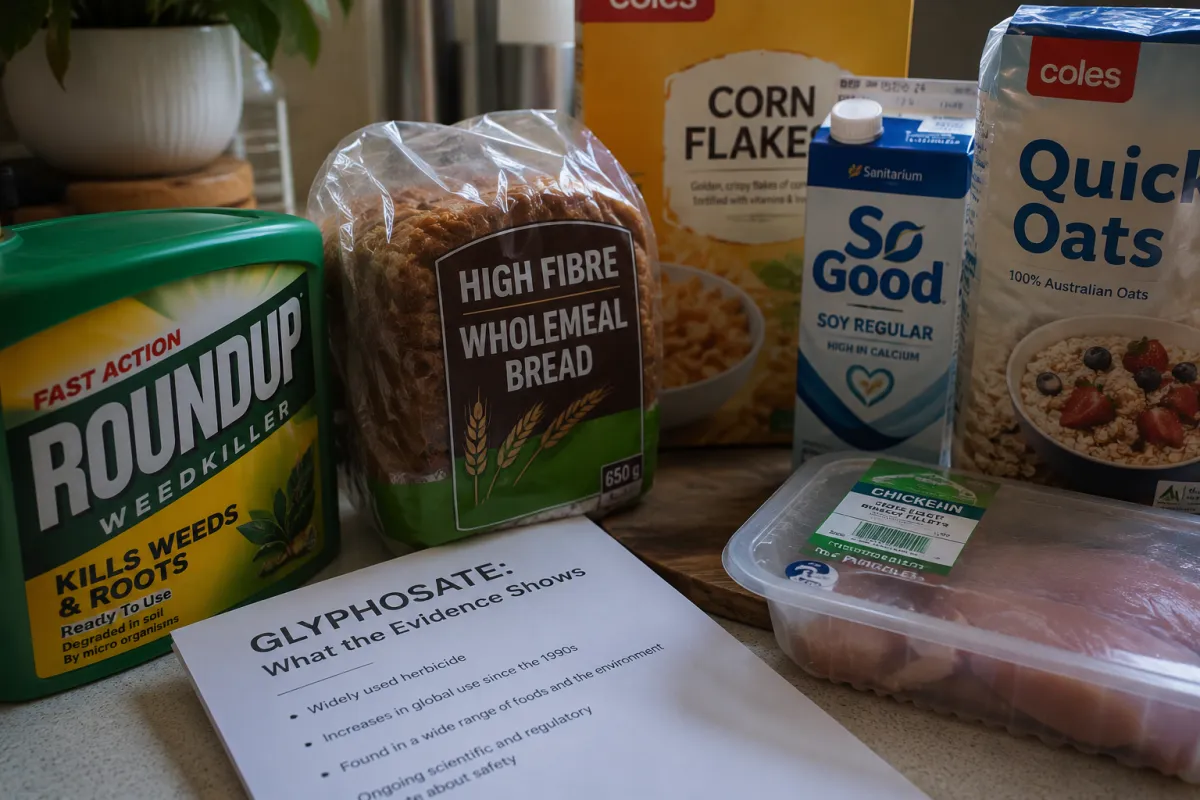
Glyphosate: What It Is, Where It’s Hiding in Your Food, and What the Research Says About Its Effects on Our Health
Glyphosate is simultaneously one of the most studied and most contested chemicals in the modern food system. It is used on an enormous scale globally, it shows up in foods most people would never suspect, and the scientific and regulatory debate around its safety is ongoing, unresolved, and deeply relevant to families trying to make informed decisions about what they eat.
This is what the evidence currently shows.
What Is Glyphosate?
Glyphosate is a broad-spectrum systemic herbicide — a weedkiller that works by blocking a specific enzyme pathway (the shikimate pathway) essential to plant growth. When applied to plants, it prevents them from producing certain amino acids they need to survive, causing them to die.
It is the active ingredient in Roundup, the herbicide introduced by Monsanto (now owned by Bayer) in 1974. It is also sold under dozens of other brand names and is now used by farmers, local councils, landscapers, parks departments, and homeowners worldwide.
Global glyphosate use has increased dramatically since the 1990s — driven largely by the introduction of genetically modified “Roundup Ready” crops engineered to be resistant to it, as well as its widespread adoption as a pre-harvest treatment on non-GM crops.
Where Is Glyphosate Used on Food Crops?
Understanding glyphosate’s presence in food requires understanding two distinct uses:
1. On genetically modified (GM) crops Crops genetically engineered to tolerate glyphosate — including soybeans, corn (maize), canola, sugar beets, and cotton — are sprayed with glyphosate throughout the growing season to kill weeds without harming the crop. These are the crops most commonly associated with glyphosate in public discussion.
2. As a pre-harvest desiccant on non-GM crops This is the less-known but arguably more relevant use for food residue. Glyphosate is sprayed on certain non-GM crops shortly before harvest to speed up the drying and ripening process — a practice called desiccation. The timing means the crop absorbs glyphosate during its final days in the ground, resulting in higher residue levels in the harvested product.
Crops commonly treated with pre-harvest glyphosate include: - Oats — one of the highest-residue items in testing - Wheat — widely used in Australia and globally as a pre-harvest treatment - Barley - Chickpeas and lentils - Canola - Sunflower seeds - Peas and beans
This is why glyphosate shows up in products like oat-based cereals, bread, crackers, muesli bars, and legume-based foods — not because of genetic modification, but because of pre-harvest agricultural practices.
How Much Glyphosate Is in Common Foods?
Testing by the Environmental Working Group (EWG) in the US has produced some of the most detailed publicly available data on glyphosate in food products.
Key findings from EWG testing: - Glyphosate residues were detected in all 45 oat-based food samples tested in one round of testing - More than 95% of oat-based products including cereals, granola bars, and oatmeal contained glyphosate residues - Many popular children’s cereals tested at levels the EWG considered potentially concerning for regular child consumption - Products tested included major brands of rolled oats, instant oatmeal, granola, and oat-based snack bars
Important context on measurement: The presence of a detectable level does not automatically indicate harm — regulatory maximum residue limits (MRLs) exist precisely to establish what levels are considered safe. The debate is over whether those MRLs are set appropriately, and whether they adequately account for children’s higher relative exposure and the cumulative effects of multiple pesticide exposures.
In Australia, FSANZ sets MRLs for glyphosate in food under the Australia New Zealand Food Standards Code. Australian testing data is less publicly available than EWG’s US data, but many of the same crops and food products are used here, and Australian oats and wheat are subject to the same pre-harvest desiccation practices.
How Much Glyphosate Are We Carrying in Our Bodies?
Several population studies have found glyphosate in the urine of a significant proportion of people tested in countries where it is widely used.
Key findings:
United States — JAMA Internal Medicine (2017) Researchers at the University of California San Diego analysed urine samples collected from a cohort of Americans between 1993 and 2016. They found that the percentage of participants with detectable urinary glyphosate increased from 12% in 1993-1996 to 70% in 2014-2016. Average glyphosate levels increased by more than 1,200% over the same period — tracking directly with the rise in glyphosate use on food crops and the adoption of GM crop technology.
Germany — Environmental & Analytical Toxicology (2012) A study of non-occupationally exposed individuals in Germany found glyphosate in the urine of all 182 participants tested, at levels 5 to 42 times the European drinking water limit. Germany has since moved to ban glyphosate.
European Human Biomonitoring study The HBM4EU project, a major European biomonitoring initiative, has found glyphosate residues in urine samples across multiple European countries, including in children and adolescents.
Australia Published population biomonitoring data for glyphosate in Australia is limited. However, given that Australian agricultural practices closely mirror those in the US and UK — including pre-harvest desiccation of oats, wheat, and legumes — exposure pathways are comparable.
What Does the Research Say About Health Effects?
This is where the science is most contested, most consequential, and most important to understand clearly.
Cancer — the IARC classification In 2015, the International Agency for Research on Cancer (IARC) — the cancer research arm of the World Health Organization — classified glyphosate as “probably carcinogenic to humans” (Group 2A) based on a systematic review of available evidence. The primary cancer of concern was non-Hodgkin’s lymphoma.
The IARC reviewed animal studies showing increased tumour incidence, human epidemiological data from agricultural workers, and mechanistic evidence for how glyphosate could cause cancer.
This classification is significant. The IARC Group 2A designation means the evidence is considered “limited in humans but sufficient in experimental animals.” Other Group 2A substances include red meat and shift work.
The regulatory counterposition: The US Environmental Protection Agency (EPA), the European Food Safety Authority (EFSA), and Food Standards Australia New Zealand (FSANZ) have all concluded that glyphosate is unlikely to be carcinogenic to humans at typical dietary exposure levels. Their assessments draw on different study sets and methodologies than the IARC, and the basis for the divergence in conclusions has itself been the subject of academic and regulatory scrutiny.
The legal landscape: Bayer, which acquired Monsanto in 2018, has paid out more than $10 billion USD in settlements related to claims that glyphosate caused non-Hodgkin’s lymphoma in users — primarily agricultural workers and landscapers with high occupational exposure. Bayer has maintained the product is safe while settling tens of thousands of lawsuits. In 2024 the US Supreme Court declined to block future lawsuits, leaving Bayer exposed to ongoing liability.
The legal settlements do not constitute scientific proof of harm — companies settle for many reasons. But the scale of the litigation and the amounts involved represent one of the largest product liability situations in US corporate history.
Gut Microbiome Effects
Beyond cancer, an emerging area of research focuses on glyphosate’s effects on the gut microbiome.
Glyphosate’s mechanism of action — blocking the shikimate pathway — was long considered irrelevant to human health because human cells do not use this pathway. However, the bacteria in the human gut do. Many beneficial gut bacterial strains use the shikimate pathway, and research has begun examining whether glyphosate exposure disrupts the composition and function of the gut microbiome.
Studies in animals have found that glyphosate exposure alters gut microbiome composition, reduces beneficial bacterial populations, and increases populations associated with dysbiosis. Translation of these findings to human health effects at real-world dietary exposure levels is an active area of research.
Given the central role of the gut microbiome in immune function, mental health, metabolic health, and neurological development — particularly in children — this is a research direction worth following closely.
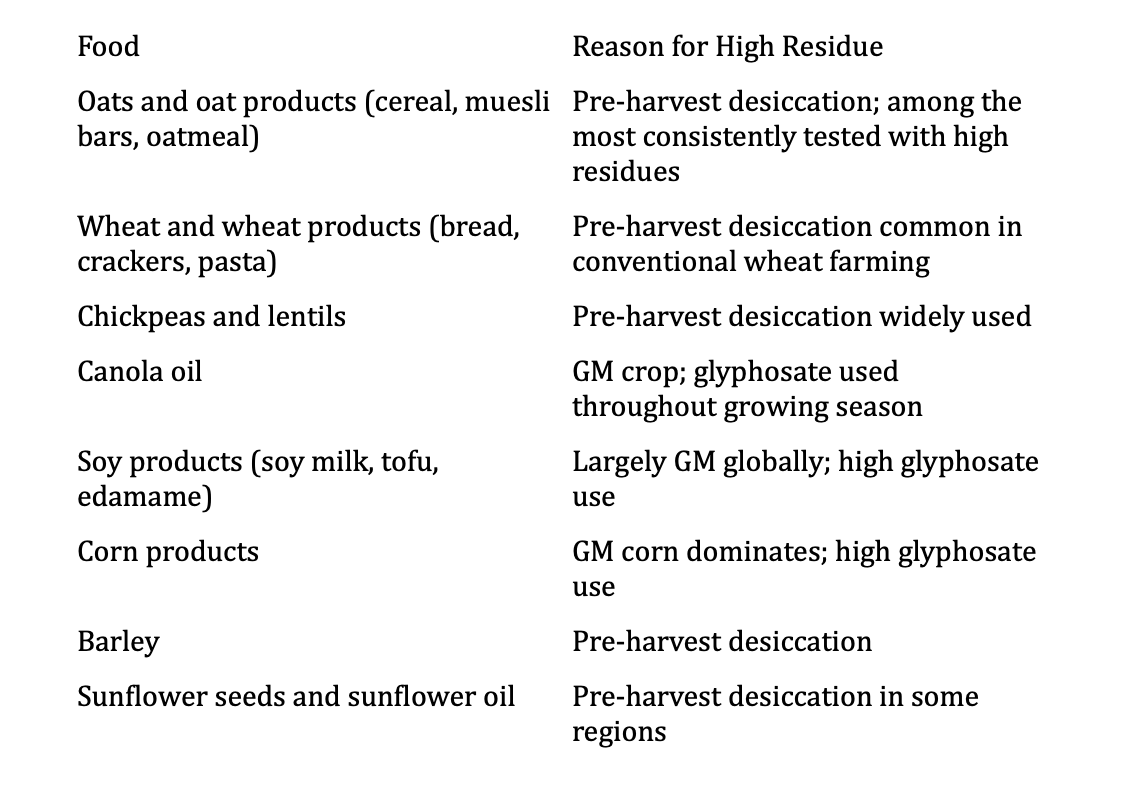
Which Foods Carry the Highest Glyphosate Residue?
Based on available testing data, the foods most likely to carry significant glyphosate residues include:
The Organic Question
Certified organic produce and products cannot be treated with synthetic glyphosate under organic certification standards. This is one of the substantive differences between organic and conventional in terms of chemical residue.
Research comparing organic and conventional urine glyphosate levels has found that individuals consuming predominantly organic diets have measurably lower urinary glyphosate levels than those on conventional diets.
A 2019 study published in Environmental Research found that participants who switched to a fully organic diet for six days showed a 70% reduction in urinary glyphosate levels within those six days — a striking demonstration of how quickly dietary source reduction affects body burden.
For families concerned about glyphosate exposure, the evidence-based priority areas for organic purchasing are: - Oats — most impactful single switch given high residue and frequent child consumption - Wheat products — particularly for families consuming bread, crackers, and pasta regularly - Chickpeas and lentils — high-residue legumes common in Australian diets - Soy products — particularly relevant for children on soy-based formula or consuming soy milk
What Can Australian Families Do?
Practical, evidence-based steps for reducing glyphosate exposure:
Switch to organic oats — this is consistently identified as the highest-impact single dietary swap for glyphosate reduction
Choose organic or sprouted legumes — chickpeas, lentils, and peas from organic sources have lower residue
Reduce oat-based packaged snacks — muesli bars, oat crackers, and similar products are common sources of glyphosate in children’s diets
Choose organic bread and wheat products where possible — or reduce overall wheat intake
Read labels on oat-based products — organic certification is the most reliable indicator of lower glyphosate content
The Bottom Line
Glyphosate is present in the food supply at measurable levels, it is detectable in the bodies of a significant proportion of the general population, and it has been classified as a probable human carcinogen by the WHO’s cancer research body.
The regulatory position — that exposure levels are safe — is not without basis. But the gap between the regulatory consensus and the IARC’s classification, combined with the scale of litigation around cancer claims, the emerging gut microbiome research, and the documented increase in human body burden over the past three decades, suggests that a precautionary approach is reasonable.
For children, whose developing systems are more sensitive to chemical disruption, reducing exposure through targeted organic purchasing — particularly oats, wheat, and legumes — is a practical and evidence-supported step.

Facebook
Instagram
X
TikTok