
Why Invest in Healthcare Real Estate?
HPA Exchange is a vertically integrated, internally managed real estate investment platform that acquires, owns and actively manages single- and multi-tenant medical and life science centric properties throughout the United States. We believe that the demand for healthcare real estate facilities will steadily increase over the next decade as a result of a variety of demographic, economic and regulatory trends.
Market Drivers
An Aging Population
Not only did the number of Americans aged 65 and over grow by nearly 15 million over the past decade, but it is also expected to increase by 47% by 2050, and the age group’s share of the total population is projected to rise an additional 6% to total 23%, according to the U.S. Census Bureau’s 2023 National Population Projections Tables.1
65+ Population in U.S. (Millions)
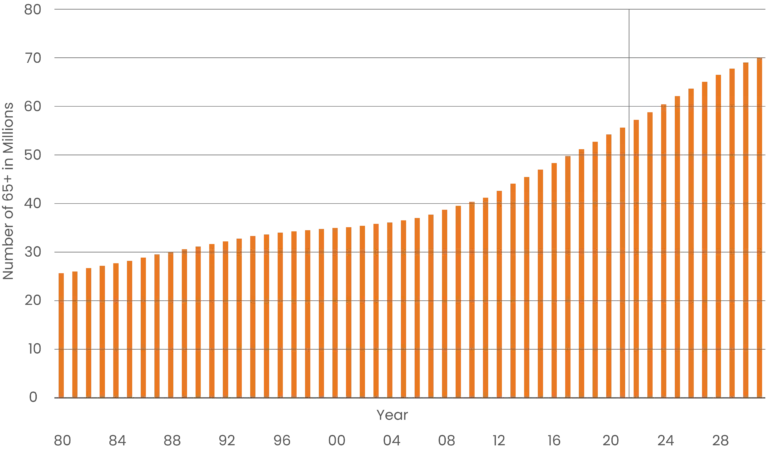
Chart Source: U.S. Census Bureau, Oxford Economics. As of October 2023.
“An aging population means higher use of healthcare services and a greater need for family and professional caregivers.”
– The Office of Disease Prevention and Health Promotion; U.S. Department of Health and Human Services
As we age, we typically need more medical treatments. In fact, Americans 65+ drove 36% of healthcare spending in 2021, while composing only 18% of the total population, according to an analysis of the 2021 Medical Expenditure Panel Survey data from the Agency for Healthcare Research and Quality.2
Average Number of Healthcare Events Per Person
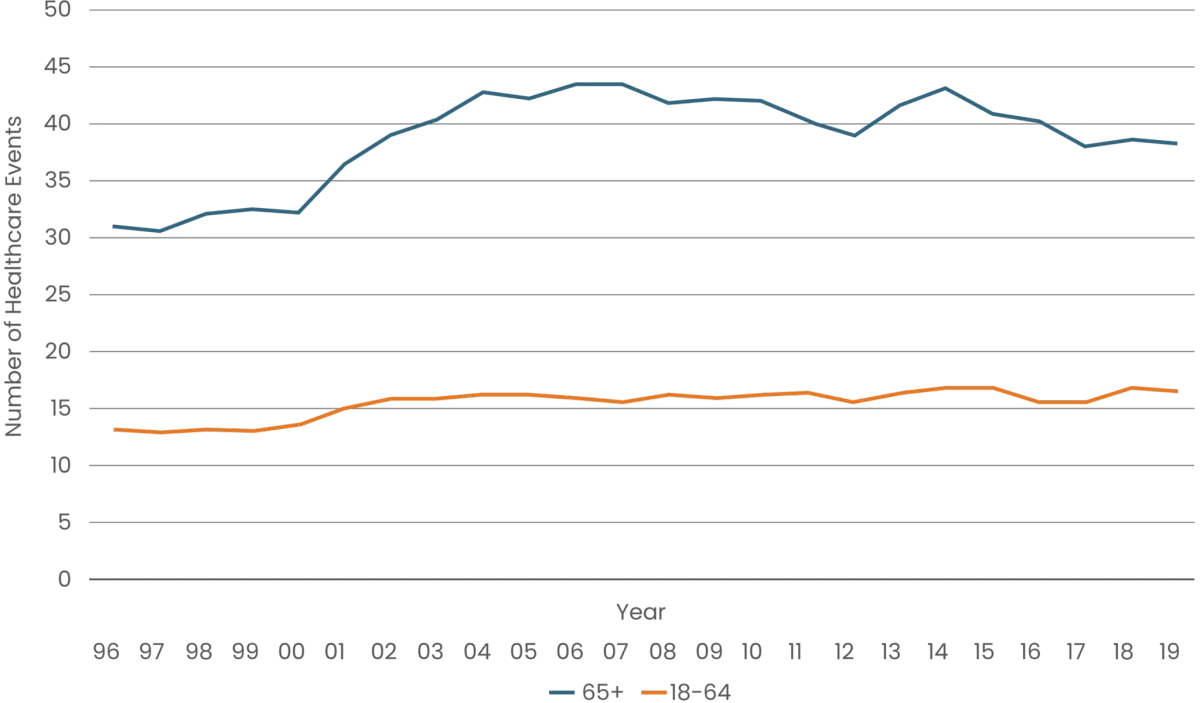
Chart Source: Agency for Healthcare Research and Quality Medical Expenditure Panel Survey. Data as of 2019.
Demand For Services
Technological advances, obesity, diabetes, personalized medicine, access to insurance and more – they all play a role in the demand for healthcare services. For example, between the generations of 1988-1994 and 2015-2018 the share of U.S. adults aged 65 and older with obesity nearly doubled, increasing from 22% to 40%, according to results of the National Health and Nutrition Examination Survey conducted by the U.S. Centers for Disease Control and Prevention’s National Center for Health Statistics.3
Increase In Spending
Healthcare spending increased by 4.1% in 2022 to $4.4 trillion, totaling more than 17% of the nation’s gross domestic product, according to the Center for Medicare & Medicaid Services.4 The Office of the Actuary also projects that health expenditures are expected to total 19.7% of the nation’s GDP by 2032.5
Barriers To Entry
As an asset class, healthcare real estate has a fundamental barrier to entry due to various state and municipal regulations that keep assets from being overbuilt.
Job Creation
Healthcare hiring grew 3.9% in 2023, more than double the 1.5% growth rate seen across other industries at the same time, according to Altarum’s analysis of monthly current employment statistics data from the U.S. Bureau of Labor Statistics.6 Additionally, healthcare accounted for 24% of all jobs created in the overall economy in 2023, and within such jobs, ambulatory care services continued to lead in job creation, per HealthLeader, a healthcare media company, in its analysis of the year-end 2023 U.S. Bureau of Labor Statistics’ preliminary federal data.7
“Regardless of the economic environment, people still need medical care, which makes healthcare real estate relatively stable and resilient.”
– BOMA International, “Top Trends to Watch in Healthcare Real Estate in 2024,” May 2024
Historic Resiliency
During the most recent COVID-19 crisis, vacancy rates and rent collections remained strong at many medical office buildings. For example, according to data firm Revista LLC, medical office landlords reported collection rates in excess of 90% even during the worst of the pandemic.8 CBRE states in “The Future of Medical Office: A Resilient Investment in Healthcare’s Future” that demand for medical office space stayed positive throughout the pandemic with vacancy rates remaining at pre-COVID-19 levels. Because of this, CBRE states, medical offices have the best long-term adjusted return profile compared traditional office, apartment, logistics and retail properties.9
Historically Healthy Returns
Income Return, Medical Office v. Other Property Types
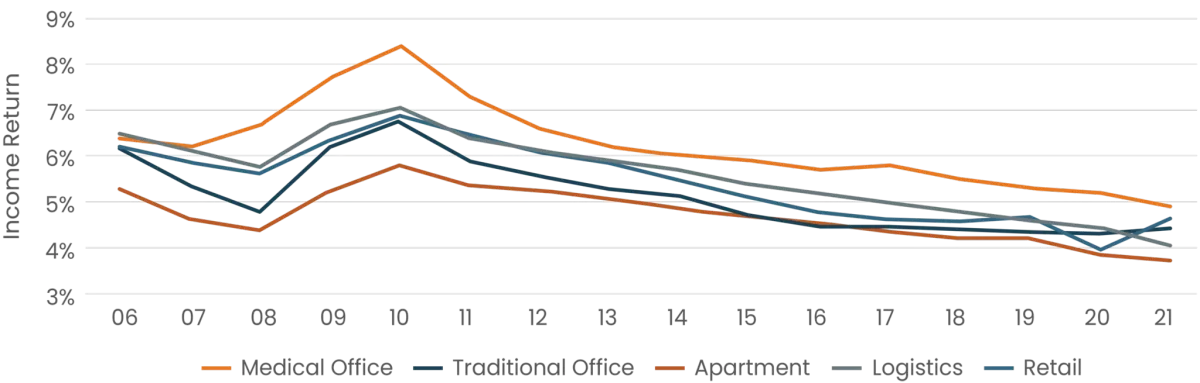
Year
“In addition to healthy fundamentals, since 2006, the medical office subsector has delivered on average the highest income returns compared with the four major property types.”9
– CBRE, “The Future of Medical Office: A Resilient Investment in Healthcare’s Future,” November 2023
The Rise of Ambulatory Surgery Centers
Hospital systems are strategically seeking to increase the availability of outpatient medical care in order to control costs and meet the needs of care from those in the Baby Boomer and Gen X generations who are not willing or able to travel for care. As more patients expect high-end services, and care becomes more specialized as humans age, a change in the outpatient experience has occurred. These shifts and changes are expected to lead to a growth in the use of ambulatory surgery centers (ASCs), with 12% growth predicted by 2028, and 22% growth predicted by 2033.10 Additionally, more than 80% of surgeries in the U.S. are now performed in an outpatient setting, according to ASCData.11 The firm reports that ASCs reduce expenditures for patients, insurers, and Medicare, with $42.4 billion of savings in one year of spending from patients choosing ASCs, as well as $2.3 billion annual Medicare savings also created by patients choosing ASCs.11
Sources:
1. U.S. Census Bureau. 2023 National Population Projections Tables: Main Series.
2. JLL. Medical Outpatient Building Perspective. 2024.
3. PRB. Rising Obesity in an Aging America. July 2022.
4. https://www.cms.gov/data-research/statistics-trends-and-reports/national-health-expenditure-data/nhe-fact-sheet#:~:text=Historical%20NHE%2C%202022%3A,18%20percent%20of%20total%20NHE
5. https://www.cms.gov/newsroom/press-releases/cms-releases-2023-2032-national-health-expenditure-projections
6. Altarum. Health Sector Economic Indicators, Insights from Monthly National Health Employment Data through December 2023. January 2023.
7. https://www.healthleadersmedia.com/human-resources/healthcare-accounts-24-all-new-us-jobs-2023
8. https://revistamed.com/mob-sales-were-okay-in-1q-at-2-5-billion/
9. CBRE. The Future of Medical Office: A Resilient Investment in Healthcare’s Future. November 2023.
10. Sg2.2023 Impact of Change Forecast. June 2023.
11. ASC Data. ASC Industry Overview. August 2024.
HPA Exchange LLC 915 W Imperial . Ste. 165 BREA, CA 92821
© HPA Xchange. All Rights Reserved.
Statistical date is as of January 2026. Figures are subject to change.
This is for informational purposes only and should not be relied upon as tax or legal advice. HPA Exchange does not offer legal or tax advice. Because investor situations and objectives vary this information is not intended to indicate that an investment is appropriate for or is recommended to any individual investor. Please consult the appropriate professional regarding your individual circumstance.
This is neither an offer to sell nor a solicitation of an offer to buy securities described herein. An offering is made only by the Confidential Private Placement Memorandum (PPM). All sale and advertising literature must be read in conjunction with the PPM in order to understand fully all of the implications and risks of the offering to which it relates. A copy of the PPM must be made available to you in connection with an offering. Prospective Members should carefully read the PPM and review any additional information they desire prior to making an investment and should be able to bear the complete loss of their investment.
There is material risks associated with investing in private placements and real estate securities including illiquidity, speculation, general market conditions, interest rate risks, financing risks, potentially adverse tax consequences, general economic risks, development risks, and potential loss of the entire investment principal. Prospective investors should perform their own due diligence carefully and review the “Risk Factors” section of any prospectus, private placement memorandum or offering circular before considering any investment.
DST 1031 properties are only available to accredited investors or accredited entities. If you are unsure if you are an accredited investor and/or an accredited entity, please verify with your CPA and Attorney.
An accredited investor is typically defined as having a $1 million net worth excluding primary residence or $200,000 income individually/$300,000 jointly of the last two years; or have an active Series 7, Series 82, or Series 65. Individuals holding a Series 66 do not fall under this definition) and accredited entities only.
An accredited entity is typically a private business development company or an organization with assets exceeding $5 million; or if an entity consists of equity owners who are accredited investors, the entity itself is an accredited investor provided the organization was not formed with a sole purpose of purchasing specific securities.
Potential cash flows/returns/appreciation are not guaranteed and could be lower than anticipated. Diversification does not guarantee a profit or protect against a loss in a declining market. It is a method used to help manage investment risk.
All forward-looking statements address matters that involve risks and uncertainties and investors should be able to bear the loss of their entire investment. All investors should make their own determination of whether or not to make any investment, based on their own independent evaluation and analysis. Past performance is not indicative of future returns or Fund results. Individual investment performance, examples provided and/or case studies are not indicative of overall returns of the Company. In addition, there can be no guarantee of deal flow in the future. Forward looking statements are not statements of historical fact and reflect the Company’s views and assumptions regarding future events and performance.
The securities are offered in reliance on an exemption from the registration requirements of the Securities Act of 1933, as amended, and are not required to comply with specific disclosure requirements that apply to registration under the Securities Act. Neither the SEC nor any state regulator has reviewed the merits of or given its approval to the securities, the terms of the offerings, or the accuracy or completeness of any offering materials. The securities are subject to legal restrictions on transfer and resale and investors should not assume they will be able to resell their securities.
HPA Exchange, LLC (“HPA”) offers securities through American Alternative Capital, LLC (AAC), a member FINRA / SIPC. HPA and AAC are independent of each other. For more information on AAC, please visit BrokerCheck.