
Blog
Blog
Apartment Rent Specials Explained: Market Rent vs. Effective Rent
"8 weeks free." "1 month free." "$1,500 off."
Apartment specials sound incredible on the surface. But here's the thing: there are multiple ways they're applied, multiple numbers involved, and the one you get approved on isn't always the one being advertised. If you've ever signed a lease and wondered why your income requirement was higher than expected, this post is for you. Let's break it all the way down.
What Even Is an Apartment Special?
Think of a special (also called a concession) as a property's way of saying, "We really want you to sign here." Landlords use them to fill vacancies faster especially during slower seasons or when a unit has been sitting too long. Not all specials are created equal, though. There are two flavors:
Fee-Based Specials - the easy wins. Certain costs simply disappear from your move-in total:
Waived admin fees
Free parking (huge in cities)
Reduced or zero deposit
Free storage unit
Rent-Based Specials - this is where the math gets interesting, and where most renters get tripped up:
1 month free
6-8 weeks free
$1,000 off your lease
2 months free on longer terms
Fee-based specials are straightforward take them every time. It's rent-based specials that require you to understand the numbers before you sign.
Market Rent vs. Effective Rent: Two Numbers, One Unit, Totally Different Meanings
This is the most misunderstood concept in apartment hunting — and it can genuinely affect whether you get approved.
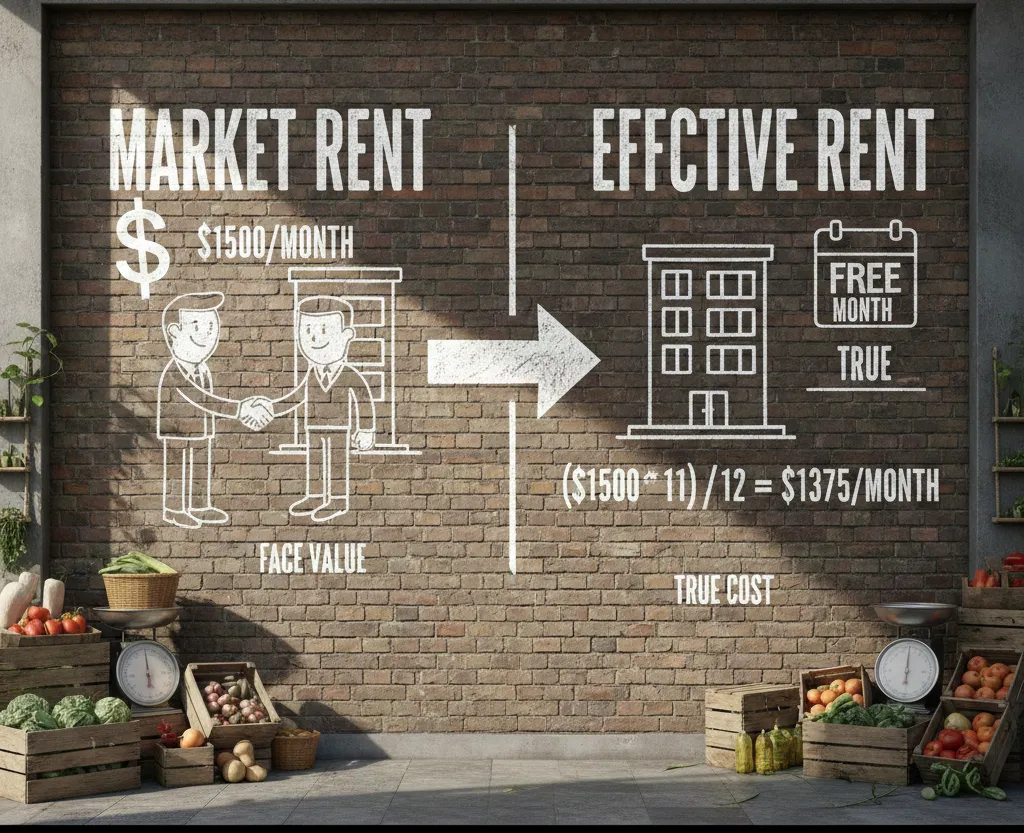
Market Rent is the actual listed monthly rent for the unit. It's what appears on the lease. More importantly, it's usually the number properties use to qualify your income and determine approval eligibility.
Effective Rent is your real average monthly cost after the special is factored in. It's lower but most properties don't use this number for approval. That's the catch.
Let's run the numbers:
Market rent: $1,500/month
Special: 1 month free on a 12-month lease = −$1,500
Total lease value: $16,500
Effective rent (÷ 12 months): $1,375/month
You're still signing at $1,500. Income qualification? Based on $1,500. The effective rent of $1,375 is your average savings not the number that gets you approved.
How Specials Are Actually Applied
Knowing a special exists is only half the battle. How it's applied changes your budget in a big way. Properties typically use one of two methods:
1.) Upfront Special - "First Month Free" You pay $0 in month one, then full market rent for months 2-12. Your cash flow looks amazing at move-in, but it evens out fast. Smart move: mentally spread that free month across your lease to budget accurately. ($1,500 ÷ 12 = $125/month in real savings.)
2.) Credit Applied to Your Renter Portal Instead of a free month, the property loads a rent credit into your account like a gift card for rent. Some apply it all at once. Others spread it across specific months. Always ask: "How will this credit appear in my portal and when?"
Two residents in the same building with the same "1 month free" special could have completely different payment timelines. Ask specifically before you sign.
Why Timing Changes Everything
That special you saw yesterday might be gone tomorrow and that's not an accident.
Rent pricing is driven by revenue management, the same system airlines and hotels use. Specials shift constantly based on:
Seasonal demand (summer vs. winter)
Occupancy levels
Lease expiration balancing
Renewal cycles
Your move-in date and lease term length
Two identical units, same floor, same view, same finishes, can have dramatically different pricing depending on when your lease starts and ends. A unit coming available in December (low demand) will almost always carry a better special than the same unit in June (peak season). This is by design, not luck.
The #1 Thing Renters Miss
Here it is, plain and simple: income qualification is almost always based on market rent — not effective rent. This catches people off guard every single day.
Example:
Market rent: $1,500/mo
Standard income requirement (3×): $4,500/mo
What renters assume they need (3× effective rent): $4,125/month
That $375/month gap isn't a rounding error it can be the difference between approved and denied. Always verify which number the property uses before you apply.
The same logic applies to "weeks free" deals. Whether it's 6 or 8 weeks free, the dollar value is converted and spread across your lease, but the approval math still runs on market rent.
Smart Renter Strategy: Walk In Knowing More Than Expected
✔ Compare multiple lease terms, a 13-month lease can sometimes save more than a 12-month, even if it looks pricier upfront
✔ Ask exactly how the special is applied, free month upfront, portal credit, or spread across months?
✔ Confirm which rent number the property uses for income qualification
✔ Calculate total lease cost, not just the monthly average
✔ Understand that pricing changes daily, lock in when you find something good
✔ Ask if move-in date flexibility unlocks a better special or term length
Pro move: Always ask, "What is the total lease value with the special applied?" Divide by months yourself. You'll instantly know your true effective rent, and whether it actually works for your budget.
Clarity Shouldn't Cost Extra
Rent specials can save you thousands, but only if you understand how they're applied, what number you're approved on, and how to budget correctly. Rent is most people's largest monthly expense. It deserves more than a guess.
At Apartment Lease Finders, we don't just hand you the lowest advertised number and send you off. We walk you through every layer:
Market vs. effective rent, explained clearly
How specials are applied to your specific lease
What you actually qualify for (no surprises at approval)
How to structure your lease strategically to save the most
Because saving money shouldn't feel confusing.



Get Started
© 2024 Apartment Lease Finders Inc| LIC
#9003398 - All rights reserved.
Apartment Lease Finders Group is a real estate team affiliated with Spirit Realty, a licensed real estate broker and abides by all applicable Equal Housing Opportunity laws. All material presented herein is intended for informational purposes only. Information is compiled from sources deemed reliable but is subject to errors, omissions, changes in price, condition, sale, or withdrawal without notice. No statement is made as to accuracy of any description. All measurements and square footages are approximate. This is not intended to solicit property already listed. Nothing herein shall be construed as legal, accounting or other professional advice outside the realm of real estate brokerage.
Apartment Rent Specials Explained: Market Rent vs. Effective Rent
"8 weeks free." "1 month free." "$1,500 off."
Apartment specials sound incredible on the surface. But here's the thing: there are multiple ways they're applied, multiple numbers involved, and the one you get approved on isn't always the one being advertised. If you've ever signed a lease and wondered why your income requirement was higher than expected, this post is for you. Let's break it all the way down.
What Even Is an Apartment Special?
Think of a special (also called a concession) as a property's way of saying, "We really want you to sign here." Landlords use them to fill vacancies faster especially during slower seasons or when a unit has been sitting too long. Not all specials are created equal, though. There are two flavors:
Fee-Based Specials - the easy wins. Certain costs simply disappear from your move-in total:
Waived admin fees
Free parking (huge in cities)
Reduced or zero deposit
Free storage unit
Rent-Based Specials - this is where the math gets interesting, and where most renters get tripped up:
1 month free
6-8 weeks free
$1,000 off your lease
2 months free on longer terms
Fee-based specials are straightforward take them every time. It's rent-based specials that require you to understand the numbers before you sign.
Market Rent vs. Effective Rent: Two Numbers, One Unit, Totally Different Meanings
This is the most misunderstood concept in apartment hunting — and it can genuinely affect whether you get approved.
Market Rent is the actual listed monthly rent for the unit. It's what appears on the lease. More importantly, it's usually the number properties use to qualify your income and determine approval eligibility.
Effective Rent is your real average monthly cost after the special is factored in. It's lower but most properties don't use this number for approval. That's the catch.
Let's run the numbers:
Market rent: $1,500/month
Special: 1 month free on a 12-month lease = −$1,500
Total lease value: $16,500
Effective rent (÷ 12 months): $1,375/month
You're still signing at $1,500. Income qualification? Based on $1,500. The effective rent of $1,375 is your average savings not the number that gets you approved.
How Specials Are Actually Applied
Knowing a special exists is only half the battle. How it's applied changes your budget in a big way. Properties typically use one of two methods:
1.) Upfront Special - "First Month Free" You pay $0 in month one, then full market rent for months 2-12. Your cash flow looks amazing at move-in, but it evens out fast. Smart move: mentally spread that free month across your lease to budget accurately. ($1,500 ÷ 12 = $125/month in real savings.)
2.) Credit Applied to Your Renter Portal Instead of a free month, the property loads a rent credit into your account like a gift card for rent. Some apply it all at once. Others spread it across specific months. Always ask: "How will this credit appear in my portal and when?"
Two residents in the same building with the same "1 month free" special could have completely different payment timelines. Ask specifically before you sign.
Why Timing Changes Everything
That special you saw yesterday might be gone tomorrow and that's not an accident.
Rent pricing is driven by revenue management, the same system airlines and hotels use. Specials shift constantly based on:
Seasonal demand (summer vs. winter)
Occupancy levels
Lease expiration balancing
Renewal cycles
Your move-in date and lease term length
Two identical units, same floor, same view, same finishes, can have dramatically different pricing depending on when your lease starts and ends. A unit coming available in December (low demand) will almost always carry a better special than the same unit in June (peak season). This is by design, not luck.
The #1 Thing Renters Miss
Here it is, plain and simple: income qualification is almost always based on market rent — not effective rent. This catches people off guard every single day.
Example:
Market rent: $1,500/mo
Standard income requirement (3×): $4,500/mo
What renters assume they need (3× effective rent): $4,125/month
That $375/month gap isn't a rounding error it can be the difference between approved and denied. Always verify which number the property uses before you apply.
The same logic applies to "weeks free" deals. Whether it's 6 or 8 weeks free, the dollar value is converted and spread across your lease, but the approval math still runs on market rent.
Smart Renter Strategy: Walk In Knowing More Than Expected
✔ Compare multiple lease terms, a 13-month lease can sometimes save more than a 12-month, even if it looks pricier upfront
✔ Ask exactly how the special is applied, free month upfront, portal credit, or spread across months?
✔ Confirm which rent number the property uses for income qualification
✔ Calculate total lease cost, not just the monthly average
✔ Understand that pricing changes daily, lock in when you find something good
✔ Ask if move-in date flexibility unlocks a better special or term length
Pro move: Always ask, "What is the total lease value with the special applied?" Divide by months yourself. You'll instantly know your true effective rent, and whether it actually works for your budget.
Clarity Shouldn't Cost Extra
Rent specials can save you thousands, but only if you understand how they're applied, what number you're approved on, and how to budget correctly. Rent is most people's largest monthly expense. It deserves more than a guess.
At Apartment Lease Finders, we don't just hand you the lowest advertised number and send you off. We walk you through every layer:
Market vs. effective rent, explained clearly
How specials are applied to your specific lease
What you actually qualify for (no surprises at approval)
How to structure your lease strategically to save the most
Because saving money shouldn't feel confusing.


Get Started
© 2026 Apartment Lease Finders Inc| LIC #9003398 - All rights reserved.
Apartment Lease Finders Group is a real estate team affiliated with Spirit Realty, a licensed real estate broker and abides by all applicable Equal Housing Opportunity laws. All material presented herein is intended for informational purposes only. Information is compiled from sources deemed reliable but is subject to errors, omissions, changes in price, condition, sale, or withdrawal without notice. No statement is made as to accuracy of any description. All measurements and square footages are approximate. This is not intended to solicit property already listed. Nothing herein shall be construed as legal, accounting or other professional advice outside the realm of real estate brokerage.