
Return 2 Sport
BLOG
All things running, physical therapy, strength training, mobility, and education!
Welcome to the Return 2 Sport PT blog. Here, we share insights and tips to improve your movement quality, alleviate pain and dysfunction, and equip you with the knowledge to maintain a pain-free and active lifestyle for the long haul.
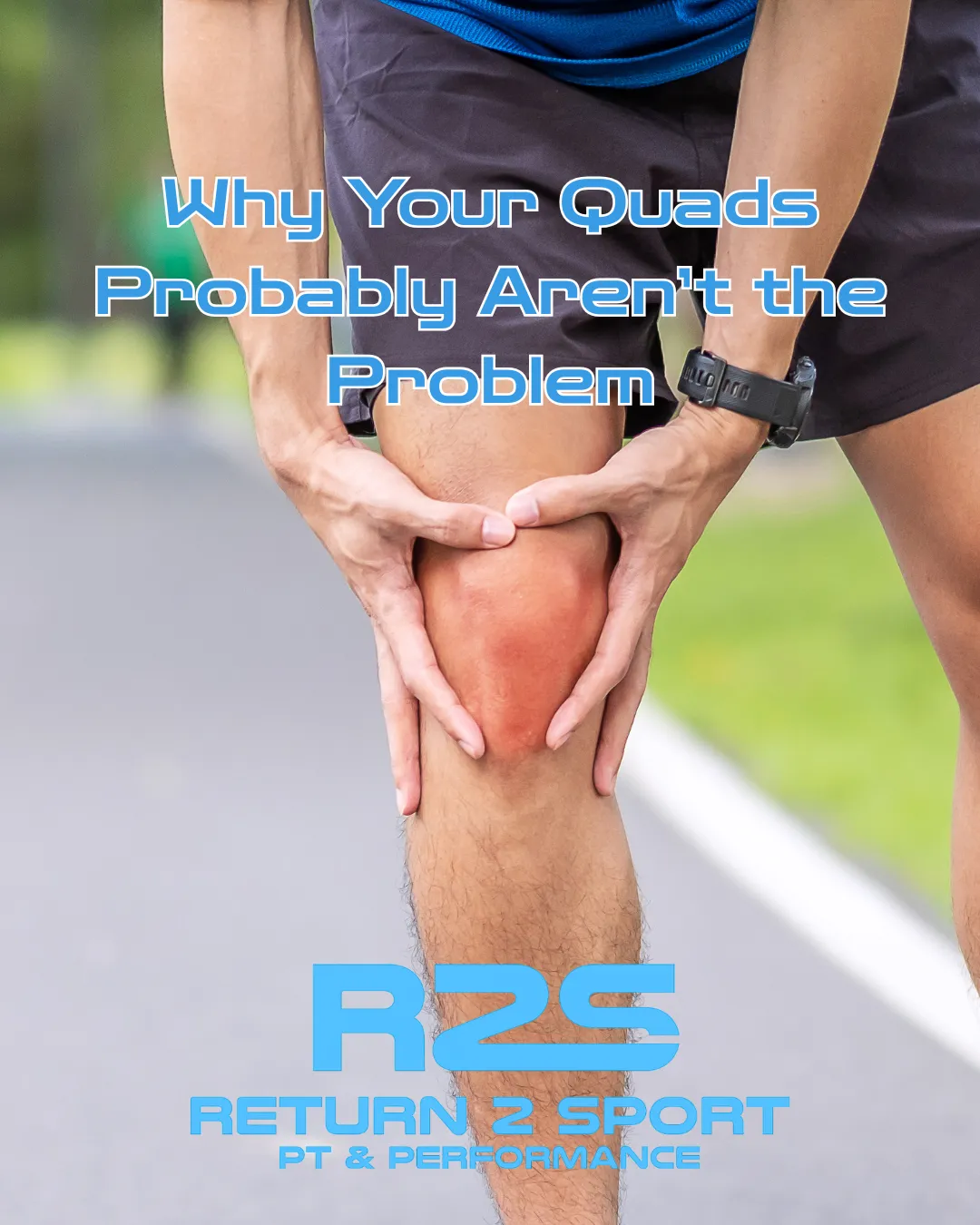
Why Runners Need to Pay More Attention to Their Hips

Why Runners Need to Pay More Attention to Their Hips

A lot of runners and active adults come into the clinic convinced their pain is coming directly from the area that hurts.
Front of the knee? Must be the quads.
IT band pain? Probably need to foam roll more.
Achilles pain? Calves must be tight.
But one of the biggest mistakes we see is treating symptoms without looking at the system driving them.
The body works as a chain. If one area is not doing its job well, another area usually has to pick up the slack. And more often than not, the hips are the missing piece.
The Hips Are the Engine
Your hips are responsible for producing force, controlling rotation, stabilizing your pelvis, and helping transfer energy efficiently while running and moving.
If the hips are weak, poorly coordinated, stiff, or simply not contributing enough, your body has to find another way to keep moving.
That compensation often shows up as:
Knee pain
IT band irritation
Quad tightness
Shin splints
Achilles overload
Hamstring strains
Low back discomfort
The frustrating part is that many people spend months chasing the painful area without ever addressing the actual driver.
How This Effects Runners
Running is essentially thousands of single-leg jumps strung together.
Every step requires:
Stability
Force production
Rotation control
Shock absorption
Your hips sit at the center of all of it.
When hip control breaks down, runners often start to:
Overstride
Collapse inward at the knee
Lose stiffness and efficiency
Overwork the quads and calves
Burn more energy at the same pace
This is one reason why strengthening alone does not always fix injuries. You can have strong muscles in isolation but still move poorly under load or fatigue.
The Real Goal Is Better Movement
At Return 2 Sport PT, we are rarely just asking:
“Is this muscle weak?”
We are asking:
Is it firing at the right time?
Is it controlling motion correctly?
Does it maintain stability when fatigued?
Does it transfer force efficiently during running?
That changes how we evaluate injuries.
Instead of only treating pain, we look at:
Running mechanics
Hip control
Single-leg stability
Strength asymmetries
Mobility restrictions
Force production patterns
Because the goal is not just getting you out of pain.
The goal is making you more durable, more efficient, and ultimately a better runner.
What Most People Actually Need
Most runners do not need random band exercises forever.
They need:
Better single-leg strength
Improved hip stability
Better rotational control
Proper loading progressions
Running-specific strength training
Better recovery and tissue capacity
And importantly, they need exercises that actually transfer back into running performance.
Pain Is Often the Warning Sign, Not the Root Cause
Your quads may feel tight.
Your knee may hurt.
Your calves may constantly feel overloaded.
But that does not always mean those tissues are the primary problem.
Sometimes they are just working overtime because another system is underperforming.
That is why good rehab should never just chase symptoms. It should improve how the entire system moves and performs.
Because when the hips do their job well, everything downstream usually works better too.
Happy running,
R2S Team
Dr. Dylan Glass, PT, DPT, SMTC
Dr. Josh Cornett PT, DPT, COMT, CDNT
Return 2 Sport PT
256-513-9525


Copyright (C) 2026 Return 2 Sport PT & Performance. All
rights reserved.
At Return 2 Sport PT & Performance, we specialize in performance-based physical therapy.
© 2025 Return 2 Sport PT & Performance All Rights Reserved |