

There's a reason evenings fall apart. It's not you.
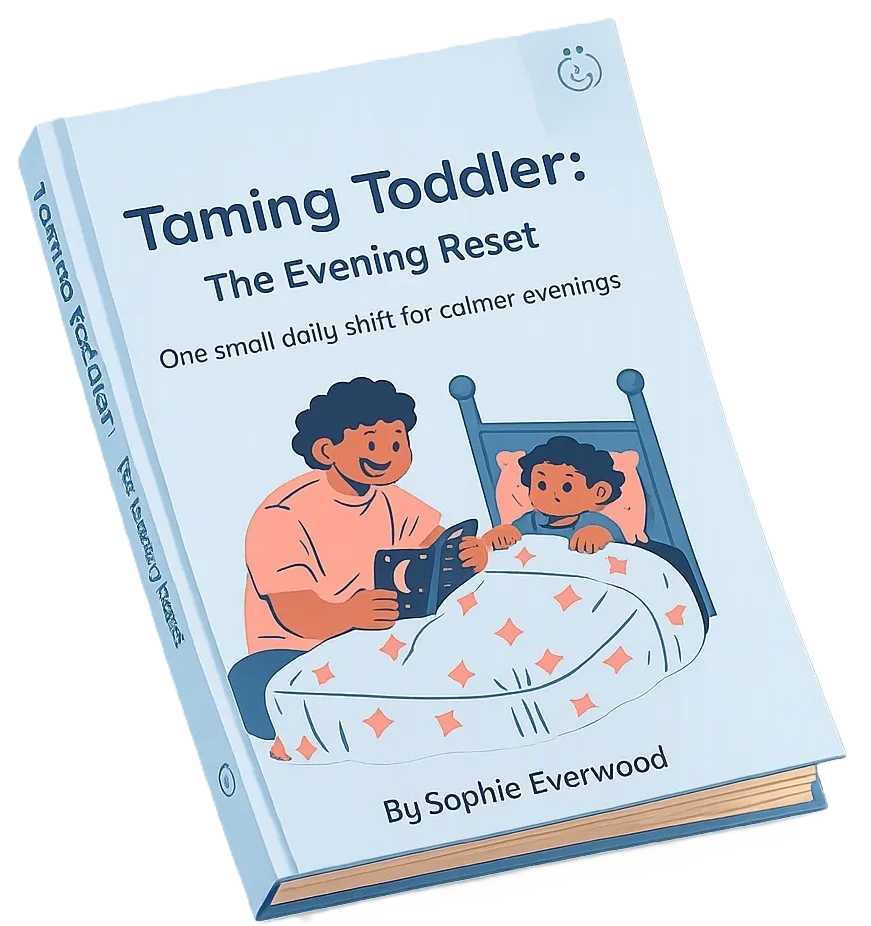
The Evening Reset is a 7-day guide for the stretch between dinner and bedtime — one small shift per day, so you're not trying to remember everything when the day has already used everyone up.
PDF download. Instant access. 25 pages.
30-day money-back guarantee.
By the end of the day, everyone is running on less.
Your child has spent hours holding it together — moving through noise, transitions, expectations, waiting, stopping, starting, and feelings they don't yet know how to manage.
By 5 PM, they've used up a lot of what they had.
You're running low too. Less patience. More decisions.
Thinner capacity. Less room for one more hard moment.
So when something small suddenly becomes something big, it can feel like it came from nowhere. But often, it has been building all day.
That's why evenings can feel like a different universe from mornings.
And it's why advice that sounds simple at 9 AM can feel impossible at 6:30 PM.
The Evening Reset helps you lower the pressure before everything spills over.
This is not a full parenting course.
It's not another system to memorize.
It's a short, evening-specific guide that helps you make one small shift each day — so the hardest window of the day feels a little steadier.
Most parents aren't looking for more theory at night. They need something they can actually use when dinner is late, bedtime is close, and everyone is already tired.
Most parents feel something shift by Day 3.
Not a miracle. Just a noticeably calmer evening — the kind where you get to bedtime and realize you're not clenched.
That's the goal here. Not perfect evenings. Just evenings that don't unravel quite so easily.
One small shift each day.
The Evening Reset is built around one idea — The Lighter Load™. Evenings go better when you lower the load before everything spills over.
Each day gives you:
- One thing to change
- One thing to say
- One thing to stop doing
So when emotions rise, you're not guessing.
Here's what each day covers.
One small shift before the evening begins.
Before you try to change your child's evening, you start with your own. Day 1 helps you find the small shift in yourself that changes how the room feels.
Letting go of expectations that don't fit evenings.
Some standards make sense at 9 AM and fall apart by 6 PM. Day 2 helps you see which ones are adding pressure — and which ones can be softened tonight.
Softening transitions before they unravel things.
Transitions are often where evenings start to slip. Day 3 helps the next step feel less sudden, so your child has less to brace against.
Staying close when explanations stop working.
Sometimes talking more makes things worse. Day 4 shows you what to do when your child can't take in another word.
For tired, hungry, overwhelmed evenings.
When a child is tired or hungry, no script works well. Day 5 helps you notice the body needs underneath the behavior.
Holding limits without escalating the moment.
You don't have to become permissive to stay calm. Day 6 helps you hold the limit without adding more heat.
Reconnecting after the hard moments.
Even good evenings have hard moments. Day 7 helps you reconnect afterward, so the relationship stays steady through the hard parts.
This is for you if...
It's especially helpful if you've already tried scripts or advice, but find that by evening, you're too tired to use them the way you planned.
What you get.
- The Evening Reset PDF guide
- 7 short daily shifts
- Simple language for hard moments
- Practical changes for transitions, tiredness, boundaries, and reconnection
- A calm structure you can repeat any week you need it
Start The Evening Reset today.
One small daily shift for calmer evenings.
PDF download. Instant access. 25 pages.
30-day money-back guarantee.
If evenings aren't your biggest challenge…
If evenings are where everything falls apart, the Reset was made for that exact window.
If meltdowns are happening across the whole day, Taming Toddler ($19.95) may be the better fit. It covers why meltdowns happen and what to do in the moment — at any time of day.
If you want broader support across routines, communication, boundaries, screen time, sibling rivalry, and staying calm as the parent, the From Chaos to Calm course ($47) may be the better next step.