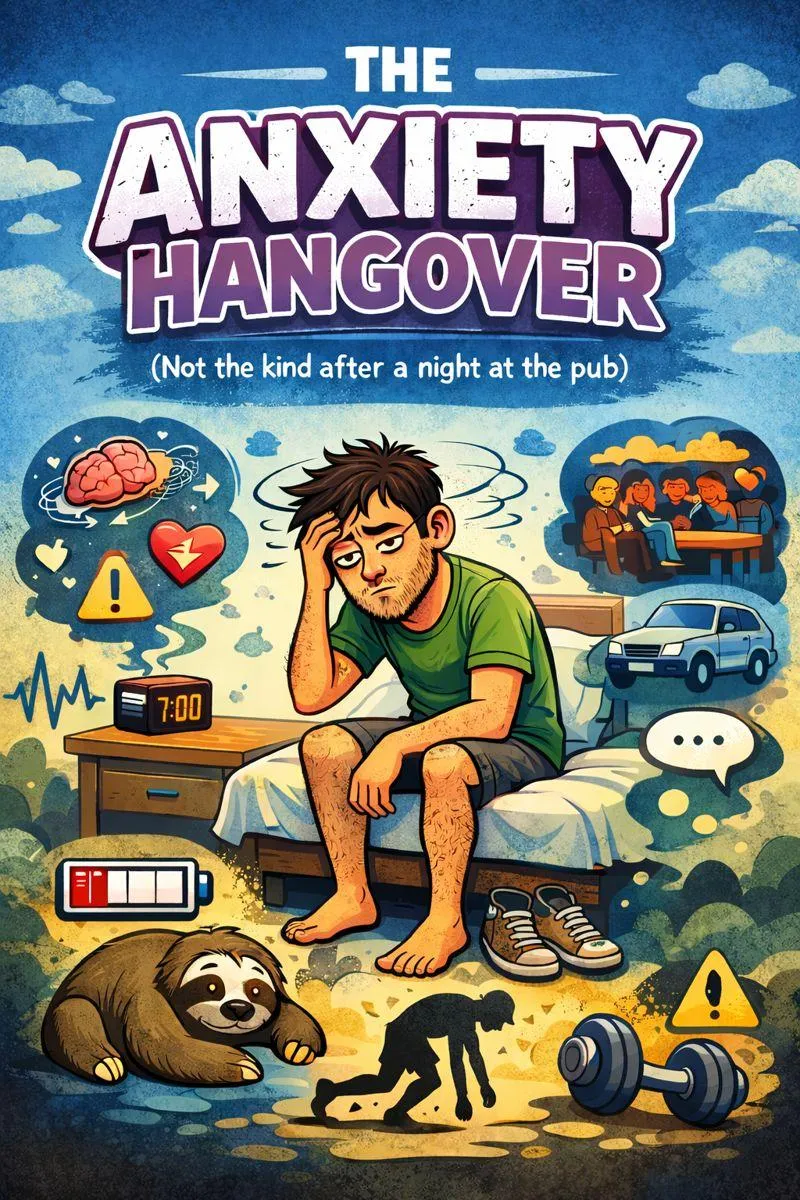
Hangxiety - The Anxiety Hangover
The Anxiety Hangover
(And no, it’s not the kind you get after a night at the pub.)
When people hear the word hangover, they usually think of too many pints, a sore head, and a greasy breakfast.
But this is a very different kind of hangover and if you suffer from Anxiety you will no doubt know what I'm talking about. Something I may have just invented a new word for...
Hangxiety
Because what I experienced today had nothing to do with alcohol and everything to do with anxiety. When I went to the pub to watch the football yesterday I didn’t drink and I wasn't out late.
Yet today I feel absolutely wiped out, groggy, heavy, exhausted and drained. It feels like I’ve just run a marathon with a weighted backpack on my shoulders.
This is something I’ve noticed every time I push myself out of my comfort zone while recovering from anxiety. And it took me a long time to understand why.
Not the Hangover People Think
When you live with anxiety, doing “normal” things isn’t experienced normally by your body.
Going to the pub.
Meeting friends.
Driving.
Being in busy places.
Even if you want to do these things, your nervous system often doesn’t feel the same way.
While you’re out, your body is:
Constantly scanning for danger
Monitoring every sensation
Checking your breathing
Tensing your muscles
Staying on high alert
And all of that is happening silently, beneath the surface.
You might look calm on the outside, but internally your system is working overtime to protect you. Even when nothing bad happens, your body doesn’t know that yet. Being constanty on edge is exhausting.
Your Body Never Truly Switches Off
During anxiety, your nervous system doesn’t relax in the background.
It stays “on”.
Your shoulders tense.
Your jaw tightens.
Your stomach contracts.
Your breathing becomes shallow.
You’re not choosing this it’s automatic. Your body believes it’s keeping you safe. And when that level of alertness lasts for hours, it takes a huge amount of energy. And when your body has been doing this for hours, it doesn’t just switch off when you get home.
That’s why the exhaustion afterwards feels so intense.
When I got back from the pub last night the lower half of my rib cage felt so tense and tight and like I was struggling to breathe. That came from being so tense in the pub and breathing so shallowly. That tightness didn’t come from danger, it came from tension
Why It Feels Like Rugby Pre-Season
The best way I can describe it is this.
It reminds me of going back to school after the long summer holidays and starting rugby training again.
The couple of days after those first few training sessions were brutal.
Your legs ached.
Your shoulders felt heavy.
Every muscle was stiff and sore and you'd feel tired.
You’d wake up the next day feeling like you’d been hit by a bus. Not because anything was wrong but because your body had been pushed after a period of rest.
That’s exactly what an anxiety hangover feels like. The sensation is similiar even if the cause isn’t.
Except here’s the part thats difficut to get your head round
You haven’t run laps.
You haven’t lifted weights.
You haven’t tackled anyone.
Yet your muscles ache in the same way.
That’s how tense and strained your body has been while you were out.
Your muscles have been clenched.
Your breathing restricted.
Your nervous system firing constantly.
So even though you might have only been sitting in a pub, walking down the street, or chatting with friends, your body experienced it like intense physical effort.
That’s why the exhaustion feels so real because it is.
The Problem with Anxious Exhaustion
Being someone who used to be very active and look after myself physically I found this really difficult to begin with. I could not for the life of me understand how I could be so physically exhausted having done, in my mind, nothing.
I was used to running 5 to 10k regularly and working out everyday and just going about life straight after, no long period of recovery and now I was almost keeled over with exhaustion after walking 50 meters down the road. Even going to to the cinema to watch a film could wipe me out for 2 days afterwards.
And I'm not just talking about feeling tired, this is physical mental exhaustion to the point I'm crying almost in pain. It was like being a toddler wanting to stay awake but half falling asleep and waking up again in tears.
For a long time this really played into my anxiety because I couldn't understand it or make the connection as to what was happening or why it was happening and so I fought it and tried to push on, compounding the issue. I wanted to live life and not miss out But my body was screaming for rest.
I really had to learn when to push and when to pullback.
This Doesn’t Mean You’ve Gone Backwards
This part is really important. And took me a long time to get my head around, because in my mind I was doing simple, everyday things that made me feel like I was scaling Everest.
So if you’re reading this and thinking, “Have I messed up by pushing myself too far yesterday because I feel awful today?” you haven’t!
An anxiety hangover does not mean:
You overdid it
You pushed too far
You’ve relapsed
Your anxiety is getting worse
It means your nervous system has done a lot of work. In fact, it often shows that you’ve done something brave. You stepped outside your comfort zone. You challenged avoidance.
You taught your brain something new and you have achieved a higher low.
Stop Fighting Anxiety and it Gets Easier
I would try and fight the exhaustion, I couldn't give myself Grace or acknowledge the achievements I was making in my recovery.
I was continuosly comparing myself to what I could do pre anxiety to what I could do now and I would just think I was pathetic.
I couldn't give myself credit for going out in the car for 2 mins without feeling anxious because I used to be able to drive for hours.
I couldn't give myself credit for walking alone outside because I was a 42 year old male and why would I be scared of walking around the block when I've travelled the world alone. It just didn't make sense to me.
But then I came to the realisation I couldn't keep fighting myself. I had to face the reality that I had Anxiety and Panic Disorder, it's real and I have to accept it and that what I was doing now was an improvement on where I was when I first got anxiety and Agoraphobia.
I started measuring my success from not being able to leave the house, to now I can walk on my own. From not being able to sit at the dinner table and eat a meal with my family to being in a crowded boisturous pub chatting and laughing again with my mates.
Switching that narrative in my own mind took away the pressure. I didn't need to be who I used to be straight away, I just needed to be better than I was yesterday. Small improvements overtime.
And that comes with allowing myself to recover from Hangxiety. I don't beat myself up for feeling tired after I've pushed myself, I don't question why I'm feeling tired, I know why its effecting me more than it used to, I don't have to prove to myself I can keep pushing and pushing. I can slow down and give my body the time it needs to recover.
And here is what I learned
Each time you do something uncomfortable and survive it:
Your body learns there is no danger
The fear response weakens
The tension reduces faster
The recovery period shortens
and when you stop fighting yourself, what once took days to recover from might become:
A day
Then half a day
Then just a tired morning
Then barely noticeable at all
This is your nervous system re-conditioning itself.
Just like muscles adapting to rugby training after a long summer hoiday. .
How to Handle an Anxiety Hangover Day
Another lesson I learned the hard way is, this isn't about fixing Anxiety, it is about supporting recovery. On these days, the goal isn’t to push harder.
It’s to recover.
Helpful things include:
Acccepting you are tired because you pushed yourself outside your comfort zone yesterday
Rest if you need to, take a nap
Go for a gentle walk in nature
Hydrate
Deep breathing without forcing it
Reassuring yourself that this is normal
You’re not lazy.
You’re not weak.
You’re not broken.
Your body is simply recalibrating after being on high alert.
A Final Thought on Recovering From Anxiety
Recovery isn’t just about the moment we face fear and stepping out of our comfort zone.It’s also about what happens afterwards.
The anxiety hangover is not failure. It’s the nervous system catching its breath. And each time we experience it, it gets a little lighter, a little shorter, a little easier.
One day soon, we’ll realise it didn’t turn up at all. And that’s when we’ll know just how far we’ve come.
So today remember to be kind to yourself and give yourself grace.







Mail
Facebook
LinkedIn
X
Pinterest
Snapchat
Reddit