WEIGHT LOSS & FITNESS BLOG
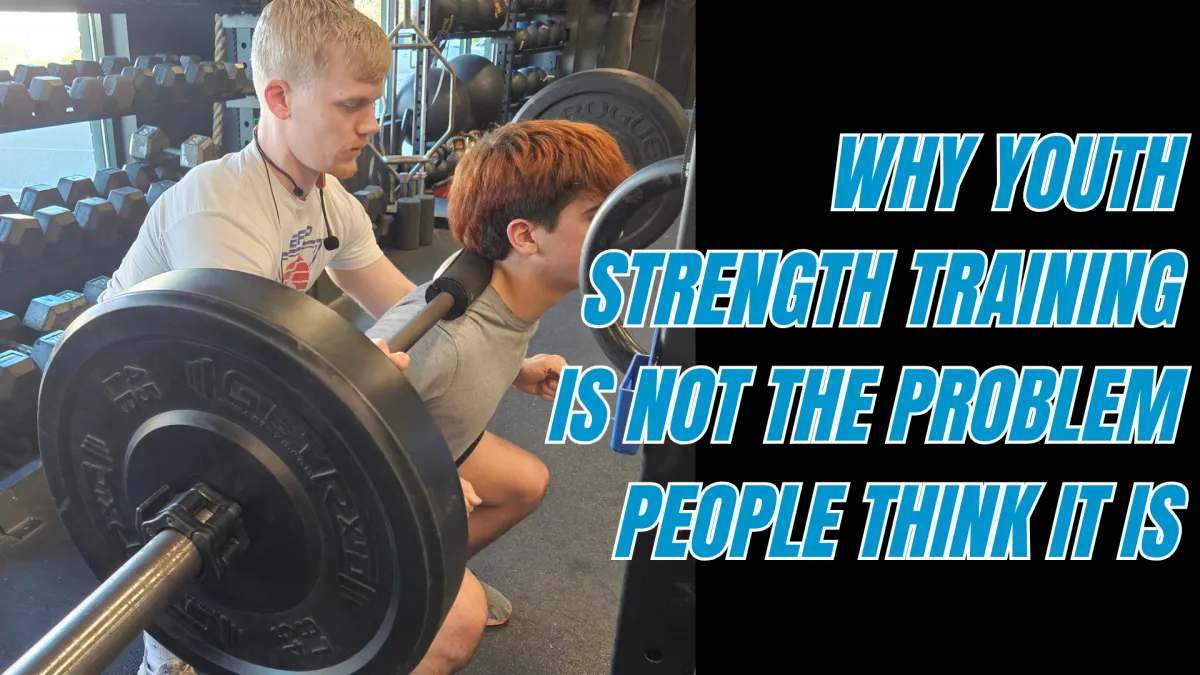
Why Youth Strength Training Is Not the Problem People Think It Is
A lot of parents still hear the phrase “kids shouldn’t lift weights” and immediately think stunted growth, blown-out joints, or a child doing something their body is not ready for. I discuss this with parents almost weekly when I meet new parents of the kids we work with.
That thinking is old. It has hung around longer than it should. As a parent, I get it though. We all want what's best for your kids. We want to make sure they don't make the same mistakes we may have made when we were working out or avoiding working out while we were younger.
For me, in high school, I maxed out on bench press at least once a week and did leg work about twice a month. That's because I didn't have any consistent guidance in teh weight room. But I digress.
The better question is not whether kids should strength train. The better question is whether they are being coached well, progressing appropriately, and doing things that match their age, ability, and maturity. Current consensus statements and reviews support youth resistance training when it is supervised and properly prescribed, and broader public-health guidance also includes muscle- and bone-strengthening activity for kids and teens.
What people usually get wrong
Too many people picture “youth training” as a kid trying to max out a barbell like an adult powerlifter. Much like I did in highschool.
That is not what good youth training looks like.
Good youth training is:
Learning how to squat, hinge, push, pull, brace, run, jump, land, and carry
Building coordination before chasing intensity
Using load as a tool, not as the whole point
Teaching focus, body awareness, and confidence
That is training. And done right, it helps kids move better and become more resilient. Reviews and position statements have described youth resistance training as a way to improve strength, motor skill, physical literacy, and injury resilience when qualified supervision is in place.
Strength training is about preparation, not proving something
At Breakaway, the point of youth training would never be to turn the gym into a highlight reel.
The point is to help kids build a body they can control.
That matters whether they play basketball, baseball, soccer, volleyball, softball, football, or no sport at all. Resistance training in youth has been associated with improvements in strength and motor performance, and umbrella-level evidence shows broad physical-fitness benefits across the literature.
What that means in real life:
Better mechanics
Better balance and coordination
Better force control
Better confidence doing athletic tasks
Better foundation for sport later
The real risk is usually poor coaching, not training itself
The problem is not that a kid learns to deadlift.
The problem is when:
Technique is ignored
Volume is reckless
Exercises are chosen to impress adults
Progressions are skipped
The kid is treated like a small adult
That is where things go sideways.
Good coaching respects development. It does not rush it.
What parents should look for in a youth program
If you are a parent, here is what matters more than whether dumbbells or barbells are involved:
Is the coach teaching movement, not just running workouts?
Is there progression?
Is there attention to landing, deceleration, posture, and control?
Is the environment encouraging instead of intimidating?
Are kids coached based on readiness, not ego?
That is the standard.
Practical takeaway
Youth strength training is not something to fear when it is coached well.
Kids do not need extreme programming. They need structure, good teaching, and repetition of the basics. Done right, strength training helps them become more capable athletes and more confident humans.
References
NSCA Position Statement: Youth Resistance Training.
CDC physical activity guidance for school-aged children and adolescents.
WHO 2020 physical activity guideline summary for children and adolescents.
Zwolski et al. Resistance Training in Youth: Laying the Foundation for Injury Prevention and Physical Literacy (review).
Lesinski et al. Effects of Resistance Training on Physical Fitness in Healthy Children and Adolescents: An Umbrella Review.
Behringer et al. Effects of strength training on motor performance skills in children and adolescents: a meta-analysis.