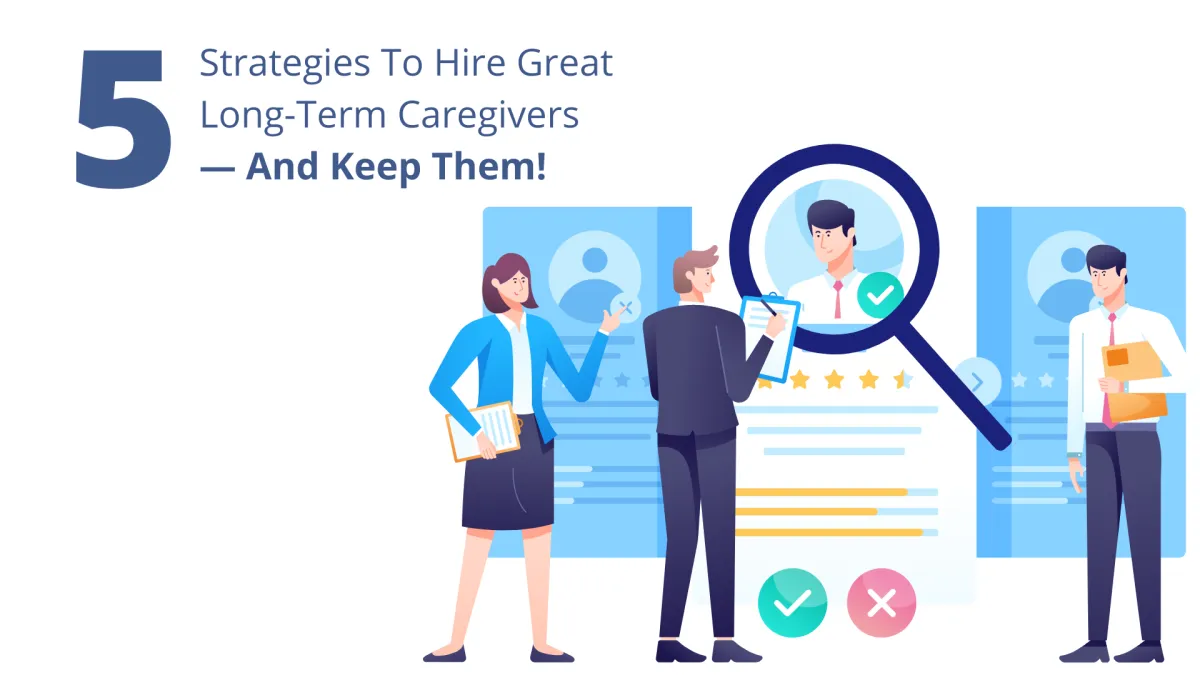
5 Strategies To Hire Great Long-Term Caregivers — And Keep Them!
It’s no secret that turnover in the long-term care industry hovers at around 65%. That’s a lot of new hires that won’t make it through their first year of employment, leaving you with an overstretched staff and thousands of dollars in turnover expenses.
Is this kind of attrition inevitable … or are there steps you can take to build a care team with some staying power? Here are five strategies you can start employing right now to hire the best possible candidates as long-term caregivers … and then keep them.
1. Employer Brand Comes First
Your care clients aren’t your only consumer base. Every brand has at least two consumer bases — the people who buy from the brand … and the people who work for the brand. You aren’t just selling care services. You’re selling your employees on continuing to report to work every day.
So how’s your pitch? If you are losing most of your new caregiver hires within the first year, it may need some work.
One of the first steps to improving your brand as an employer comes down to solidifying what your brand stands for. According to LinkedIn, 88% of Millennials report that they would take a pay cut in exchange for a culture that aligns with their values. That’s a powerful motivating factor, and Millennials will form the bulk of caregivers for the next several decades.
Besides honing in on your values and purpose, start making employee feedback a priority. Check in with your team on a regular basis and take their concerns seriously. Assume that your candidate will locate someone else on your team and ask them what it’s like to work for you. Make sure they report that you are fair-minded, dedicated to the team, and committed to their success.
2. Engage Candidates Early and Often
In a seller’s market for caregiving services like the one we find ourselves in, hiring is a race and there’s no Silver Medal. Candidates are more likely to go with the first opportunity rather than hold out for the best opportunity.
Want the best candidates? Make sure to be the first prospective employer to get back to them, and follow up consistently and frequently until the interview. Show them you mean business! Follow up after the interview. Even if the candidate goes elsewhere, check in from time to time — you never know when they will be back on the market.
One of the reasons PreIntent is such a great tool for recruiters is that it automates and customizes this engagement process, from the first contact to the long follow-up. With PreIntent, it’s easy to be first in line and constantly in touch.
3. Be Up-Front, Honest, and Transparent
Some recruiters want to be vague about the compensation and what it’s like to work for them. They fear that if they tell the naked truth, candidates will flee. That should tell you something, shouldn’t it?
Candidates value transparency. Tell them up front exactly what they will make and what challenges they will face as a member of your team. If candidates keep running for the hills after you tell them what the job consists of, it may be time for a hard look in the mirror — maybe the cost/benefit balance of your opportunity is off.
But it certainly doesn’t help to set candidates up for “gotcha” moments when they come on board. You’re basically guaranteeing that the new hire will be one of the 65% who leave in the first year.
4. Ask Retention-Focused Questions in your Interviews
The interview isn’t just theatre. It’s a priceless chance to screen a candidate. Don’t waste it with questions that every interviewee sees coming a mile away. If you surprise them with challenging questions, they will have no choice but to default to the truth. Retention-focused interview questions include:
- Tell me about a situation that arose with a difficult care client. How did you resolve it?
- Tell me about a time you made a mistake in your last care job. How did you rectify it?
- What is the most important trait a caregiver can have?
- How would you respond to a care client who refused to eat a meal? Or take a shower? Etc.
5. Make the Onboarding Process Quick and Painless
What it’s like to onboard with your company says a lot about what it will be like to work for you. Do your best to streamline the process and get your new hire trained, empowered, and on the job as quickly as possible.
—————————————————————————————————
Retention is the name of the game in every industry. In an industry like long-term care, where retention is a persistent problem, getting your hiring process handled is a significant competitive advantage.
PreIntent can help you achieve this advantage by automating the recruiting and hiring process, so you have effortless access to the best candidates when you need them.
More Blogs

COMPANY ANNOUNCEMENT: Pre-Intent Acquired by Home Care Pulse
Today marks a significant milestone in our journey. I am pleased to announce that Pre-Intent has been acquired by Home Care Pulse (HCP), a recognized leader in employee and customer satisfaction solutions for the long-term and post-acute care industry.

4 Ways to Make Your Caregiver Job Postings More Attractive to Applicants
Special Guest Blog Post by Connor Kunz, VP of Growth at Careswitch.

In-Office vs. Virtual Interviews: Pros & Cons
When it comes to recruitment, virtual interviews have their defenders. Other recruiters are ride-or-die for in-person interviews. Who is right?

3 Retention Strategies Beyond the Dollar Bill
Not every problem can be solved by throwing money at it—especially money you don’t have to spend. Here are three employee retention strategies, besides the dollar bill, that you can focus on to keep the team intact.

Does cold-calling job candidates still work?
In recruiting as much as sales, the cold call enjoys near-mythic status.
So it’s 2022 … does cold-calling job candidates still work?
5 Strategies To Hire Great Long-Term Caregivers — And Keep Them!
It’s no secret that turnover in the long-term care industry hovers at around 65%. That’s a lot of new hires that won’t make it through their first year of employment, leaving you with an overstretched staff and thousands of dollars in turnover expenses.

What should recruiters be spending their time on?
New recruiters often think that their time will be spent interviewing prospective candidates and showing new hires the ropes. Here's what you should actually be doing...

Employee Retention: 3 Key Strategies
Nearly one in four employees left their job in 2021. Read below for 3 key strategies to focus on to improve talent retention in 2022.
Ask Us Anything
Got questions? We've got answers. Ask away.

Pre·Intent is an automated engagement platform and mobile app designed for high-volume recruiters to automate the hiring process — to connect, qualify, schedule, and hire top candidates faster than humanly possible.
Navigation
Contact


Social


© 2023 PreIntent - All Rights Reserved.