
WEIGHT LOSS & FITNESS BLOG
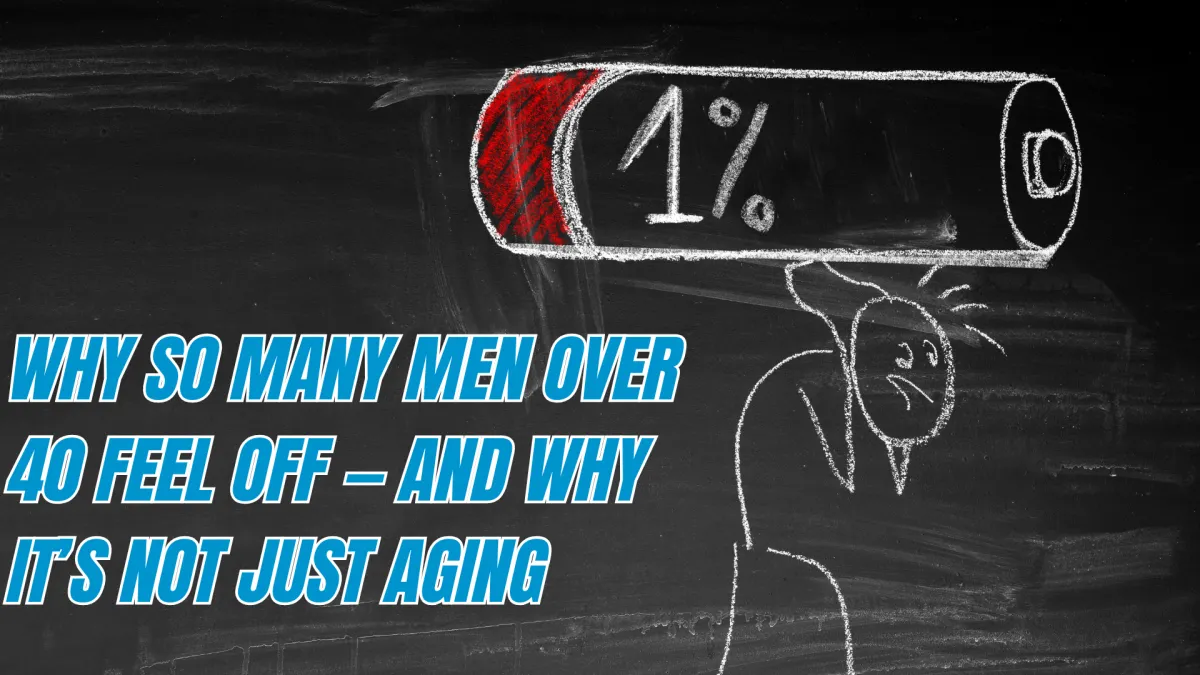
Why So Many Men Over 40 Feel Off — And Why It’s Not Just Aging
I’m 41.
I enjoy a good bourbon. I appreciate a solid IPA. I like training hard, working hard, and living life without pretending I’m a robot who only eats grilled chicken and drinks water.
But I’m also at the age where a lot of men start noticing things feel a little different.
Energy is not quite the same. Recovery takes longer. Belly fat shows up faster. Sleep matters more. Libido can shift. Motivation can feel flat. You do not feel broken, exactly. You just do not feel like yourself.
A lot of guys chalk that up to getting older and leave it there.
That is where I think a lot of men miss it.
Yes, testosterone naturally declines with age. This decline often starts around age 40 and can drop roughly 1 to 3 percent per year. Testosterone impacts far more than muscle. It affects energy, mood, metabolism, strength, and sexual health.
But the bigger issue is this: a lot of men do not feel “off” just because of age. They feel off because age, body composition, stress, sleep, alcohol, and lifestyle habits all start catching up at the same time. Your habits matter more than most guys want to admit.
What men usually notice first
Most men do not wake up one morning and say, “I think I have a hormone issue.”
It usually sounds more like this:
I am tired even when I slept
I cannot lose this gut like I used to
My drive is down
My workouts feel flat
I am more irritable than I used to be
I do not recover like I did at 30
I just do not feel sharp
Men are not usually searching for “endocrine dysfunction.” They are searching for answers to why they do not feel like themselves anymore.
And to be clear, that does not automatically mean low testosterone.
The Endocrine Society recommends diagnosing hypogonadism only in men who have both symptoms consistent with testosterone deficiency and unequivocally, consistently low testosterone levels on testing. They also recommend confirming the diagnosis with repeat morning fasting testosterone measurements, not just one random lab draw or a vague feeling that something is off.
That matters because a lot of men are being sold solutions before they have even asked the right question.
The age excuse is too easy
I think “I’m just getting older” has become a lazy explanation.
It gives men a reason to stop paying attention.
Yes, age changes things. But your habits can make those changes hit harder or softer.
Healthy Steps Nutrition highlights higher body fat as being strongly linked to lower testosterone, partly through inflammation and increased conversion of testosterone to estrogen. They also lays out the big lifestyle buckets that support testosterone naturally: exercise, weight management, stress management, sleep, nutrition, limiting alcohol, and reducing exposure to certain environmental chemicals.
That lines up with the broader evidence too. A 2024 clinical update on male obesity-related secondary hypogonadism describes obesity as the single most important risk factor for testosterone deficiency in men and notes that lifestyle measures are the cornerstone of management.
That is a big deal.
Because it means a man can feel worse hormonally without it being some mysterious, random curse of aging. Sometimes the issue is that excess body fat, poor sleep, high stress, low activity, and too much alcohol are all working together against him.
That is not bad news.
That is actually good news, because it means there is something you can do about it.
Sleep, stress, body fat, and yes, alcohol
This is the part nobody wants to hear, because it is less exciting than a magic fix.
But it is the truth.
Sleep matters.
Stress matters.
Body fat matters.
Training matters.
Alcohol matters.
Alcohol can lower testosterone in as little as five days of regular intake and can increase estrogen activity. Sleep is also one of the most powerful hormone regulators and chronic stress elevates cortisol, which can suppress testosterone.
Now, let me say this clearly as a guy who enjoys bourbon and a good IPA: I am not writing this from some fake purity mindset.
I am not saying a man can never have a drink.
I am saying a lot of men want hormone health while also pretending their weekly habits do not count.
They do count.
A systematic review and meta-analysis found that total sleep deprivation reduces testosterone levels in healthy males. That does not mean one rough night destroys your hormones. It does mean sleep is not optional if you care about feeling and functioning like a man who still has gas in the tank.
And if a man is carrying more body fat than he used to, sleeping six hours a night, stressed out all the time, barely strength training, and drinking heavily on weekends, then blaming everything on age is just avoiding reality.
Feeling off does not mean you should panic
Here is where I want to be careful.
Feeling off does not mean you need to jump straight to TRT.
It also does not mean you should ignore it.
It means you should pay attention.
If you have symptoms that keep showing up, it may be worth getting evaluated the right way. Not through internet guesswork. Not through bro-science. Not through some ad promising to make you feel 25 again.
The right move is to look at the full picture:
symptoms
training habits
sleep
body composition
stress
nutrition
alcohol intake
then, if needed, proper lab work interpreted in context
The Endocrine Society specifically recommends against routine screening of men in the general population without context, and instead emphasizes a full diagnostic workup when symptoms and low levels are both present.
That is the grown-man approach.
My coaching take on this
From my point of view as a 41-year-old man, this is not really just a testosterone conversation.
It is a standards conversation.
A lot of men over 40 want to feel strong, clear-headed, leaner, more driven, and more present.That is fair.
But too many of us want those outcomes without being honest about the inputs.
You do not need perfection.
You do need honesty.
Are you lifting consistently?
Are you sleeping enough?
Are you carrying more body fat than you should?
Are you eating like a grown man or like a teenager with a debit card?
Are you drinking in a way that matches your goals or in a way that fights them?
Those are not glamorous questions, but they are usually the right ones.
Where to start this week
If you are a man over 40 and you have been feeling off, start here:
Lift weights 3 to 4 times per week
Prioritize 7 to 9 hours of sleep
Eat protein at each meal
Focus on body composition, not just scale weight
Cut back on alcohol if it has started becoming more regular than you want to admit
Stop assuming how you feel is “just age”
Those recommendations are consistent with the practical takeaways in your uploaded guide.
You do not need to become obsessive.
You do need to stop being passive.
Because maybe you are getting older.
But maybe that is not the full story.
And that matters.
References
Male Hormone Health Guide by Nicole Aucoin, MS, RD. Key points on age-related testosterone decline, body fat, stress, sleep, nutrition, alcohol, and practical lifestyle support.
Endocrine Society Clinical Practice Guideline: diagnosis of hypogonadism requires symptoms plus consistently low testosterone, confirmed with repeat morning testing.
Systematic review and meta-analysis: total sleep deprivation reduces testosterone in healthy males.
Clinical review: obesity-related secondary hypogonadism in men and the central role of lifestyle and weight loss.


Are you Ready to become
sTRONG - FIT - cONFIDENT?
Click the Button To Start Your Journey Today!!


