
Patient Portal
Origins Integrative Health

Regenerative
Aesthetics: Musculoskeletal
Regenerative injection
therapies for joints, tendons & soft tissue
Hair
PRP for Hair Restoration — Awakening Your Follicles' Natural Potential
Evidence-informed therapies that work with your
body to heal
Musculoskeletal pain — whether from injury, overuse, degeneration, or chronic conditions — is one of the most common and functionally limiting health challenges people face. At Origins Integrative Health, we offer a comprehensive suite of regenerative injection therapies designed to address the underlying structural causes of pain, stimulate tissue repair, and restore function — without surgery or long-term reliance on anti-inflammatory medications.
Our approach is precise, evidence-informed, and deeply personalized — beginning with a thorough orthopedic assessment to understand the full picture of your condition before any treatment is recommended.
Evidence-Informed Treatment for Thinning Hair & Alopecia
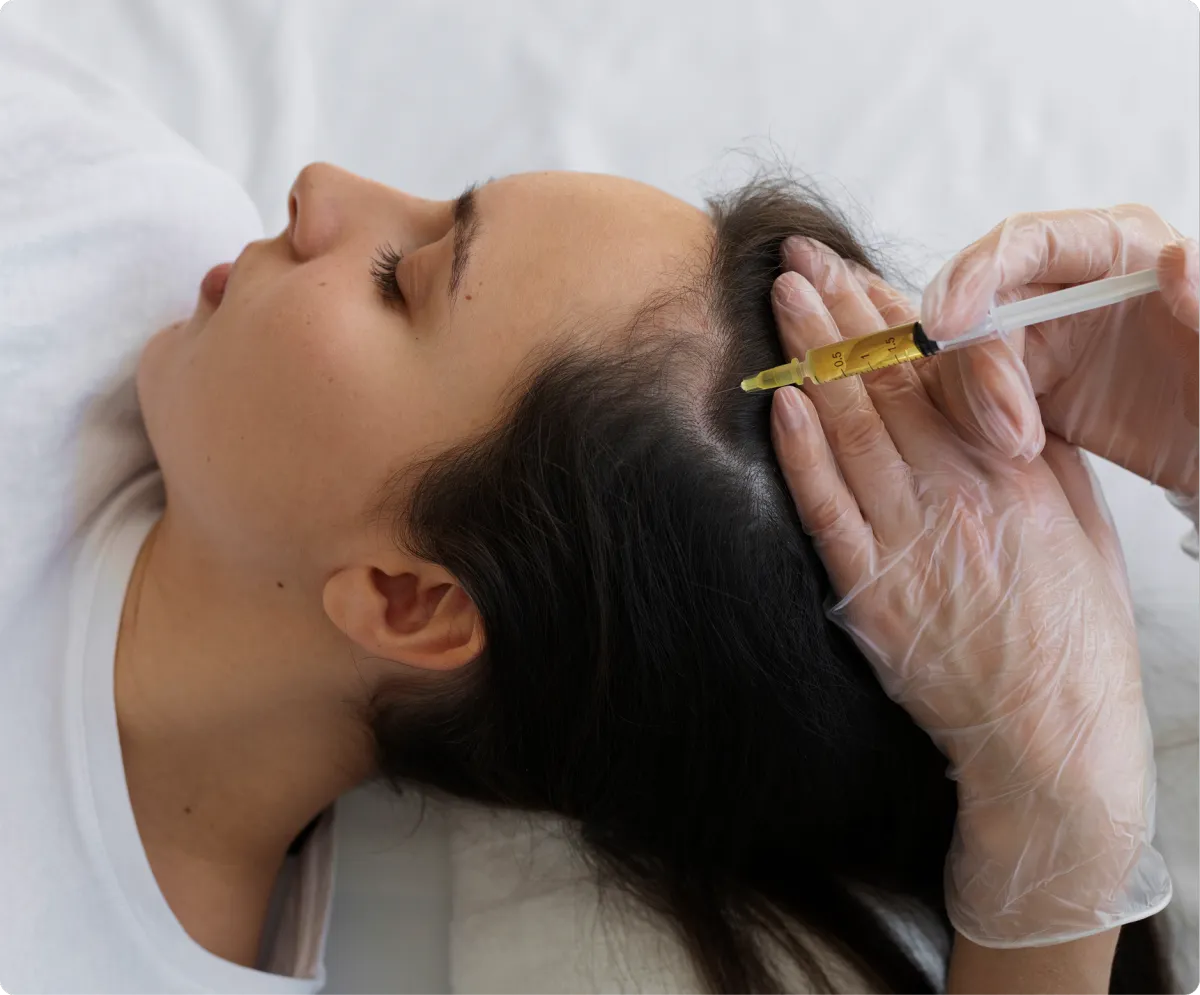
Hair loss is one of the most common and emotionally significant health concerns affecting both men and women — and one that conventional medicine has historically offered limited solutions for. At Origins Integrative Health, we offer Platelet-Rich Plasma (PRP) therapy for hair restoration — an evidence-informed, biologically intelligent approach that works with your body's own healing capacity to stimulate follicle health, slow hair loss, and encourage meaningful regrowth.
This is not a surface treatment. PRP for hair restoration works at the level of the hair follicle itself — delivering concentrated growth factors precisely where they are needed to reawaken dormant follicles, improve scalp circulation, and create the biological conditions your hair needs to grow.
How PRP Stimulates
Hair Growth
The hair follicle is a remarkably dynamic structure — and one that is highly responsive to the growth factors concentrated in platelet-rich plasma. When PRP is injected into the scalp, it delivers a potent combination of growth factors — including PDGF, VEGF, IGF-1, and EGF — directly to the follicular unit and surrounding dermal papilla cells.
These growth factors stimulate follicular stem cells, promote angiogenesis (the formation of new blood vessels) to improve follicle nutrition, extend the anagen (growth) phase of the hair cycle, and shift follicles from the telogen (resting) phase back into active growth. The result is a measurable improvement in hair density, diameter, and overall scalp health — achieved through your body's own biological resources.
What the Research Shows
PRP for hair loss has been studied extensively across multiple randomized controlled trials and systematic reviews — consistently demonstrating meaningful clinical benefit. A systematic review and meta-analysis published in the Journal of Cosmetic Dermatology found that PRP therapy produced significant improvements in hair density, hair diameter, and the anagen-to-telogen ratio compared to placebo controls. A randomized controlled trial published in Dermatologic Surgery demonstrated that patients receiving PRP injections showed a mean increase of 33.6 hairs per cm² at six months — a clinically significant result with no serious adverse effects reported. Research has also shown that PRP is particularly effective for androgenetic alopecia — the most common form of hair loss in both men and women — as well as alopecia areata, telogen effluvium, and hair thinning associated with hormonal changes.
Our Regenerative Therapies
Platelet-Rich Plasma (PRP)
for Musculoskeletal Conditions
PRP therapy for musculoskeletal conditions harnesses the concentrated healing factors in your own blood to stimulate tissue repair and regeneration in joints, tendons, ligaments, and soft tissue. PRP is particularly effective for conditions involving cartilage degradation, tendon injury, and joint inflammation — delivering growth factors directly to the site of damage to activate the body's own repair mechanisms.
SIGNIFICANT STUDIES
What the research shows
PRP for osteoarthritis has been among the most extensively studied applications of regenerative medicine. A landmark systematic review and meta-analysis published in the American Journal of Sports Medicine demonstrated that intra-articular PRP injections produced significantly greater improvements in pain and function compared to hyaluronic acid and placebo injections in patients with knee osteoarthritis — with benefits maintained at twelve-month follow-up. A randomized controlled trial published in the British Journal of Sports Medicine found that patients with chronic tendinopathy who received PRP injections demonstrated significantly greater improvements in pain scores and functional outcomes compared to controls — with sustained benefit at both three and six months. Research has also demonstrated meaningful benefit for PRP in rotator cuff injuries, plantar fasciitis, lateral epicondylitis, and hip osteoarthritis — making it one of the most versatile and well-supported regenerative options available for musculoskeletal care.
Prolotherapy — connective tissue repair
Prolotherapy involves the injection of a concentrated dextrose solution into weakened, lax, or injured connective tissue — including tendons, ligaments, and joint capsules — to stimulate the body's natural inflammatory healing response and promote the deposition of new, healthy collagen. Unlike anti-inflammatory treatments that suppress the healing process, prolotherapy works by intentionally activating it — triggering a controlled healing cascade that strengthens and stabilizes damaged connective tissue over time.
SIGNIFICANT STUDIES
What the research shows
Prolotherapy has been studied extensively for a wide range of musculoskeletal conditions, with a particularly strong evidence base for chronic low back pain, knee osteoarthritis, and tendinopathy. A randomized controlled trial published in Spine demonstrated that prolotherapy produced significantly greater reductions in pain and disability compared to control injections in patients with chronic low back pain — with improvements maintained at twelve months. A systematic review published in the British Journal of General Practice found that prolotherapy was effective for chronic tendinopathy and ligament injuries — with evidence supporting its use as a safe, effective alternative to surgery for patients who have not responded to conservative care. Research has also demonstrated meaningful benefit for prolotherapy in sacroiliac joint dysfunction, knee ligament laxity, and Achilles tendinopathy.
Our Regenerative Therapies
Perineural injection therapy (PIT) — nerve pain and neurogenic inflammation
Perineural Injection Therapy is a precision injection technique that targets inflamed or sensitized peripheral nerves — delivering a low-concentration dextrose solution subcutaneously along the course of affected nerves to reduce neurogenic inflammation, restore normal nerve function, and provide lasting relief from chronic pain. PIT is based on the understanding that many chronic pain conditions involve sensitized or inflamed peripheral nerves — and that addressing this neurogenic component is essential for lasting pain resolution.
SIGNIFICANT STUDIES
What the research shows
PIT has been studied in multiple clinical trials with consistently positive outcomes for chronic musculoskeletal pain. Research published in the Journal of Prolotherapy demonstrated that PIT produced significant reductions in pain scores across a range of chronic pain conditions — including knee pain, shoulder pain, and cervical pain — with improvements in functional outcomes and quality of life at follow-up. A clinical trial published in Regional Anesthesia and Pain Medicine found that subcutaneous dextrose injections targeting peripheral nerves produced significantly greater pain relief compared to control injections — with a meaningful proportion of patients achieving sustained remission of chronic pain.
WE’RE HERE FOR YOU.
Conditions we support
Joint pain & osteoarthritis
Knee Osteoarthritis
Hip Osteoarthritis
Shoulder Joint Pain
Ankle & Foot Pain
Wrist & Hand Pain
Elbow Pain
Joint Hypermobility & Instability
Endometriosis and hormonal pain
Endometriosis-Related Pelvic Pain
Adenomyosis
Hormonal Pelvic Pain
PCOS-Related Pelvic Discomfort
Painful Menstruation (Dysmenorrhea)
Tendon and ligament injuries
Rotator Cuff Tendinopathy
Achilles Tendinopathy
Patellar Tendinopathy
Plantar Fasciitis
Lateral Epicondylitis (Tennis Elbow)
Medial Epicondylitis (Golfer's Elbow)
IT Band Syndrome
Ligament Sprains & Laxity
Nerve pain
Neck Pain
Sciatica
Sacroiliac Joint Dysfunction
Nerve Entrapment & Radiculopathy
Muscle pain and myofascial conditions
Myofascial Pain Syndrome
Trigger Points
Muscle Strains
Chronic Muscle Tension
Fibromyalgia
Sports and activity-related Injuries
Overuse Injuries
Sports Injuries
Post-Surgical Rehabilitation
Return-to-Sport Support
GET STARTED
Ready to find your root cause?
Your health story deserves more than a surface-level answer. Let’s go deeper – together.
CONDITIONS WE SUPPORT
Androgenetic Alopecia (Male & Female Pattern Hair Loss) · Alopecia Areata · Telogen Effluvium · Hormonal Hair Loss · Postpartum Hair Loss · Hair Thinning & Reduced Density · Hair Loss Associated With Thyroid Conditions · Hair Loss Associated With Nutritional Deficiencies
What to Expect
Most patients require an initial series of three to four treatments spaced four weeks apart, followed by maintenance sessions every three to six months. Results are typically noticeable at three to six months — with continued improvement over the course of a full treatment year. PRP is safe, well-tolerated, and derived entirely from your own blood — making it one of the most biologically compatible treatments available for hair restoration.
Ready to Find Your Root Cause?
Your health story deserves more than a surface-level answer.
Let's go deeper — together
Testimonials
Hear From Our Patients
Real experiences from real people. At Origins Integrative Health, our measure of success is simple — how our patients feel, heal, and thrive over time.
Origins Integrative Health
1432 SE Ankeny St.,
Portland, OR 97214
Discover
Services
Follow Us


© 2026 Origins Integrative Health.
All rights reserved.
Testimonials
Hear from our patients
Real experiences from real people. At Origins Integrative Health, our measure
of success is simple — how our patients feel, heal, and thrive over time.
Origins Integrative Health
1432 SE Ankeny St.,
Portland, OR 97214
Discover
Services
Sign up for our newsletter
and stay in the know
Get our latest insights to support your journey to better health.
© 2026 Origins Integrative Health. All rights reserved.