
Patient Portal
Origins Integrative Health Blog
Origins Integrative Health

Origins Integrative Health Blog
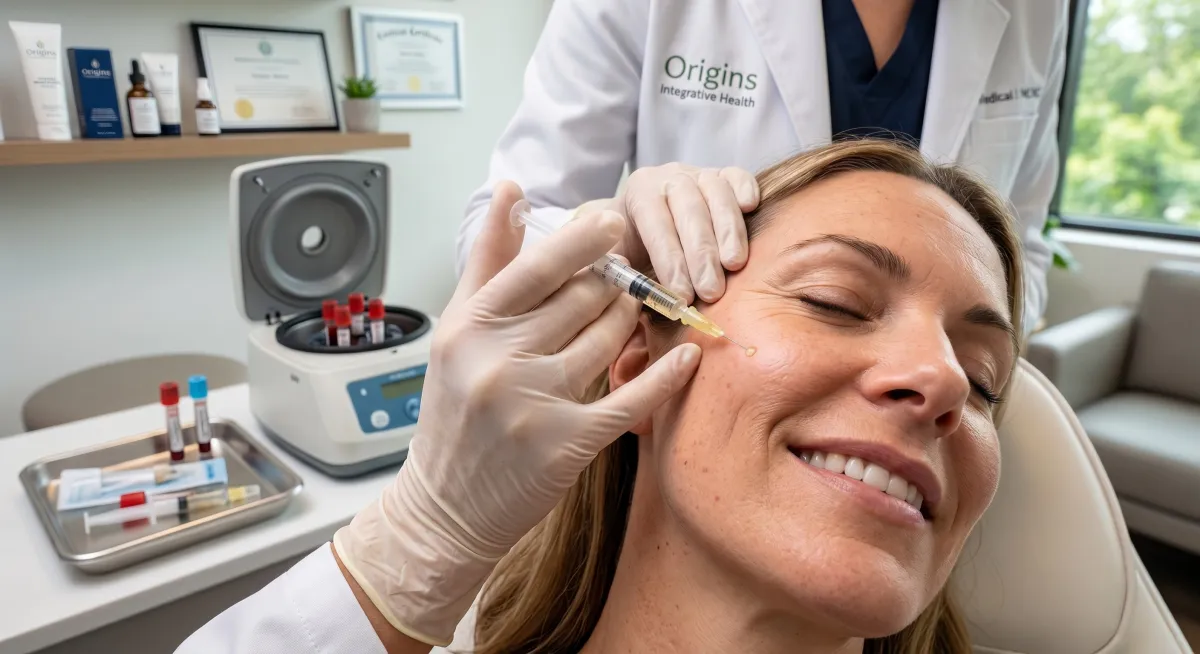
PRP for Facial Collagen: Your Body's Own Blueprint for Younger-Looking Skin
PRP for Facial Collagen: Your Body's Own Blueprint for Younger-Looking Skin
Platelet-Rich Plasma therapy — often called the "vampire facial" — has moved well beyond celebrity buzz. Backed by a growing body of clinical research, PRP is now recognized as one of the most effective, biologically intelligent approaches to rebuilding facial collagen and reversing the visible signs of skin aging.
Understanding Facial Aging at the Cellular Level
Skin aging is driven by two interwoven processes: intrinsic aging (genetically determined changes in cell function over time) and extrinsic aging (cumulative damage from UV radiation, environmental toxins, smoking, and other external factors). The common result is a progressive breakdown of the extracellular matrix — the scaffolding that gives skin its structure, firmness, and elasticity.
At the heart of this process is collagen. As we age, collagen production slows and collagen fibers are increasingly degraded by matrix metalloproteinase (MMP) enzymes, which are activated by UV exposure and oxidative stress. The result is thinner, looser skin with more visible lines, wrinkles, and loss of radiance. Compounding this, the number of dermal fibroblasts — the cells responsible for producing new collagen — declines with age, further slowing the skin's natural renewal capacity.
The skin loses collagen at a rate of approximately 1% per year after age 20. By the time visible aging is apparent, significant structural changes have already occurred in the deeper dermal layers.
What Is PRP and How Does It Work?
Platelet-Rich Plasma is an autologous biological treatment — meaning it is derived from your own blood. A small sample of blood is drawn and then processed through centrifugation to concentrate the platelets into a highly potent plasma. This PRP contains more than 1,100 different proteins, including a powerful collection of growth factors that are essential to tissue repair, cellular regeneration, and collagen synthesis.
These growth factors include platelet-derived growth factor (PDGF), transforming growth factor-beta (TGF-β), vascular endothelial growth factor (VEGF), epidermal growth factor (EGF), and fibroblast growth factor (FGF) — each playing a distinct role in activating dermal fibroblasts, stimulating collagen deposition, promoting angiogenesis, and remodeling the extracellular matrix.
When PRP is injected intradermally into the face, it triggers a cascade of regenerative activity. Fibroblasts are activated and begin producing new collagen and elastin. The extracellular matrix is remodeled and rebuilt. Hyaluronic acid synthesis increases, improving skin hydration and volume. Over weeks and months, the skin becomes measurably firmer, smoother, and more youthful in appearance — from the inside out.
What the Clinical Research Shows
PRP for facial rejuvenation has been studied extensively, with findings from multiple clinical trials, systematic reviews, and meta-analyses painting a consistent picture of meaningful benefit.
Collagen Density and Skin Structure
In vivo clinical studies have established that PRP treatment significantly increases the density of dermal collagen (p < 0.05). A prospective controlled clinical study published in Dermatologic Surgery demonstrated histological evidence of new collagen formation following PRP injection — confirmed through tissue biopsy showing measurably increased collagen fiber density at 28 days post-treatment. The same study concluded that even a single PRP application can be an effective and safe procedure for facial skin rejuvenation.
A 2020 study evaluated split-face PRP treatment in patients and found that the treated side showed markedly increased skin thickness, better skin texture, fewer wrinkles, and relatively smoother, firmer skin compared to the untreated control side — after just three rounds of PRP injections.
Wrinkles, Texture, and Skin Quality
A systematic review published in 2024 (PMC) examining PRP monotherapy for skin rejuvenation found significant improvements across multiple facial parameters following one to three treatment sessions. Improvements were documented in skin pore size, surface texture, wrinkle reduction, pigmented spots, collagen density, and hyaluronic acid levels. Patient satisfaction at six-month follow-ups averaged over 90%, and FACE-Q outcome scores showed statistically significant improvement in facial appearance.
Studies confirm improvements in periorbital wrinkles, nasolabial folds, skin firmness, skin tone, and volume — with best results typically observed after a series of two to three sessions spaced several weeks apart.
UV Damage Protection and Photoaging
One of the more remarkable findings in PRP research is its potential to protect against and reverse photoaging. Research has demonstrated that PRP treatment can ameliorate skin damage caused by UV-B radiation by regulating the expression of MMP-1 (the primary collagen-degrading enzyme), tyrosinase (the key enzyme in melanin production), fibrillin, and tropoelastin — all critical proteins in maintaining structural skin integrity. This suggests that PRP does more than fill in wrinkles; it may actually address some of the underlying molecular mechanisms driving skin aging.
PRP is derived from your own blood — making it one of the safest aesthetic treatments available. There is no risk of allergic reaction or rejection, and adverse effects are minimal, typically limited to mild temporary swelling or redness at the injection site.
What to Expect from PRP Treatment at Origins
At Origins Integrative Health, our PRP facial treatments begin with a thorough consultation to assess your skin health, concerns, and goals. The treatment itself involves a simple blood draw, centrifugation to prepare your PRP, and precise intradermal injection to the areas of most concern — commonly the forehead, crow's feet, cheeks, and nasolabial folds.
Most patients require two to three sessions for optimal collagen stimulation, with sessions typically spaced four to six weeks apart. Results develop gradually over two to three months as new collagen forms and matures — meaning the best outcomes are visible not immediately after treatment, but as your skin rebuilds from within.
PRP can also be effectively combined with microneedling, hyaluronic acid, or other regenerative treatments for enhanced results. Research has shown that combining PRP with hyaluronic acid produces a synergistic effect, particularly enhancing skin elasticity and firmness in patients in their 50s and 60s.
Is PRP Right for You?
PRP is an excellent option for men and women who want to address fine lines, loss of firmness, skin texture changes, or early signs of aging without synthetic fillers or downtime. It is particularly well-suited for patients who prefer a natural, biologically driven approach — using the healing intelligence already present in their own body to restore their skin.
As with any treatment, results vary, and PRP is not a replacement for surgical intervention in cases of significant volume loss or laxity. But for the right candidate, it represents one of the most scientifically grounded and satisfying non-surgical options available in aesthetic medicine today.
Interested in PRP facial rejuvenation?
Schedule a consultation at Origins Integrative Health to learn whether PRP is the right next step for your skin health journey. We offer in-person and telehealth appointments — flexible, accessible, and personalized to you.

Caring for Your Body, Mind,
and Spirit
Caring for Your Body, Mind, and Spirit
Origins Integrative Health
1432 SE Ankeny St.,
Portland, OR 97214
Discover
Services
Follow Us


© 2026 Origins Integrative Health.
All rights reserved.
Origins Integrative Health
1432 SE Ankeny St.,
Portland, OR 97214
Discover
Services
Sign up for our newsletter
and stay in the know
Get our latest insights to support your journey to better health.
© 2026 Origins Integrative Health. All rights reserved.