
Patient Portal
Origins Integrative Health Blog
Origins Integrative Health

Origins Integrative Health Blog
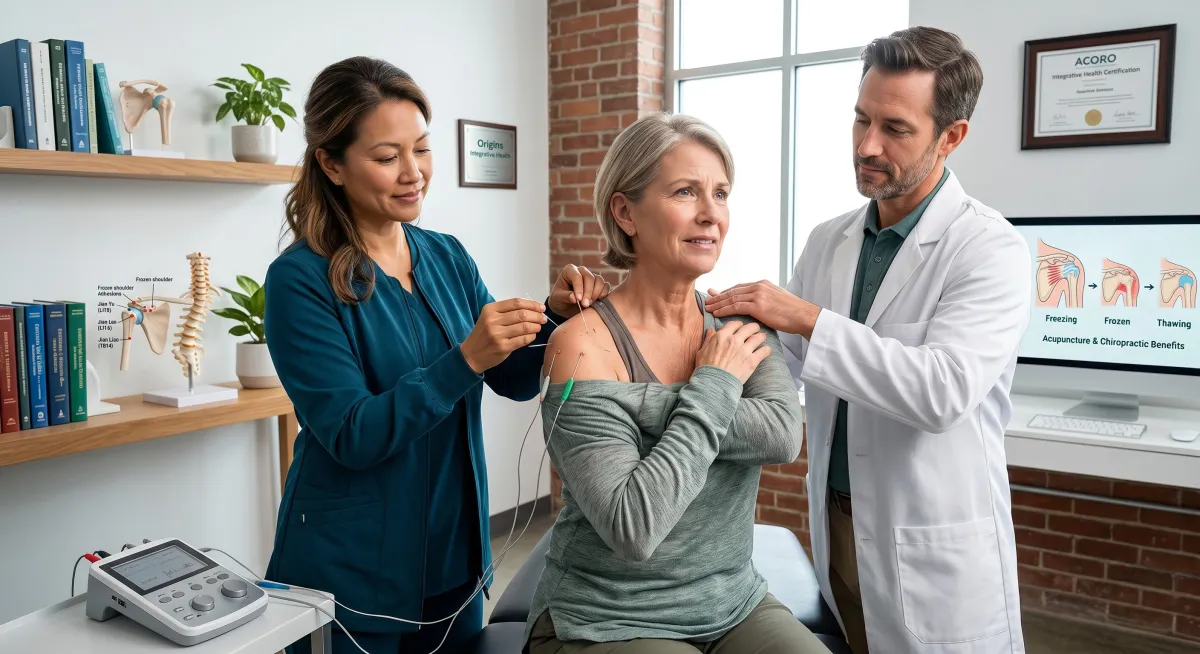
Frozen Shoulder? Acupuncture May Be the Missing Piece in Your Recovery
Frozen Shoulder? Acupuncture May Be the Missing Piece in Your Recovery
Frozen shoulder — clinically known as adhesive capsulitis — is one of the most frustrating and functionally limiting musculoskeletal conditions a person can experience. The progressive loss of shoulder mobility, the disrupted sleep, the inability to reach, lift, or move without pain — for many patients, it becomes a condition that quietly takes over daily life.
The conventional advice is often simply to wait it out. And while frozen shoulder does eventually resolve on its own in many cases, that process can take anywhere from one to three years — sometimes longer. What most patients are not told is that active treatment can meaningfully shorten that timeline, reduce pain, and restore mobility far sooner than watchful waiting alone.
Acupuncture is one of the most well-researched and clinically meaningful active treatments available for frozen shoulder — and at Origins Integrative Health, it is a cornerstone of how we approach this condition.
What Is Frozen Shoulder — and Why Does It Happen?
Frozen shoulder occurs when the connective tissue capsule surrounding the shoulder joint becomes inflamed, thickens, and tightens — eventually forming adhesions that restrict movement in all directions. The result is a shoulder that progressively loses its range of motion, often accompanied by significant pain — particularly at night and at the end ranges of movement.
The condition affects approximately two to five percent of the general population and is most common around age fifty. Women are disproportionately affected — at approximately 58% greater risk than men. It is also strongly associated with diabetes, thyroid disorders, hormonal changes including perimenopause and menopause, and prolonged shoulder immobility following injury or surgery.
Frozen shoulder typically progresses through three distinct phases:
The Freezing Phase — gradual onset of pain and progressive stiffening of the shoulder. This phase can last anywhere from six weeks to nine months and is often the most painful stage of the condition.
The Frozen Phase — pain may begin to subside, but significant restriction of movement remains. Daily tasks — reaching overhead, fastening a seatbelt, dressing — become difficult or impossible. This phase typically lasts four to six months.
The Thawing Phase — gradual return of mobility as the capsule slowly loosens. This phase can last anywhere from six months to two years — and without active treatment, many patients never fully regain their pre-injury range of motion.
The critical point is this — frozen shoulder is rarely self-resolving in any meaningful timeframe. Early, active treatment significantly improves outcomes, shortens the duration of the condition, and may prevent the incomplete recovery that many patients experience when they simply wait.
How Acupuncture Addresses Frozen Shoulder
Acupuncture works for frozen shoulder through several well-understood physiological mechanisms — and its benefits extend well beyond simple pain relief.
Pain Modulation Acupuncture stimulates the release of endogenous opioids — the body's own natural pain-relieving compounds — and modulates the nervous system's central pain processing pathways. This produces meaningful reductions in both the intensity and the character of frozen shoulder pain — including the deep, aching nighttime pain that so commonly disrupts sleep in this condition.
Reduction of Inflammation Acupuncture has been shown to reduce local inflammatory markers and modulate the immune response in inflamed tissue — directly addressing the capsular inflammation that drives frozen shoulder. By reducing inflammation in the shoulder capsule, acupuncture helps create the biological conditions necessary for the adhesions to soften and the capsule to begin releasing.
Restoration of Range of Motion By reducing pain and inflammation, acupuncture creates a therapeutic window in which the shoulder can begin to move again — and movement is essential for recovery. Specific acupuncture points used for frozen shoulder — particularly Jian Yu (LI15), located in the anterosuperior joint capsule region, and Jian Liao (TB14), located near the rotator cuff interval — have been shown to produce direct improvements in shoulder mobility, with the most pronounced gains in flexion and abduction — the movements most characteristically lost in adhesive capsulitis.
Electroacupuncture At Origins, we also utilize electroacupuncture — a technique in which a gentle, controlled electrical current is passed through pairs of acupuncture needles — for patients with moderate to severe frozen shoulder symptoms. Electroacupuncture has demonstrated enhanced analgesic and anti-inflammatory effects compared to manual acupuncture alone, making it a particularly valuable tool for patients in the more painful freezing phase of the condition.
Sleep and Mood Support One of the most underappreciated aspects of frozen shoulder is its impact on sleep. The pain of frozen shoulder is notoriously worse at night — disrupting sleep quality, elevating cortisol, and creating a cycle of fatigue, heightened pain sensitivity, and slowed recovery. Acupuncture's well-documented effects on sleep quality and stress regulation make it uniquely suited to address this dimension of the condition — supporting the whole-body recovery process, not just the shoulder itself.
What the Research Shows
A systematic review and meta-analysis published in Evidence-Based Complementary and Alternative Medicine (2020) provides some of the most comprehensive clinical evidence available for acupuncture in the treatment of frozen shoulder. The review analyzed seven individual clinical studies and concluded that acupuncture is safe and effective for pain reduction, restoration of shoulder function, and improvement of flexion range of motion in patients with adhesive capsulitis — with meaningful benefits demonstrated in both the short and mid-term.
Across the studies included in the review, acupuncture produced statistically significant improvements in shoulder function compared to control groups — with pain scores measured by the Visual Analog Scale showing clinically meaningful reductions at three months post-treatment. The review's authors concluded that acupuncture represents a clinically valuable treatment option for frozen shoulder — offering meaningful relief without the rebound effects or procedure-related risks associated with pharmacological approaches.
Importantly, the research supports the use of acupuncture across all three phases of frozen shoulder — meaning that whether you are in the early, painful freezing stage or the movement-limited frozen phase, acupuncture can play a meaningful role in your recovery.
What to Expect at Origins
At Origins Integrative Health, your frozen shoulder care begins with a thorough assessment of your shoulder, your history, and where you are in the progression of the condition. From there, your acupuncturist builds an individualized treatment plan designed around your specific presentation — taking into account the phase of your condition, your pain pattern, your sleep quality, and any underlying contributing factors such as hormonal changes, diabetes, or thyroid dysfunction.
Treatment sessions typically run 45 to 60 minutes and are designed to be as comfortable and restorative as possible. Most patients begin to notice meaningful improvements in pain and mobility within the first four to six sessions — with continued gains over the course of a full treatment plan.
Because Origins is an integrative clinic, your acupuncture care can also be coordinated with naturopathic support — addressing the hormonal, inflammatory, and nutritional factors that may be contributing to your condition — for a more comprehensive and effective recovery.
Who Is a Candidate for Acupuncture for Frozen Shoulder?
Acupuncture is appropriate and beneficial for patients at every stage of frozen shoulder — including those who:
Are in the early freezing phase and want to get ahead of progressive stiffening
Are in the frozen phase and are struggling with significant mobility limitation
Have diabetes, thyroid conditions, or hormonal changes contributing to their condition
Have not found adequate relief through conventional approaches including physical therapy or corticosteroid injections
Want a safe, evidence-informed, non-pharmacological approach to their recovery
Are looking for care that addresses the whole picture — pain, sleep, stress, and the underlying biology of the condition
Don't wait for frozen shoulder to resolve on its own — early, active treatment makes a meaningful difference. Contact Origins Integrative Health to schedule an acupuncture evaluation and take the first step toward getting your shoulder — and your life — back.

Caring for Your Body, Mind,
and Spirit
Caring for Your Body, Mind, and Spirit
Origins Integrative Health
1432 SE Ankeny St.,
Portland, OR 97214
Discover
Services
Follow Us


© 2026 Origins Integrative Health.
All rights reserved.
Origins Integrative Health
1432 SE Ankeny St.,
Portland, OR 97214
Discover
Services
Sign up for our newsletter
and stay in the know
Get our latest insights to support your journey to better health.
© 2026 Origins Integrative Health. All rights reserved.